


Welcome back to The Customer Continuum. Issue #43.
If you’re new, here’s what you’ve walked into. I write this newsletter for customer marketing, CX, and post-sale teams, and more and more for anyone working on customer-led growth, the idea that a business grows through what customers experience after they buy. Most issues are Build With Me, where I build something real and report what happened. This week I’m going back to a story from earlier in my career that shaped how I think about all of it.
Six months on our own
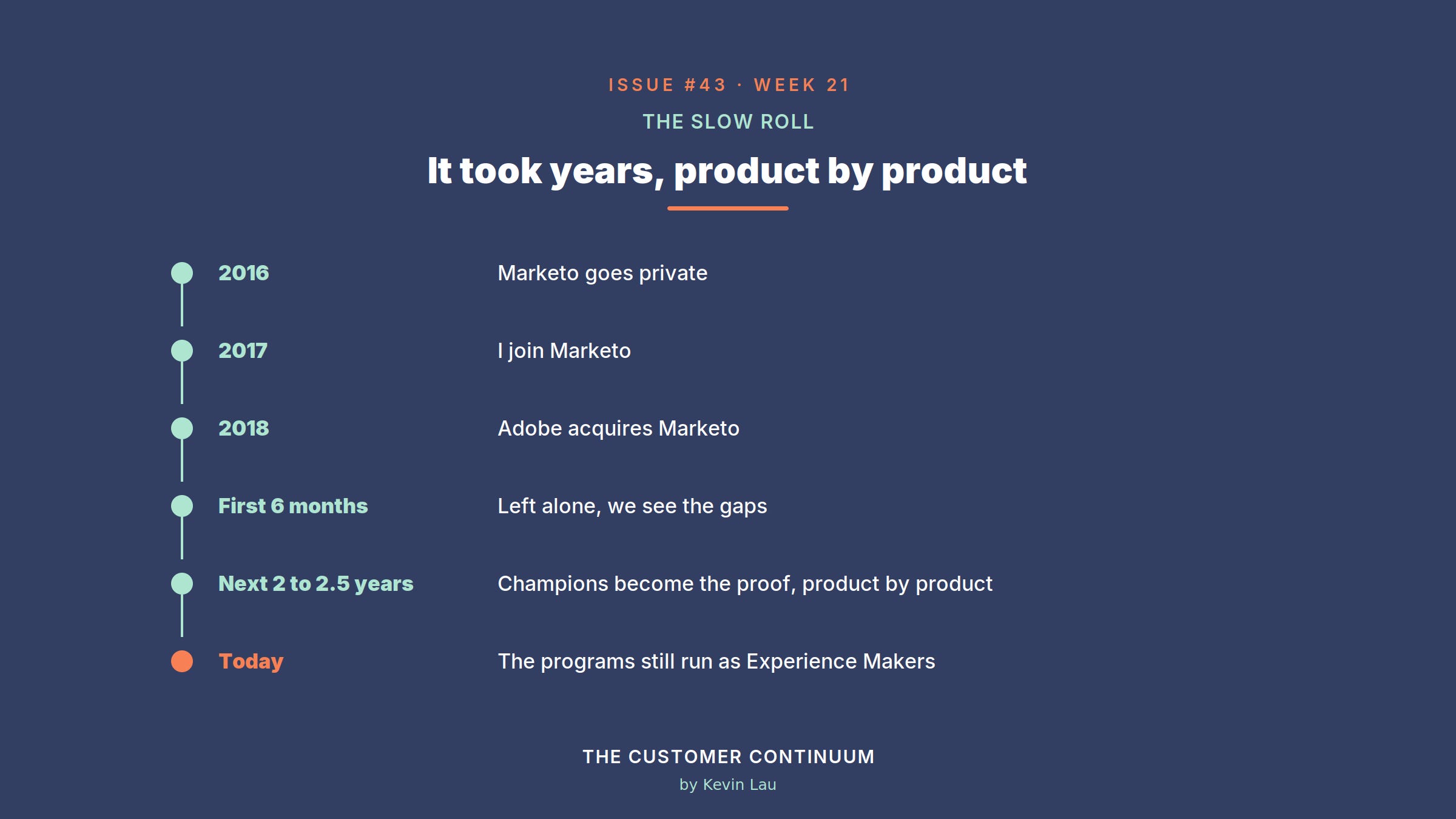
I joined Marketo in 2017, in the middle of one of the strangest stretches a company can go through. Marketo was a fast-moving business with a lot of customers and a growing enterprise side, and in the space of about two years it went from publicly traded, to owned by private equity, to acquired by Adobe.
After the acquisition closed, Adobe mostly left us alone for about six months, and that gave us time to see what our customers were seeing.
What they were seeing was a company that didn’t fit together yet. Adobe had spent years building through acquisitions, starting with Omniture, and customers would tell us plainly that the pieces weren’t integrated. Experience Cloud was the umbrella Adobe had built from those acquisitions, products like Analytics and Experience Manager, and now Marketo was joining it. Even our own Marketo customers couldn’t see how what they’d bought connected to the rest of the stack.
Six or seven teams, one customer
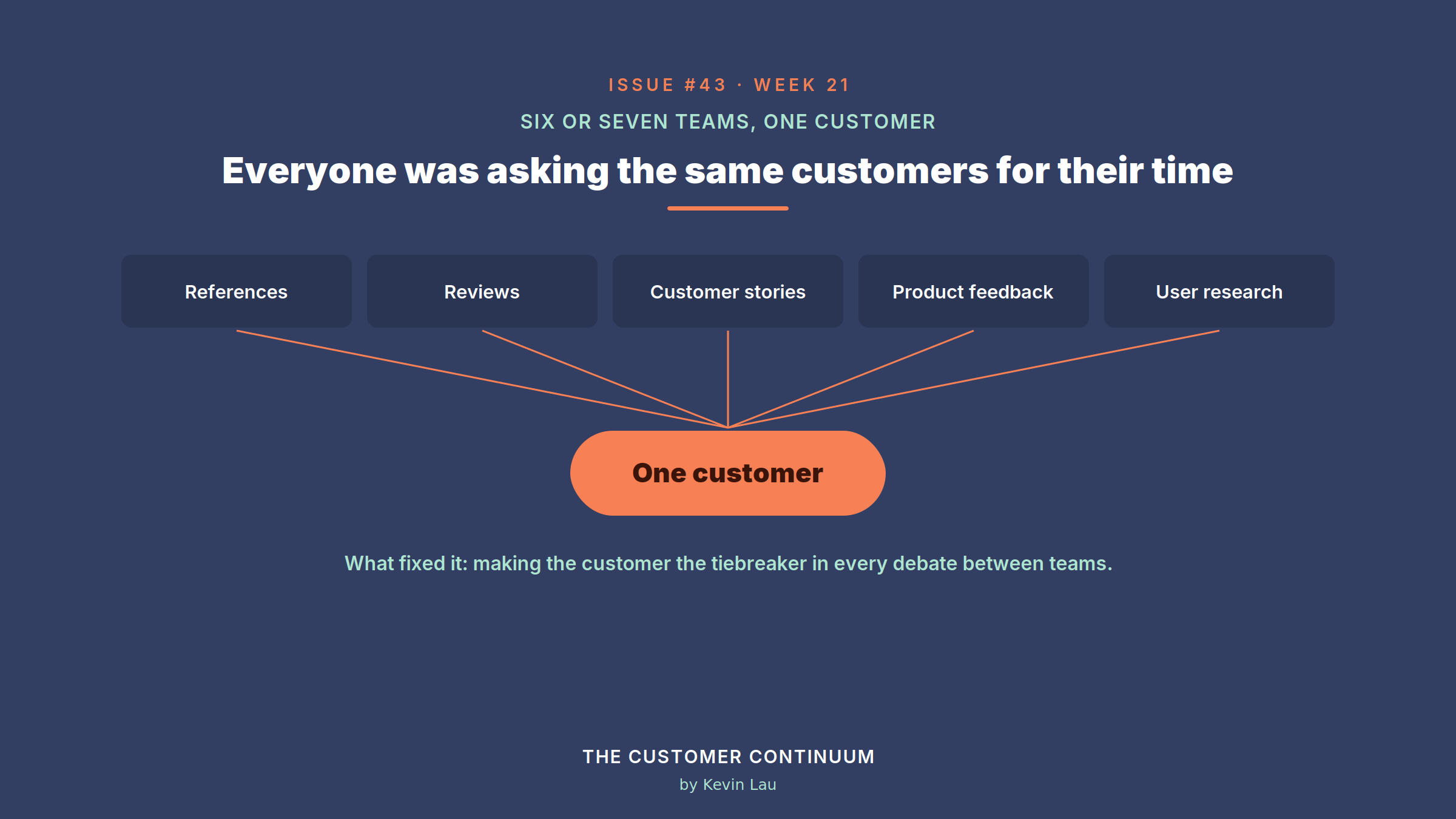
Inside, it was just as fragmented. The work we’d call customer marketing was spread across six or seven different teams. References lived in one organization, reviews in another, customer stories somewhere else, and product feedback and user research somewhere else again. Every one of those teams was reaching out to the same customers, asking for their time, and competing with each other for it.
When work is split up like that, nobody has a one-team mindset. At Marketo our CMO used to say “one team” so often it became a tagline, and it worked there because everyone could see the same customer. Across a portfolio of acquisitions, that was much harder.
The customer as the equalizer
What finally moved things was taking the argument out of our own hands. Every internal debate about whose priorities came first, marketing, customer success, or demand, went nowhere. So we stopped having it, and kept asking a different question: what would actually matter to the customer, so we stayed relevant, met their needs, and behaved like a customer-first business?
Some teams gave that lip service. So we brought in the customers themselves. Our champions, the Marketo customers who already advocated for us, became the third-party validation we carried back to decision makers, and we invited those leaders to see what it looked like to build alongside customers instead of guessing at what they wanted.
The analytics team was skeptical at first. They didn’t understand why we were doing it. Then their customers started adopting what we built with them, and that did more to change minds than anything we said in a meeting.
It was slow. It took two and a half years, product by product and organization by organization. We told the story over and over to different stakeholders, planted the idea early, and kept pointing at the same North Star until it stuck.
What the champions became
Once it took hold, the champions were everywhere. They spoke at Adobe Summit, and as speakers they helped drive registrations for their own peer groups. They helped us rebuild the education program around certification, and some of them gave more than forty hours of their own personal time to create the course material. They tested betas, gave product feedback, and shaped roadmap decisions, product by product, as the portfolio kept changing.
Advocate Nation, the program we’d built at Marketo, eventually stopped being called that. It became part of a larger Experience Makers portfolio, including the Adobe Experience Maker Awards. The user group program grew alongside it, from 60 groups to more than 2,000 chapters and 25,000 members. The name changed, and the DNA of those programs is still running today.
I was there for six years. Our most passionate Marketo customers used to say they bled purple, the brand color, and somewhere along the way I started saying it too. That’s still part of my DNA, and I’ve carried it into every company I’ve joined since. What I’m proudest of is that we built something that kept going after I left, and that’s the legacy I care about.
The model underneath all of it
Every company I’ve joined since, I’ve brought the same idea. If you help customers get value from what they bought early, before frustration sets in, they stay. Customers who stay and succeed become your advocates. And your advocates are the ones who bring the next customers in. Adoption, then retention, then advocacy, and each one feeds the next.
It sounds simple on paper. Building one connected experience from end to end, across teams that grew up separately, is one of the hardest things in this work, and it doesn’t happen in a quarter. It happens when someone keeps putting the customer in the middle of every conversation until the rest of the company starts doing it too.
If I were building it today
The part that took us years of meetings was showing everyone what customers were actually saying across every product. That’s the work I’d hand to an agent first now, the same voice of customer agent I said I’d start with last week, reading across calls, tickets, and community posts and bringing the themes back every week.
The champions would stay human. An agent can find the customer who’s ready to speak or help, and the relationship that gets them to give forty hours of their own time still comes from a person.
What this means for you
If you’re stuck in a debate between teams about whose priorities come first, bring a customer into the room. A customer’s words carry further with a skeptical leader than anything you can say about them. Expect it to take longer than you want, and pick one team or one product to prove it with first.
And ask yourself the question I still come back to: what are you building, and what will still be running after you’ve moved on?
This week’s free starter: the customer evidence brief
A single prompt that turns what customers have told you into a one-page brief for a skeptical stakeholder. Paste in quotes, survey comments, or call notes, name the leader and the decision, and it pulls out what matters to that person in the customer’s own words.
→ Get the customer evidence brief
FOR PAID SUBSCRIBERS
Run the program that does this for you
The champions in this story didn’t appear on their own. They came from a program with a clear way in, a charter, and a yearly rhythm. You already have everything you need to build one.
The Champion Program Toolkit pulls it all into one folder: the scoring agent that finds your strongest candidates, the outreach agent that drafts the invitations, the full program blueprint, and the charter you send to the champions you select. Start with the guide labeled “Start Here.”
Your task brief this week: run the scoring agent on fifteen to twenty accounts, pick your top three, and invite them to one specific thing, like a beta, a session, or a piece of course material, before you ask them to join anything bigger.
→ The Champion Program Toolkit
→ Your full 135-agent Blueprint
— Kevin
P.S. If you know someone stuck between teams that can’t agree on what customers need, forward this one. It usually starts with one customer in the room.