


Welcome back to The Customer Continuum. Issue #9.
If you are new here, every week I share what I have learned building customer marketing programs across several companies and 15+ years. The real stories. The frameworks that actually work. And the honest version of what this career looks like from the inside.
Hey there,
Let me name the thing nobody is saying out loud right now.
Customer marketing budgets are getting cut. Roles are being eliminated. And in a market where every function has to justify its existence, customer marketing is still walking into rooms without a decoder ring.
Not because the work is not valuable.
Because we have never learned to translate it into the language that makes it impossible to cut.
That changes today.
This week I want to connect three things that have been living in separate conversations for too long.
A moment from last week’s post that many people connected with.
A slide from Forrester that explains why customer marketing has an identity problem.
And a conversation I had yesterday that changed how I think about where our function is headed.
Let me start with the moment that surprised me most this week.
Last Thursday, I posted about being two years into my first VP role. The imposter syndrome at the top. The strategy ask in week two. The gap between who I am at work and who I am at home.
The comments and DMs came from GTM leaders, Chief Customer Officers, VPs of Sales. Senior people who do not usually stop to comment on leadership posts.
What they all said in different ways was the same thing.
Nobody told me this either.
And that is when I realized something.
The emotional weight of stepping into a senior role is universal. It does not matter if you are a VP of Customer Marketing or a VP of Sales or a Chief Revenue Officer. The feeling of walking into a new level and realizing the floor has changed underneath you is something every leader knows but almost nobody says out loud.
But here is the part that connects to your career right now.
That same identity crisis does not just happen when you get promoted.
It happens every time you have to explain what you do to someone who does not get it.
A new boss. A skeptical CFO. A Sales leader who thinks customer marketing is the case study team.
And if you cannot explain your value clearly in those moments, the identity crisis is not just personal.
It becomes professional.
The decoder ring problem
When I got a new boss recently I had to do something I have done multiple times across my career.
Rebuild my credibility from scratch.
Not because my track record disappeared.
Because my new boss had 50 other things competing for her attention and customer marketing was not yet on her radar as a strategic priority.
She needed a decoder ring.
Not a 40-slide deck explaining the seven pillars of CLG.
A simple translation.
Here is what customer marketing does. Here is why it matters to the numbers you care about. Here is what happens to the business if we do not do it well.
Most customer marketers cannot give that translation in under two minutes.
Not because they do not know their work.
Because they have never been forced to translate it into executive language.
We speak in programs. Executives think in outcomes.
We say: we ran 12 webinars, created 8 case studies, hosted 2 customer events.
They hear: activity. Cost. Nice to have.
We should be saying: our advocate cohort influenced $2M in pipeline last quarter. Customers who completed our education path expanded 40 percent faster. Our community members churn at half the rate of customers who never engage.
That is the decoder ring.
Not more programs. Better translation.
The Forrester slide that explains everything
I’ve shared this diagram many times in the past on how most organizations treat the overall customer lifecycle.
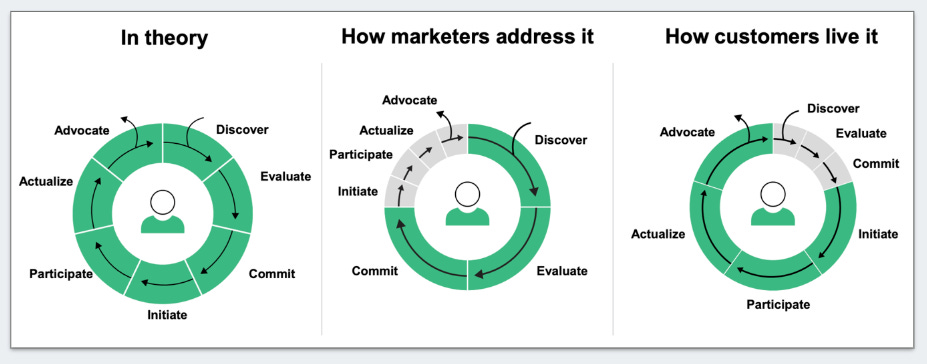
In theory: every stage of the journey is covered. Discover, evaluate, commit, initiate, participate, actualize, advocate. A complete flywheel. Beautiful.
How marketers address it: only the top half is active. Discover, evaluate, commit. Acquisition focused. Everything post-sale is grey. Barely touched.
How customers live it: the bottom half is where the experience actually happens. Initiate, participate, actualize, advocate. Customers are living the journey that marketers are ignoring.
The gap is not a strategy problem.
It is an attention problem.
Marketers are focused on bringing customers in.
Customers are living an experience nobody is designing.
And the moment a customer hits that grey zone, the unmanaged middle, is exactly when churn starts warming up.
We say we are customer obsessed.
But our org charts and budgets tell a different story.
Demand gen owns the top. CS owns the renewal. And customer marketing is supposed to cover everything in between with a team of two and a shared designer.
That is not customer obsession.
That is customer neglect with good intentions.
The companies that close this gap are the ones that treat customer marketing as a lifecycle engine, not a content factory.
Every stage of that bottom half of the flywheel is customer marketing territory.
Onboarding that drives adoption. Education that deepens value. Community that creates stickiness. Advocacy that generates proof. Executive engagement that protects and expands relationships.
That is not a support function.
That is a growth engine.
Where it is all heading
This week I had a conversation with an agency that stopped me mid-sentence.
They described something called influence orchestration.
The idea that your entire customer ecosystem, advocates, community members, reviewers, champions, can be mobilized with precision to influence how your brand shows up across every channel.
Not at scale. Surgically.
The right customer voice in the right place at the right moment.
In AI-generated answers before a buyer forms a query.
In Reddit threads where your prospects are already talking.
In peer conversations that happen before a single sales call.
And I realized this is not just an agency trend.
This is what Customer-Led Growth looks like when it is fully activated.
Most companies run CLG programs in silos. Advocacy over here. Community over there. Education somewhere else.
Influence orchestration is what happens when you connect them all with intent.
But here is why it matters to you right now specifically.
Paid campaigns are delivering diminishing returns. SEM is getting harder. LLMs are rewriting search results and your carefully optimized pages are disappearing from the conversation.
The thing that shows up in AI-generated answers is not your campaign.
It is your customers.
Their reviews. Their quotes. Their community posts. Their peer conversations.
Which means customer marketing now sits on the most valuable acquisition channel in B2B SaaS.
Even if nobody gave you the budget for it.
Even if your KPI still says retention.
Even if your team still gets treated like a service desk for sales.
The function that owns customer voice owns the front door.
That is you.
The decoder ring for your next exec meeting
Here are three translations to have ready before you walk into any leadership conversation.
Translation 1: From programs to pipeline Instead of: We hosted three customer webinars this quarter. Say: Our webinar attendees closed at 35 percent higher rates and expanded 20 percent faster than non-attendees.
Translation 2: From advocacy to acquisition Instead of: We have 50 active customer advocates. Say: Our advocate network influenced 12 late-stage deals last quarter and sourced 8 net new referrals. That is pipeline we did not have to pay for.
Translation 3: From community to retention Instead of: Our community has 10,000 members. Say: Community members churn at half the rate of customers who never engage. At our current ARR that represents X million in protected revenue.
You do not need new programs to use these translations.
You need to connect what you already do to the numbers leadership already tracks.
That is the decoder ring.
Where to go if you feel stuck
A lot of people responded to last week’s post feeling seen but not sure what to do next.
So here are three moves depending on where you are right now.
If you are a Director trying to get to VP: Stop reporting programs. Start reporting outcomes. Every conversation with your CMO should connect your work to pipeline, NRR, or CAC payback. Build that muscle now before you need it.
If you are navigating a new boss: Do not wait for them to ask what customer marketing does. Schedule the 30-minute session yourself. Come with three numbers. Leave with one clear priority they care about. Make it easy for them to sponsor you.
If you are rebuilding your identity after a transition: Remember what I learned going from Adobe to F5. The brand was a megaphone. You were always the voice. Your credibility does not live in your last company. It lives in how you show up when nobody knows your name yet.
What is next
Next week I am going deeper on the influence orchestration idea. What it actually looks like inside a company. How to start building it with the resources you already have. And the Forrester gap, how to close the middle of the journey before your competitors do.
— Kevin
P.S. If this issue helped you think differently about your role, forward it to one customer marketer who needs to hear it. That is how this newsletter grows. One right person at a time.
On the Radar: Who’s Hiring in Customer Marketing
Every week I share open roles in customer marketing, customer success, and community submitted by hiring managers in this community.
If you are hiring, send me the role. I will include it here and share it with 600 plus customer marketing leaders who read this newsletter every week.
No charge. No form. Just reply to this email or DM me on LinkedIn with the link.
Roles featured here starting next issue. Submit yours today.
Customer Marketing Spotlight
Every issue I feature one customer marketing leader doing interesting work. Their story. Their lessons. The thing they wish someone had told them earlier.
If you want to be featured or know someone who should be, reply to this email with the subject line SPOTLIGHT and tell me who and why.
I worked under the environment, where not a lot of people understood what customer marketing was. They thought the role was to simply communicate with customers when there was a new product/feature release or any updates in terms and conditions. Customer marketing is a lot more than that. It's about understanding what and why customers stick with your product and how you can engage with them so they continuously get value from the product. It should be a cross functional role because it is so influencial. Love the point you mentioned about we need to be more vocal about and clearly communicate what impact we as customer marketers make to businesses.
Clever idea Kevin! I've found that so much of corporate America is not only strong execution, but promotion - different sides of the same coin. Proving what you did AND most importantly in the language the C-Suite will understand.