


Welcome back to The Customer Continuum. If this was forwarded to you, join 500+ customer marketers getting the full playbook every Thursday at kevinkennethlau.substack.com.
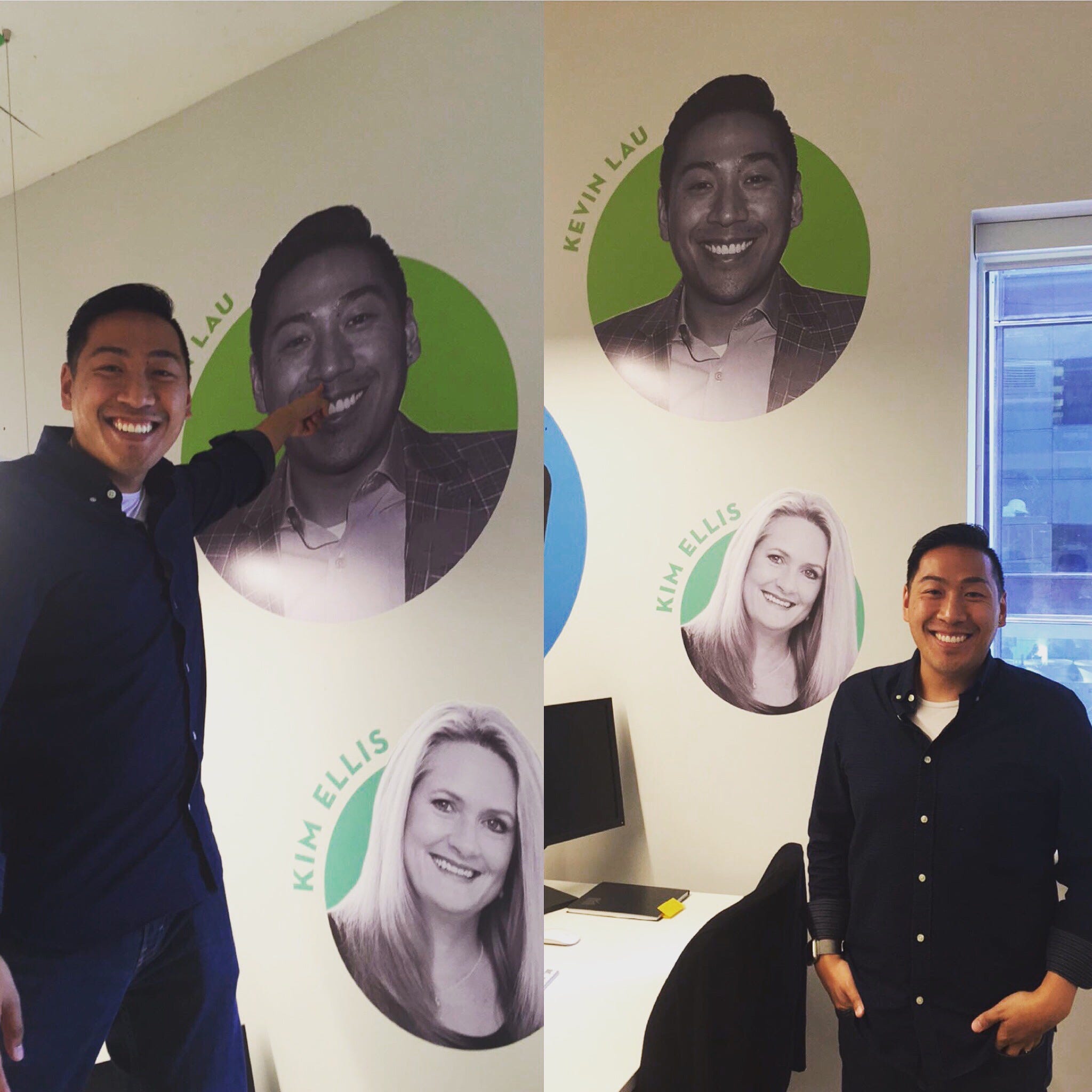
That’s me on the wall.
My face. Printed large in Influitive’s office in Toronto. Somewhere around 2015.
I remember seeing it and feeling genuinely proud. We had built something. Customers were engaged. The hub was active. The metrics looked good. And apparently, someone thought our program was worth putting on the wall.
I was not wrong to feel proud.
I was just not asking the right questions yet.
I had been using Influitive since 2013 — one of the early adopters. The concept made immediate sense to me. Give customers meaningful ways to engage. Recognize them. Reward them. Turn passive users into active advocates.
And it worked. In the ways we were measuring it.
What I did not fully understand yet was what “working” actually needed to mean.
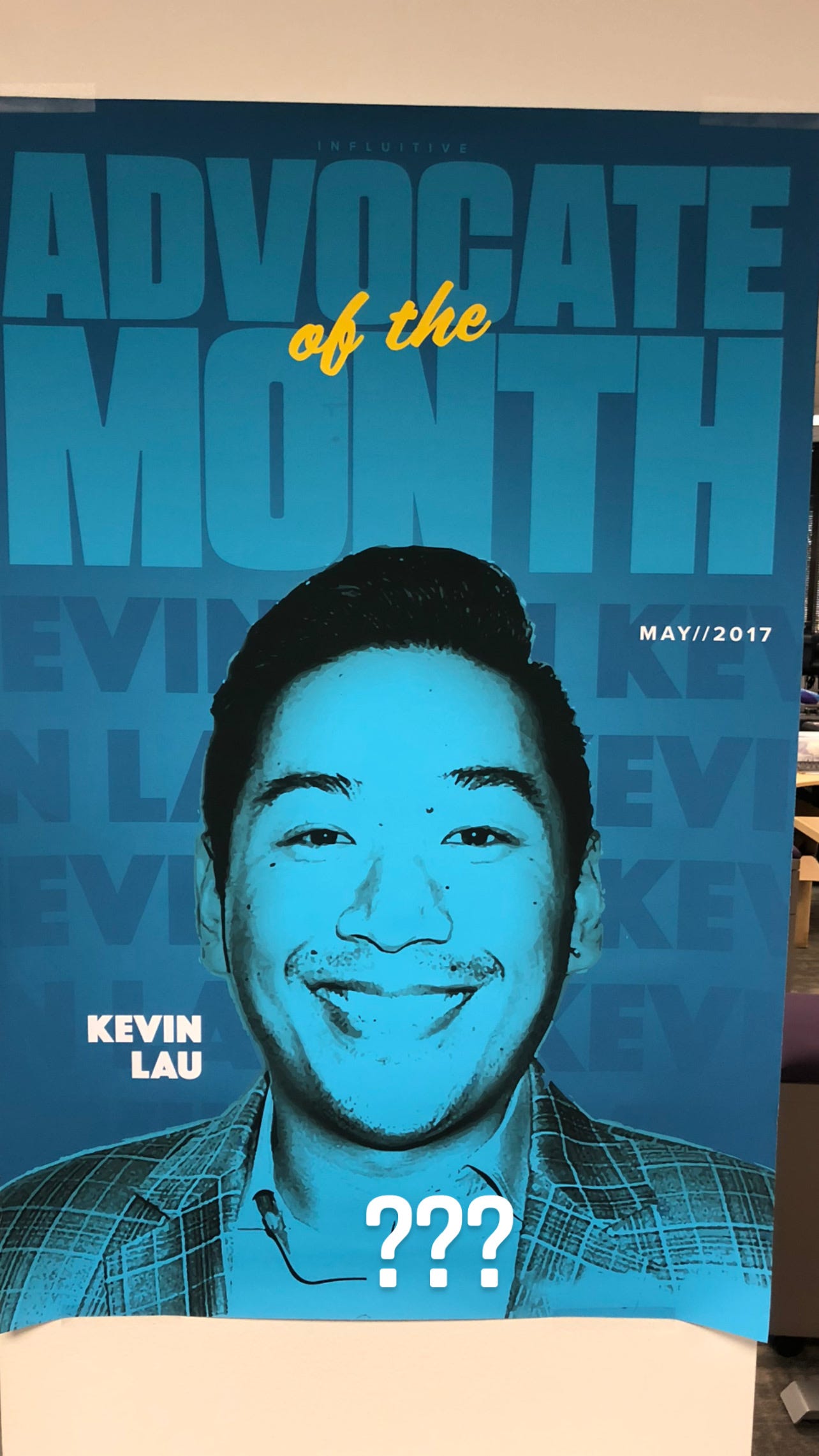
By the time I reached Marketo in 2017, the model was already under pressure. We had to have hard conversations about what our hub, we called it Purple Select, was actually driving.
The customers most active in the gamification loop were mostly brand fans. The ones who loved the purple swag. The ones who showed up to every webinar. They were enthusiastic. They were not the customers moving deals.
Some of them churned within a year of us winning an award for the program.
That was the moment I started to understand something that took a few more years to fully articulate.
We had been optimizing for acts of advocacy. Not for impact of advocacy. Transactions, not trust. Volume, not credibility.
The concept was right. The execution had limits we had not yet named.
I want to be careful here, because this is not a hit piece on any platform or the people who built them. The category grew up in important ways. Real lessons were learned.
But some of the thinking calcified.
The idea that you could systematize advocacy through enough points, enough challenges, enough incentives: that idea stuck around longer than it should have. Because it is easier to build a leaderboard than to earn a relationship.
And here is what that era actually did to customer marketing as a function.
It reinforced the exact narrative we have been fighting ever since.
Soft metrics. Nice-to-haves. Relationship stuff that does not translate to revenue. When executive leaders saw advocacy programs in those years, mine included, they drew a conclusion that took years to reverse. The disconnect between customer marketing and demand generation did not happen by accident. We built it ourselves by optimizing for activity instead of outcomes.
I built one of those programs. My face was on the wall.
What I know now is that advocacy has always been real. We were just solving for the wrong version of it.
And the deeper problem was this: we were treating advocacy like a house. When it was really just one pillar.
Customer marketing is a house with many pillars.
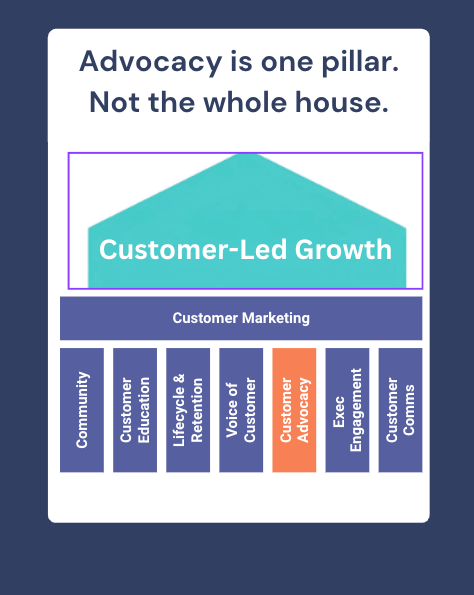
Advocacy is not the whole strategy. It never was.
The programs that fail are the ones built on a single pillar: get customers to do things, reward them for it, report the numbers, repeat. No lifecycle engine feeding the right accounts forward. No community creating the peer relationships that make advocacy feel natural. No voice of customer telling you which customers have outcomes worth sharing. No education layer ensuring customers have results worth advocating for.
A fan club is what happens when you build one pillar and call it a strategy.
A real customer marketing function is what happens when all seven pillars work in synergy. Voice of customer. Advocacy. Community. Education. Lifecycle and retention. Customer communications. Executive engagement.
Each pillar feeds the others. Advocacy without community feels transactional. Community without lifecycle feels random. Lifecycle without proof feels invisible.
When they work together, the whole becomes something no single platform can manufacture.
That is what the industry has been learning. Slowly. Often the hard way.
This issue is about the practical side of that lesson, specifically, how to build the advocacy bench the right way.
Why motivation matters more than mechanics
Before we get to the how, we need to name the real problem with most advocacy programs.
They are built almost entirely on the weakest motivator.
Motivation to advocate lives in three places. I think of it as the Advocacy Motivation Stack.
Recognition. Customers want to be seen as experts in their field. A speaking slot at your conference. A seat on your customer advisory board. A byline in your content. An introduction that positions them as a thought leader in front of their own peers. These things do something swag never can. They make your customer look smart in front of their boss. That is a different kind of currency.
Peer connection. The most underestimated driver of advocacy is the relationships customers build with each other through you. When your customer meets another operator solving the same problem, learns something real, makes a hire, gets an introduction that changes their quarter; you earned something that points and gift cards cannot touch.
Swag and gifts. These are not nothing. But they are the weakest of the three. They drive transactions. The customer who advocates for swag will stop advocating the moment the swag stops. The customer who advocates because you made them look credible in front of their CMO will advocate for years (will cover this in a future post).
Most programs are built almost entirely on tier three.
The best ones treat tier three as a thank-you, not a driver.
How to actually build the bench
Here is the full model. This is the part most content skips.
Step 1: Map before you recruit.
Pull your top 20 accounts by revenue, tenure, and expansion history. That list is your real advocacy bench. Not the people who clicked a form. Not the people already in your hub. The accounts that matter most to your business and to the deals you want to close next quarter.
Start there.
Step 2: Read before you ask.
Before you touch a single account, read the CS notes. Talk to the CSM. Understand the relationship history. What was onboarding like. Where did it get hard. What did they ask for that you delivered. What did they ask for that you did not.
The first move is never an ask. The first move is understanding.
Step 3: Align with CS before you act.
CS is not blocking you to be difficult. They are protecting accounts from clumsy marketing asks. They have seen it go wrong. One bad email to the wrong contact at the wrong time and a healthy account becomes a tense one.
The way through that door is trust. Show them you understand the account. Show them you will brief the customer before any ask. Show them you will debrief after. Show them you will close the loop every single time.
CS becomes your biggest ally when you treat their relationships with the same care they do.
Step 4: Give before you take.
The customers who become your most credible advocates say yes after value has already shown up. Long before you make any ask.
Give them recognition. A speaking opportunity. A seat on your customer council. A chance to shape your roadmap in a way that feels real, not performative.
Give them connection. An introduction to a peer solving the same problem. A room where they learn something they could not have found on their own.
Give them leverage. A tight one-page success summary they can drop into their next QBR. A slide that makes them look smart in front of their CFO. Help them win internally before you ask them to help you.
Step 5: Make the first ask small.
Not “join our program.”
A two-sentence quote they can approve in one minute. A logo update. A 15-minute call with your PM about one feature they care about. A short written answer to one question.
Small yes. Then another. Trust builds like that. So does advocacy.
Step 6: Protect them like a scarce resource.
The fastest way to burn a great advocate is to treat them like a list.
Set rules. Match reference calls by industry and use case. Limit how often you ask. Always brief them before. Always debrief after. Always close the loop with the outcome. Always say thank you in a way that feels human, not automated.
The customers who move deals are not the ones who volunteer.
They are the ones you had to earn.
That poster on the Influitive wall is still one of my favorite artifacts from my career.
Not because I was proud of the program. Because it represents a moment I did not fully understand yet.
Understanding came later. With the hard conversations. With the churn data. With the deals that slipped because we had fans but not closers. With the exec leader who looked at my advocate count and asked “but what is it actually doing for revenue?”
The answer I had then was not good enough.
The answer I have now is built on all of it. The early wins. The limitations I did not see. The evolution that followed.
Your advocacy program is not measured by how many people are in it.
It is measured by how many deals it protects. How many renewals it saves. How many conversations it starts before you walk into the room.
Build the house. Not just one pillar.
Build the bench. Earn the advocates.
The rest follows.
— Kevin
P.S. If this issue was useful, forward it to one customer marketer who is still measuring their program by advocate count. They need this more than you do. And if you want to go deeper on any of the seven pillars, reply to this email and tell me which one is your biggest challenge right now. I read every reply.