


Welcome back to The Customer Continuum. Issue 17.
If you get value from this newsletter, the best thing you can do is forward it to one person who needs it. It takes 10 seconds and it means everything.
Everyone is talking about agentic-led growth right now.
Agents that sell. Agents that onboard. Agents that expand accounts autonomously, priced on outcomes, not seats.
Mark Benioff calls it “service as software, not software as a service.” The shift is real and it is coming for every post-sale function.
But there is something missing from most of the conversation.
Agents cannot earn trust. That is still a human job.
And here is the part most people are skipping: before you add agents to your post-sale motion, you need to understand what infrastructure those agents actually depend on to work.
That infrastructure has a name. It is the Customer-Led Growth (CLG) system.
This issue is about what I built to show exactly how agents and CLG connect, and how you can use it before your next planning conversation.
What I built
The CLG Flywheel app that I built in claude code now has a new tab: the CLG Agentic Blueprint.
It is a fully interactive architecture diagram showing what a complete agentic CLG system looks like: from human strategy at the top to tech stack at the bottom. Five layers. Seven pillars. 135 agents. Six orchestrators connecting everything. I created it because I wanted to show a real diagram to help explain how all these agents can work together to help you address some of the biggest painpoints or obstacles that often impact our ability to do our job: building relationships and engaging customers.
Here is how it is structured.
Layer 1 — Human Strategy

Seven human leads sit at the top of the architecture: Community Lead, Lifecycle Lead, VoC Lead, Advocacy Lead, Comms Lead, Education Lead, and Exec Engagement Lead.
These are not roles being replaced by agents. They are the roles that become dramatically more powerful because of agents. Judgment, relationships, and business case ownership still live here. Agents free these people to focus exclusively on what only humans can do.
Layer 2 — Orchestration

Six routing engines sit between human strategy and agent execution. This is the layer most teams miss entirely.
The CLG Signal Router ingests signals from all pillars and routes them to the right agent cluster. The Revenue Attribution Engine maps CLG program activity to pipeline, expansion, and retention outcomes. The Account Intelligence Hub aggregates account-level signals into a single 360 view. The Proof Library Orchestrator routes customer evidence to the right deal, campaign, or channel. The Rewards Fulfillment Orchestrator triggers rewards when advocacy acts hit thresholds. The Comms Governance Controller enforces send limits and prevents communication overload across all systems.
Without this layer, agents work in silos. With it, they work as a system.
Layer 3 — Agent Execution
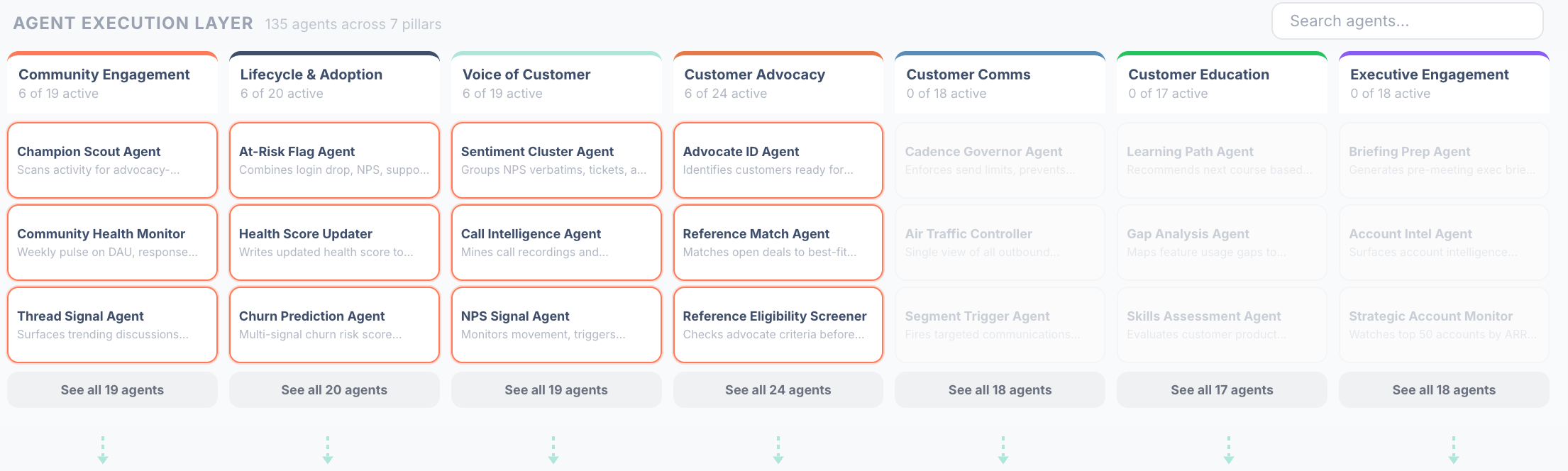
135 agents across 7 pillars. Each pillar column is expandable, click any pillar to see every agent in it, what it does, and what it writes to.
A few examples of what lives here:
The Champion Scout Agent scans community activity for advocacy-readiness signals and surfaces the right customers before your team even thinks to ask.
The At-Risk Flag Agent combines login drop, NPS movement, and support escalations into a single churn risk score and routes it to the right CSM with a recommended next action.
The Sentiment Cluster Agent groups NPS verbatims, support tickets, and review content by theme and delivers a weekly brief to your product and VoC teams.
The Reference Match Agent matches open deals to the best-fit customer references by industry, use case, and deal stage in seconds, not days.
The Briefing Prep Agent generates pre-meeting exec briefs from health scores, usage data, and relationship history before every EBR or CAB.
These are not hypothetical. Every agent in the blueprint has a name, a trigger, a data input requirement, an output, and a recommended platform.
Layer 4 — CDP / Data Backbone
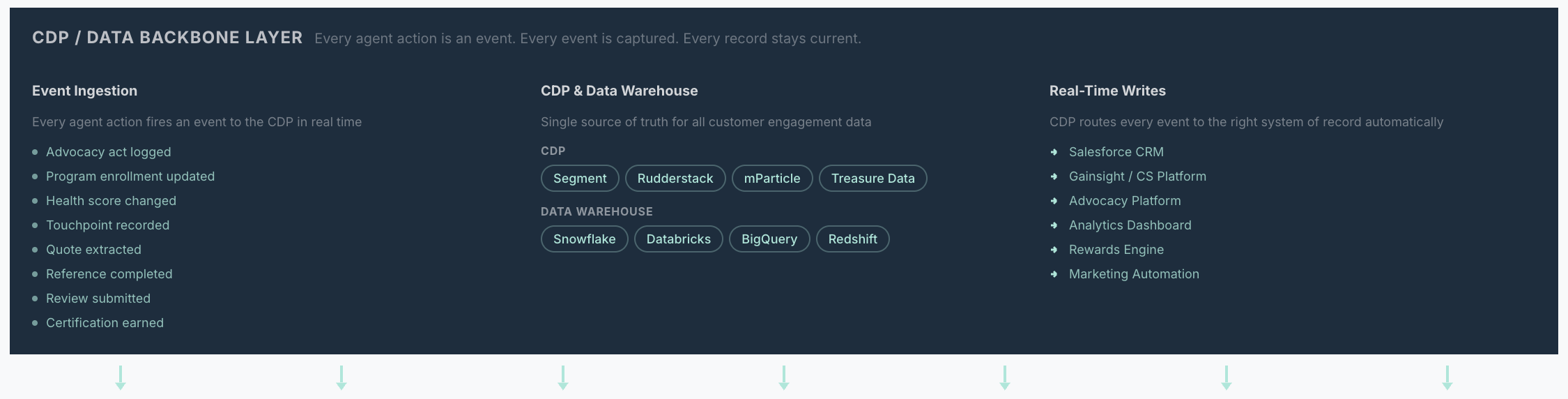
Every agent action fires an event. Every event is captured. Every record stays current.
This layer shows how the data flows: what feeds into the CDP, what the CDP writes out to your systems of record, and which platforms handle it. Segment, Rudderstack, mParticle, Treasure Data on the CDP side. Snowflake, Databricks, BigQuery, Redshift on the warehouse side. Real-time writes to Salesforce, Gainsight, your advocacy platform, and your analytics dashboard.
Without this layer, your agents are working from stale data. That is where agentic motions break down.
Layer 5 — Tech Stack
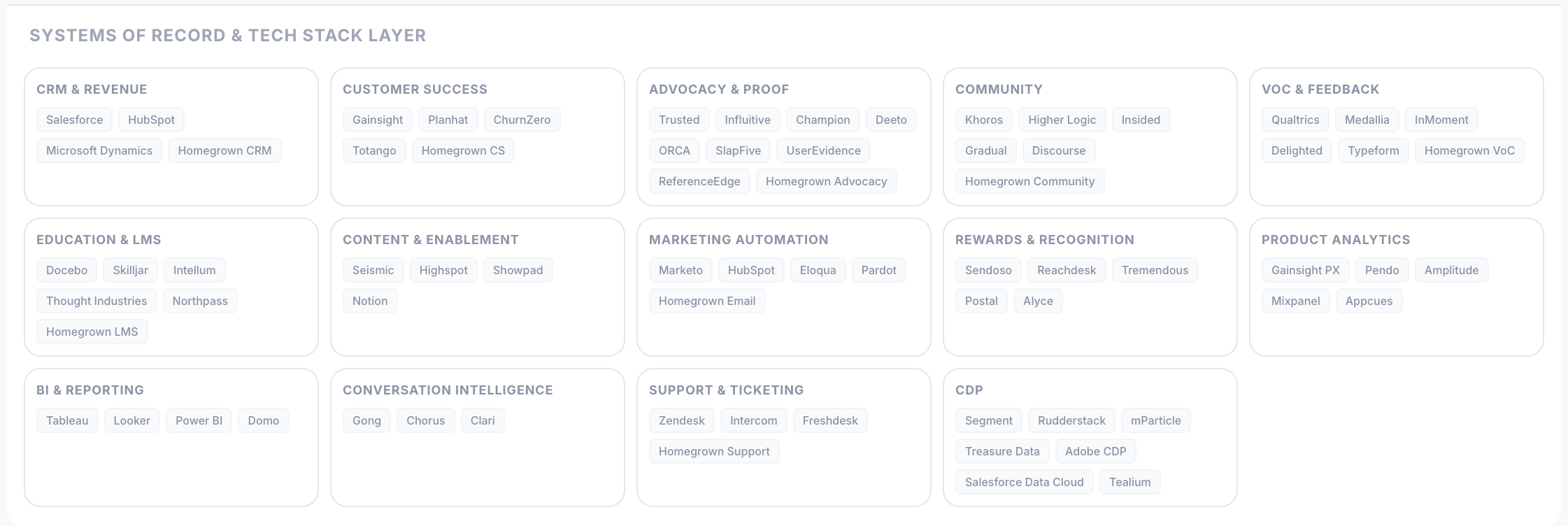
Fifteen categories of platforms that agents read from and write to. CRM, Customer Success, Advocacy, Community, VoC, Education, Content, Marketing Automation, Rewards, Product Analytics, BI, Conversation Intelligence, Support, CDP, and Data Warehouse.
Every platform in the app’s tech stack selector is mapped here. You can customize it for your own stack. Please note that it’s not intended to be exhaustive especially as new vendors launch. If anything, this should cover the majority of the core solutions that are well known across most B2B SaaS organizations.
How to use the blueprint right now
Open clg.thecustomercontinuum.com and click the Agents tab.
Start with your lowest-scoring CLG Diagnostic pillar. Find that column in the Agent Execution layer. Expand it. Read the first three agents. Ask yourself: which of these already exist in my stack in some form, and which are completely missing?
That gap is your roadmap.
If you are heading into a planning conversation or a budget discussion in the next 30 days, screenshot the architecture and bring it. Not as a “here is what I want to build” slide. As a “here is what best-in-class looks like and here is where we are today” slide. The visual does the work for you.
If you want to go deeper and actually start building these agents paid subscribers to the Customer Continuum get something else entirely. I published a companion piece with the full implementation kit: eight downloadable markdown files, one for each pillar plus the CDP backbone layer, each with every agent fully specced and ready to hand to your IT team or AI strategy lead.
Free to start at clg.thecustomercontinuum.com. Upgrade for the build specs.
ACCESS THE CLG AGENTIC .MD FILES HERE
Other updates to the app this week
Beyond the Agents tab, a few things worth knowing:
The Revenue Impact Model now factors in your number of customers and average deal size alongside ARR, NRR, and churn rate. The output is a more precise directional business case.
The Company Intelligence tab has a privacy disclaimer and handles concurrent searches cleanly. Type in any company and get a CLG maturity brief in about 30 seconds.
My Ask Kevin GPT now renders markdown in responses and has a 40-message conversation limit before prompting a fresh session.
The tech stack selector now includes a CDP category with Segment, Rudderstack, mParticle, Treasure Data, Adobe CDP, Salesforce Data Cloud, and Tealium. Freshdesk is added to Support. Gong, Chorus, and Clari are added under Conversation Intelligence.
See you next Thursday.
— Kevin
P.S. The implementation kit for paid subscribers covers all 135 agents with full build specs. If you are a customer marketer who has an AI strategy conversation coming up, this is the resource that makes you the most prepared person in the room. Link above.