


Welcome back to The Customer Continuum. Issue #20.
If this is your first issue, the best way to support this work is to forward it to one customer marketer who’s thinking about their next move.
My first job paid $7.25 an hour at Starbucks while I was in college.
I remember the mornings most. Lines stretched to the door, customers who hadn’t had their caffeine yet, every person needing something different in the next 90 seconds. The pressure was real, and so was the part nobody warned me about: most people are at their most irritated when they don’t have their coffee, and the way you handle that moment is the whole job.
What I learned at Starbucks wasn’t how to make a latte. It was that I’m good in environments where customer interaction is the work. The harder the moment, the more I leaned in. I figured out something about myself behind that counter that I’ve carried into every role since.
That insight, more than anything else, is the reason my career took the shape it did.
This issue is about the math, the engine, and the framework that turn a series of jobs into a career you actually want.
The math nobody runs
If you work 40 to 50 years and average 3 to 4 years per role, you only get 10 to 15 operator positions in your entire career.
That’s it.
Most people don’t think about their career this way. They treat each job as the next step on a continuous ladder, with promotions and lateral moves blurring together into a long stream of work. The reality is more discrete than that. You have a finite number of meaningful chapters, and each one is a strategic choice that either compounds toward where you want to end up or doesn’t.
Once you internalize this, every job conversation gets sharper. You stop accepting roles because they’re available and start accepting roles because they move you toward the seat you’re trying to land in twenty years.
For me, that seat is Chief Customer Officer or Chief Experience Officer. Every operator role I’ve taken since I figured that out has been a deliberate step toward it.
The peak earning window
There’s a second piece of math that matters even more.
Most lifetime earnings happen between roughly 35 and 55. The years before are foundation. The years after are typically when career velocity slows. The 20 years in between are when seniority, specialized skills, and reputation compound into peak compensation.
The data is clear on this. The Bureau of Labor Statistics shows median earnings rise sharply through the 30s, peak between 45 and 54, and start to taper after 55. ADP’s wage research puts the peak earning cohort at 45 to 54 with a median wage of about $97,600. After 55, the curve bends downward as people move into part-time work, reduced workloads, or early retirement.
If you don’t compound during that 20-year window, you don’t get the years back.
I’m 40 today. I’m entering the peak window right now. The work I do over the next 15 years is the work that determines how high the ceiling rises during the years where the ceiling matters most. That math is what makes this issue urgent for me, and it’s why I think it should be urgent for you too if you’re anywhere in that range.
The arc
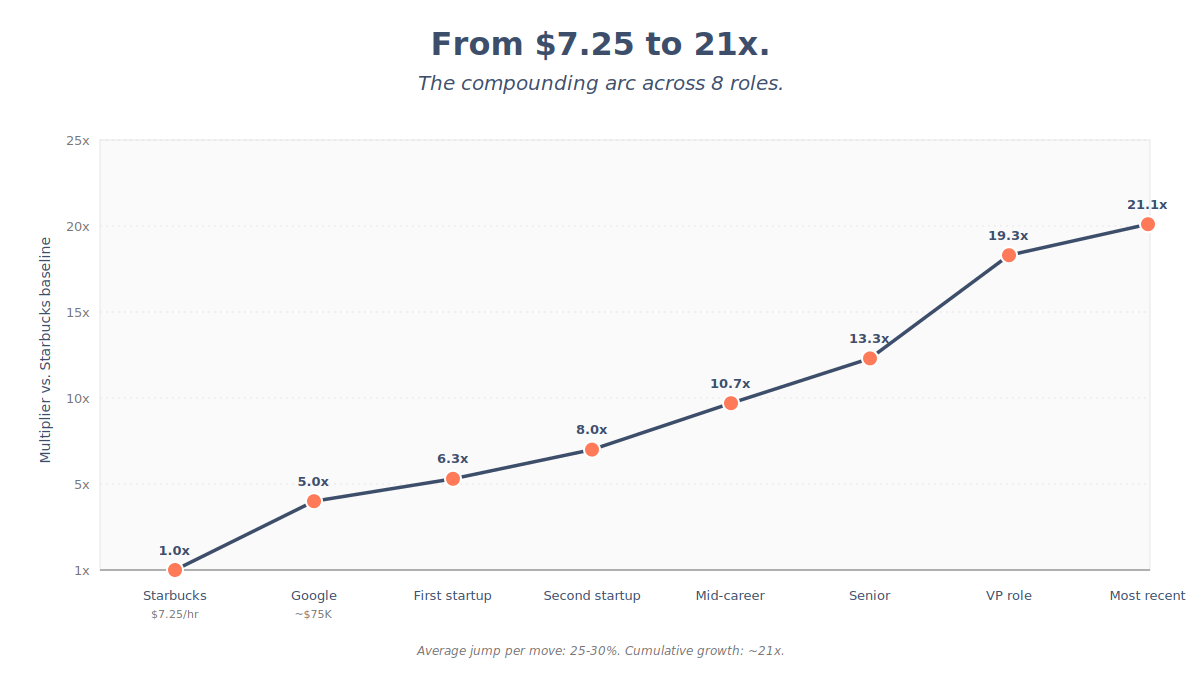
Here’s how my comp moved across roles, anchored to my Starbucks starting point as a multiplier baseline.
Starbucks (college): $7.25 / hour. Index: 1.0x
Google (2012): about $25 / hour, or roughly $75,000 base. Index: about 5x
First startup (consulting and strategy): about 26% jump. Index: about 6.3x
Second startup: about 27% jump. Index: 8x
Mid-career role: about 33% jump. Index: about 10.7x
Senior role: about 25% jump. Index: about 13.3x
VP role: a larger jump than average that reflected both the title shift and the scope expansion. Index: about 19x
Most recent role: another deliberate move. Index: about 21x
The average jump per move was 25 to 30 percent. Some were higher. The cumulative effect across 7 transitions is a base salary that grew roughly 21x from where I started.
For comparison: someone at a single company averaging the typical 3 to 5 percent annual raise over the same time would have grown their salary by roughly 60 to 100 percent. The compounding gap between staying and moving is enormous.
This isn’t an argument that everyone should change jobs constantly. It’s a data point about what’s structurally possible if you treat your career like a brand-building exercise rather than a series of next jobs.
The engine: brand-building between jobs
Here’s what most people miss about compensation jumps.
The negotiation itself is downstream of the work you’ve done in the years between jobs. The 25 to 30 percent jump didn’t happen because I was clever in the moment. By the time the conversation came up, I had become someone the next role needed, and the compensation followed.
Every role I’ve taken expanded my brand in a specific direction. Adobe and Marketo gave me depth in advocacy and post-sale growth at scale. F5 gave me the chance to lead a function in a different industry and take on a broader remit. Each role added a chapter to the story I was telling about who I am and what I do.
Two things have helped me stay intentional about the brand-building work between roles.
First, having an executive coach or mentor. The market today is harder than it was two or three years ago, but you can still be intentional about your career arc. The right coach helps you see your trajectory from outside the day-to-day grind, ask better questions about where you’re headed, and avoid the drift that happens when you let the job dictate the direction. If you don’t have a coach, find one. If you can’t afford one, find a mentor who’s two or three roles ahead of where you are. That single relationship has changed more about how I think about my career than any single role I’ve held.
Second, niche down. One of my old mentors, used to say “the riches are in the niches.” I’ve thought about that line constantly over the years. The temptation in any field is to broaden your appeal, hedge across multiple specialties, become a generalist who can fit anywhere. The reality is the opposite.
Specialization is what makes you findable, memorable, and valuable.
The deeper you go in your niche, the more the market pays for what you uniquely know. My niche is customer-led growth and post-sale revenue, and the more I’ve leaned into that lane, the more the right opportunities have come to me.
The lesson: don’t optimize for the next title. Optimize for the next chapter of your story. The compensation will follow if the story compounds.
The framework: how to choose your next role on purpose
A few years ago, working with a coach, I built what we called the Good Options Framework. It’s a way to evaluate opportunities across multiple dimensions rather than letting one dimension (usually compensation) dominate the decision.
Eight criteria:
Strategy: Will I have a seat at the table? Can I shape strategy, not just execute it?
Growth and Development: Is there real upward mobility here? Promotions, increased scope, budget expansion?
Vision of Leadership: Do I trust the C-suite? Will they give me autonomy?
Values: Is this a customer-centric company? Does the brand align with what I believe?
Title: Is the title one I’m proud of? Does it open future doors?
Compensation: Does the package meet my number?
Work-Life Balance: Can I take vacation without anxiety? Will I burn out here?
Manager Qualities: Empathy, mentorship, player-coach mentality?
The framework alone isn’t the move but the second exercise: forced-choice ranking.
You take all eight criteria and pit them against each other in head-to-head matchups. Strategy versus Compensation. Values versus Title. Work-Life Balance versus Growth. Each round you pick which one matters more, until you have a stack rank.
When I did this exercise, my stack rank looked like this:
Values (7 wins)
Compensation (5 wins)
Work-Life Balance (4 wins)
Vision of Leadership (3 wins)
Growth and Development (2 wins)
Manager Qualities (2 wins)
Strategy (1 win)
Title (1 win)
Two things became clear.
First, values matter to me more than I realized. I’d been treating compensation as the lead signal in role evaluations, when in reality, values were the deeper filter. Roles that met my comp number but failed my values check would have been mistakes regardless of what they paid.
Second, title matters less than I thought. I had been chasing VP-level titles for years, but in the forced-choice exercise, title kept losing to almost everything else. Once I saw that, I gave myself permission to evaluate roles on substance rather than label.
This framework is the most useful career tool I have. I run it every time I’m considering a meaningful move, and it has saved me from at least two roles that looked good on paper but would have been wrong for me.
For paid subscribers: the worksheet
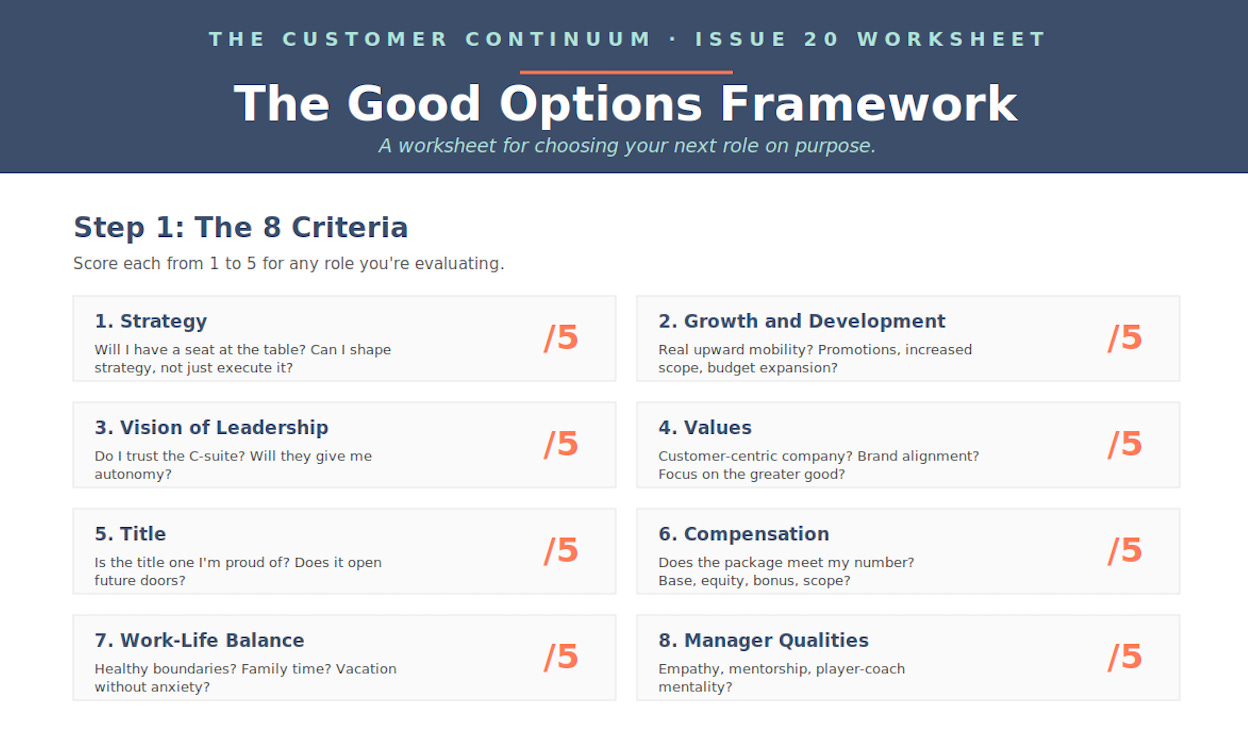
I built a worksheet to make this exercise easy to run. It walks you through scoring each of the 8 criteria for any role you’re evaluating, the full 28 head-to-head matchups, and a tally section that surfaces your stack rank.
If you’re a paid subscriber, you can find the worksheet below:
Run it once on your current role to see what you’re actually optimizing for. Run it again on any role you’re considering. The gap between the two answers is usually where the real career decision lives.
The takeaway
A career is 10 to 15 operator roles. Your peak earning window is 20 years, from roughly 35 to 55. The compensation that compounds across those years is downstream of the brand you build between jobs, the niche you commit to, and the framework you use to choose them.
If you take one thing from this issue, build your version of the Good Options Framework. Run the forced-choice exercise. Know your stack rank before the next opportunity lands in your inbox, not after.
The readers who make the best moves aren’t the best negotiators but understand what exactly they’re optimizing for before the conversation starts.
Next week
Issue 21 takes on the playbook for building a customer awards program that creates real strategic value, with the behind-the-scenes from the program we just wrapped at F1 Miami. I’ll also be doing a live session with UserEvidence on May 19 walking through the full system.
Talk soon,
— Kevin
P.S. If this issue helped you, please forward it to one person thinking about their next move. That’s how this newsletter grows.