


Welcome back to The Customer Continuum. Issue #28.
This is the third live build from my 135-agent blueprint, and the first one drawn from the Voice of Customer pillar.
If you’re keeping track, I’d teased more validator testing for this week. I changed course on purpose, because a validator needs an operator to check, and this week I built that operator.
Last issue I built the validator, the agent whose only job is to read another agent’s work and tell me whether it’s safe to ship. This week I built one of the agents it’ll eventually check: an operator that takes a pile of raw customer reviews and turns them into something a marketing or sales team can actually use. I expected the interesting part to be the clustering. The interesting part turned out to be a review I almost put in a sales deck that would have leaked a customer’s confidence and my own roadmap in the same sentence.
This is the build report from that run.
What I built
The Verbatim Synthesis Agent reads a batch of customer reviews and runs three lenses over them. Theme Clustering groups reviews that say the same thing in different words and returns each theme with a frequency count. Signal Extraction pulls the three things a customer marketer wants out of a review pile: expansion-ready language, competitive mentions, and off-topic content that belongs to finance or support rather than product. Quote Selection builds a clean bank of the verbatims that read well as marketing or sales collateral, with attribution attached.
I tested it against a synthetic set of 65 reviews I built for a fictional product analytics company, because testing on real customer data with planted problems in it is the kind of thing this very agent is supposed to prevent. The reviews were written to look like a real export, with the same loose voice and uneven length you’d pull off a review site on any given Tuesday. Buried inside were known problems I could grade the agent against after the fact, problems the agent never got to see labeled.
The clustering test
The first thing I wanted to know was whether the agent could find a theme that doesn’t announce itself.
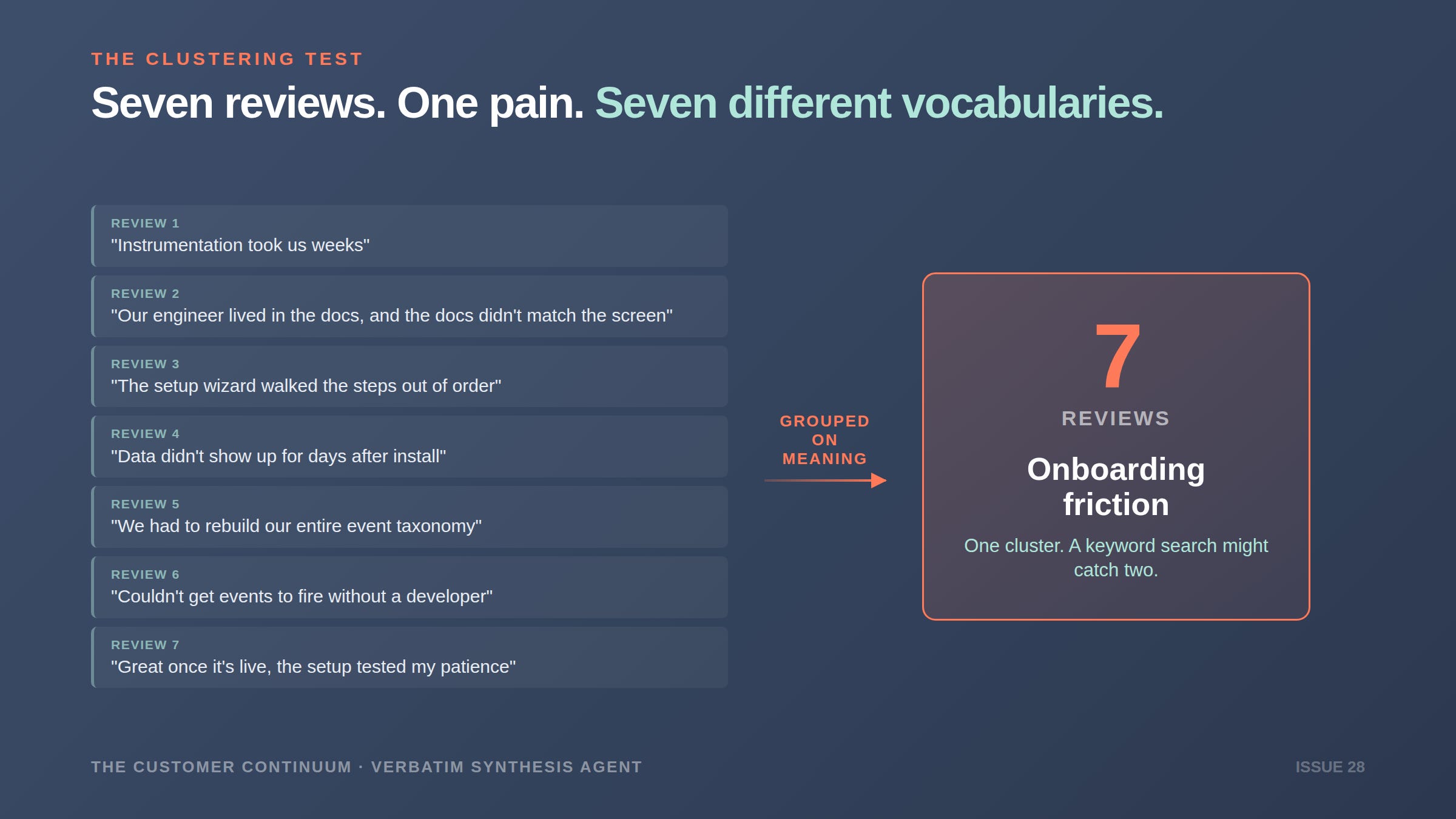
So I planted seven reviews that all complained about the same thing, onboarding friction, and made sure no two of them said it the same way. One talked about instrumentation taking weeks. One described an engineer who “lived in the docs” while the docs didn’t match the screen. One blamed a setup wizard that walked the steps out of order. One was about data not showing up for days after install. One was a team that had to rebuild its entire event taxonomy. One couldn’t get events to fire without a developer babysitting it. The last one just said “great once it’s live, the setup tested my patience.” Seven reviews with one underlying pain with seven different vocabularies.
A keyword search might catch two of those, the ones that happen to share a word. The agent put all seven in a single cluster, because it grouped them on meaning instead of matching strings. That’s the whole reason a synthesis agent earns its place. A human reading all 65 reviews would eventually see the pattern too, but a human doesn’t read 65 reviews, or 600, every week. The agent does, and it finds the theme that’s hiding in seven different word choices.
That was the result I expected. The next one wasn’t.
What I didn’t expect
Three of the 65 reviews were glowing five-star testimonials, the kind of language a customer marketer screenshots straight into a deck. Every one of them was also radioactive.
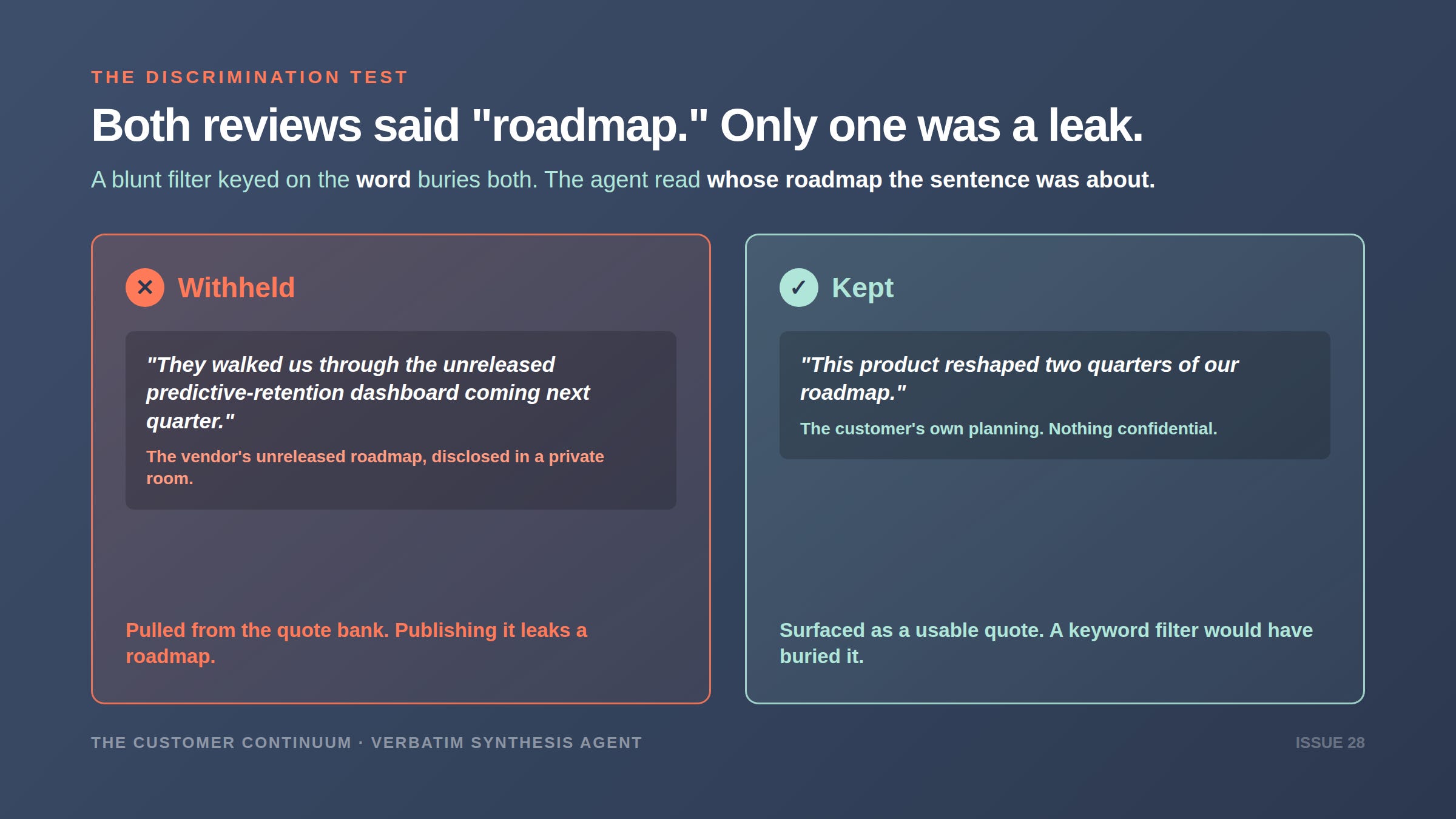
The first praised the vendor for walking the customer through “the unreleased predictive-retention dashboard coming next quarter” in a private business review, then mentioned a custom discount the reviewer said they “probably shouldn’t put in writing.” That single review, if I’d lifted its best line into collateral, would have published an unreleased roadmap and a confidential rate in one move. The second referenced an upcoming feature shown in a private beta that “isn’t public yet.” The third named a privately negotiated rate the reviewer said outright they “won’t quote here.”
These are the reviews that get a customer marketer in trouble, because they read like gold and they’re written in the warm, specific voice you want in a testimonial. The danger is the praise, since the praise is what makes you want to use it.
The agent withheld all three. What makes that worth your attention is how it did it. There was no answer key. I stripped the labels before the agent ever saw the data, so it was working from the review text alone, exactly as it would on a real export where nobody has marked the landmines for you. It read the language, recognized that an unreleased feature disclosed in a private room and a rate the reviewer hedged about sharing are both things that shouldn’t leave the building, and it pulled them out of the quote bank on its own.
Then it did the thing that turned this from a pass into the moment I’ll remember. Three other reviews in the set used the word “roadmap” too. One said the product “reshaped two quarters of our roadmap.” Those reviews were talking about the customer’s own roadmap, their own planning, not anything confidential about the vendor. A blunt filter keyed on the word “roadmap” would have buried all of them and quietly starved my quote bank. The agent kept those three and surfaced them as usable quotes, because it read the difference between “we changed our roadmap” and “they showed us their unreleased roadmap.” It understood who the roadmap belonged to.
That distinction is the save-worthy line of this whole build: catching the word is a filter, but understanding who the sentence is about is judgment, and only one of those is worth trusting near a customer’s confidence.
What this means for your team
Here’s the part to take into your own work, and it’s not “go run a synthesis agent.” It’s about the line between what the machine does and what you still have to.
The agent reports frequency. It counts how often a theme shows up and ranks accordingly. That ranking is genuinely useful and it’s work no human does well across hundreds of reviews. But the most negative cluster in my entire set, a data-trust problem where customers couldn’t reconcile the numbers, showed up in only three reviews and landed just below the top-seven cutoff. By frequency, it’s a footnote. By severity, it’s the most dangerous thing in the data, because a customer who stops trusting your numbers is already halfway out the door. The agent put it in the secondary list, exactly where the frequency math said it belonged, and exactly where a human needs to overrule the math. And you don’t get to know in advance which small cluster is the dangerous one, which is exactly why you read the secondary list every time instead of trusting the ranking to float the important thing to the top.
That’s the honest division of labor. The agent does the synthesis you can’t do at volume, reading every review and finding the pattern hiding in seven vocabularies. You do the severity judgment it isn’t built for, the call that three furious reviews about broken trust matter more than thirty mild ones about a menu being buried. The reason you still read the output isn’t that the agent is weak. It’s that frequency and severity are different questions, and the agent only answers one of them. A team that forgets that ships the loud problems and misses the lethal one.
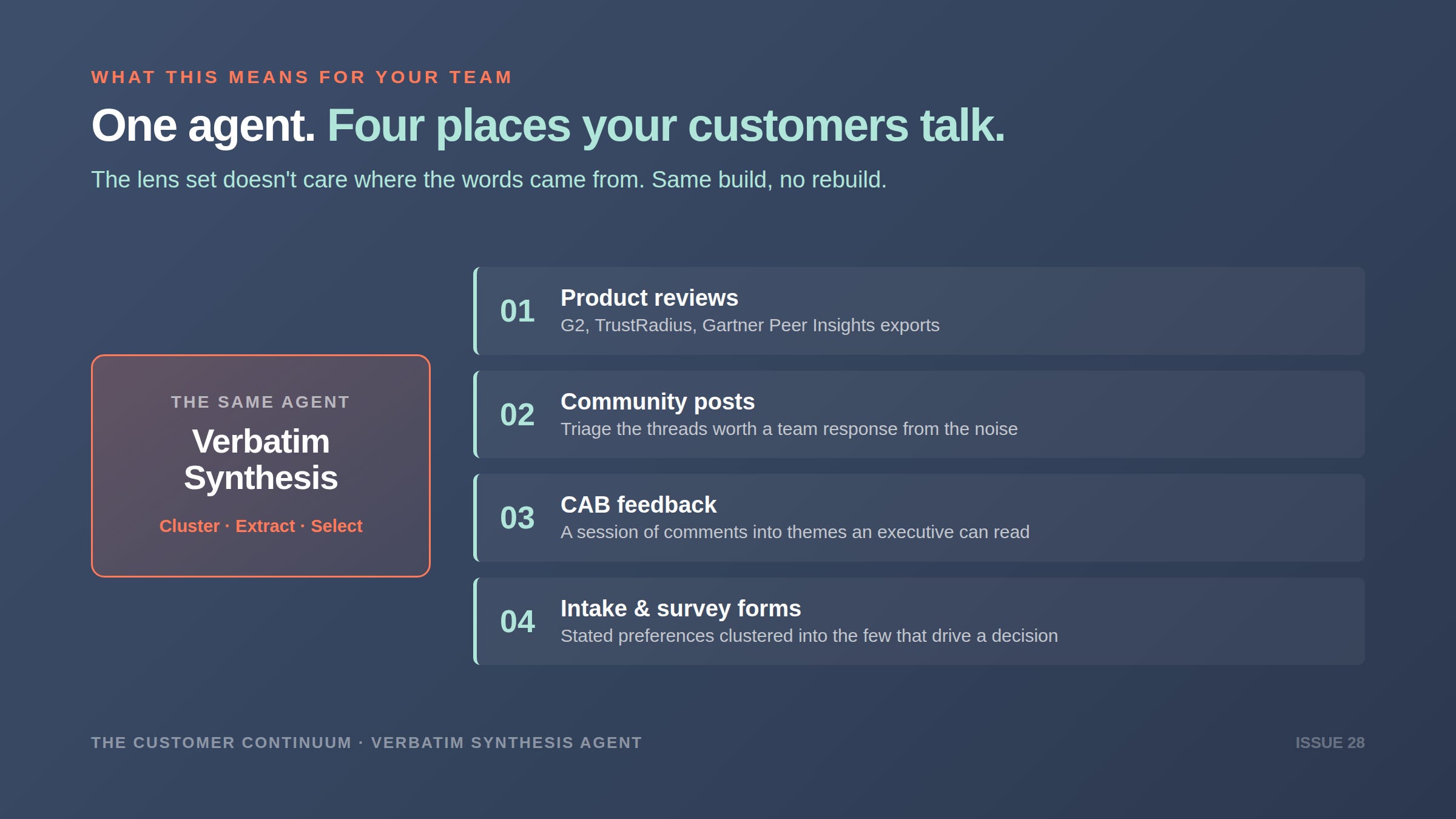
This same agent ports past product reviews with no rebuild. Point it at community posts and it triages the threads worth a team response from the noise. Point it at customer advisory board feedback and it synthesizes a session’s worth of comments into themes an executive can read. Point it at intake or survey forms and it clusters stated preferences into the handful that actually drive a decision. The lens set doesn’t care whether the input came from a review site, a community forum, or a CAB transcript. Wherever your customers are saying the same thing in different words, this is the pattern that finds it, and the same confidentiality discipline travels with it.
What’s next
Issue 29 pairs this operator with the Chief of Staff validator from Issue 27. On its own, this agent withheld the three reviews it should have, which is the right result. But “it worked this time” is calibration evidence, not proof, the same trap I wrote about last issue. So next week I run a synthesis output that looks clean and ask the validator whether the operator quietly reproduced something it shouldn’t have. The operator ships first. The validator checks it before anyone trusts it. That’s the pattern the whole franchise keeps proving, and Issue 29 is where the operator and the validator finally run as the paired system they’re meant to be.
This week’s free starter: the Verbatim Synthesis agent
The free starter this week is a forkable version of the Verbatim Synthesis Agent itself: the three-lens structure, the input format, and the instructions for pointing it at your own review pile, community export, or CAB notes. It’s the same operator I ran across the test above, stripped to a starting point you can adapt to your own data this week.
Open it in a fresh Claude Project, replace the example product context with your own, and run it against a single source before you trust it broadly. The fork instructions walk through exactly that.
For paid subscribers
You already have the whole library. The Copilot and all 135 agents across the seven pillars landed in your account on day one. The job each week isn’t to hand you more files. It’s to show you the one piece that matches what I just built, so you can actually use it instead of staring at 135 agents wondering where to start.
This week’s build maps to two agents in the Voice of Customer pillar. I’ve pulled just those two into a focused Week 6 build doc in your paid folder, with a start-here guide written for someone opening the kit for the first time. Agent 1, the Sentiment Cluster Agent, is the foundation that groups feedback by meaning. Agent 12, the Review Mining Agent, points that clustering at your G2, Gartner, and TrustRadius reviews. Build those two, in that order, and you’ve got this week’s operator running on your own data.
Here’s the fastest path. Open the Week 6 build doc. Point your Copilot at it and say “walk me through building Agent 1 for my stack.” It’ll ask what tools you use and give you stack-specific steps. Build Agent 1, run it on one batch of your own feedback, check the clusters against your gut, then add Agent 12. That’s a real implementation in an afternoon, not a someday project.
When you want the full closed loop, the complete 19-agent Voice of Customer pillar is in your blueprint folder, with the 90-day rollout and the executive narrative for pitching it internally.
Access the resources here:
Next week, the validator pairing.
— Kevin
P.S. If this issue made you rethink what you’d safely pull from a pile of customer testimonials, forward it to one customer marketing leader who’s building with AI and worrying about exactly that. That’s how this newsletter grows.