


Welcome back to The Customer Continuum. Issue #31.
When I joined Marketo, there was already something called a champion program. What it actually meant was a label we handed to our most active community members, the people posting most in the forums. It was a top-contributor badge rather than a real program.
I got voluntold to reimagine it into something more meaningful, a real structure that supported customers all the way from adoption to value realization: peer networking that connected customers to each other, thought leadership that put them on stages, access to our internal product and leadership teams, and above all a clear answer to the one question that actually matters to a customer, which is what’s in this for my career. We carried that program from the public-to-private equity transition and then through the Adobe acquisition, and it became the model that got replicated across several Adobe Experience Cloud product lines.
That was 2017. I left in 2022. The program still runs today.
That’s the closest thing I have to a legacy in this work, and it’s why I believe what I’m about to tell you: a customer champion program is the highest-return thing a customer marketer can build, and almost nobody builds it well, because the version most people picture is the badge I inherited rather than the program I replaced it with.
Why this is the program worth building first
A champion program, done right, is a structured way to turn your best customers into active advocates: people who speak for you, refer you, mentor other users, and tell you the truth about your product, in exchange for something real, which is recognition, access, and genuine help with their own careers. That last part is the whole game. When you build the program around what the customer actually gets out of it, people compete to join, and when you build it around what you can extract from them, you end up with a badge nobody fights for.
Here’s why it’s the highest-leverage bet on the board, and this is a point of view I’ve earned building these programs over the better part of a decade rather than a stat I’m quoting. A champion program costs almost nothing to run. There’s no media spend, no big tooling bill, mostly your time and some genuine recognition. And the return compounds in every direction at once: customer feedback that sharpens your product, references that close deals, education that lifts adoption, and a group of advocates who go sell you in rooms you’ll never be in. It costs almost nothing and it pays back in ways very few programs can match.
So why doesn’t every team have one? Because standing it up feels enormous when you’re alone. The first real task is figuring out who your champions even are, and that means pinging CSMs for health context, chasing account teams for expansion signals, cross-referencing who’s actually engaged against who just has a login, across your entire customer base. Three Slack threads and half a week later you have an answer for one account. Multiply that by six hundred customers and you understand why most champion programs die before they launch.
That first task, figuring out who your champions are, is fundamentally a scoring problem, and scoring is the kind of work you can hand to an agent.
Build with me: the champion scoring agent
An agent, for anyone new here, is just an AI you’ve given one job and one clear set of instructions, so it does that job the same way every time. This one reads your customers and tells you who’s worth pursuing as a champion.
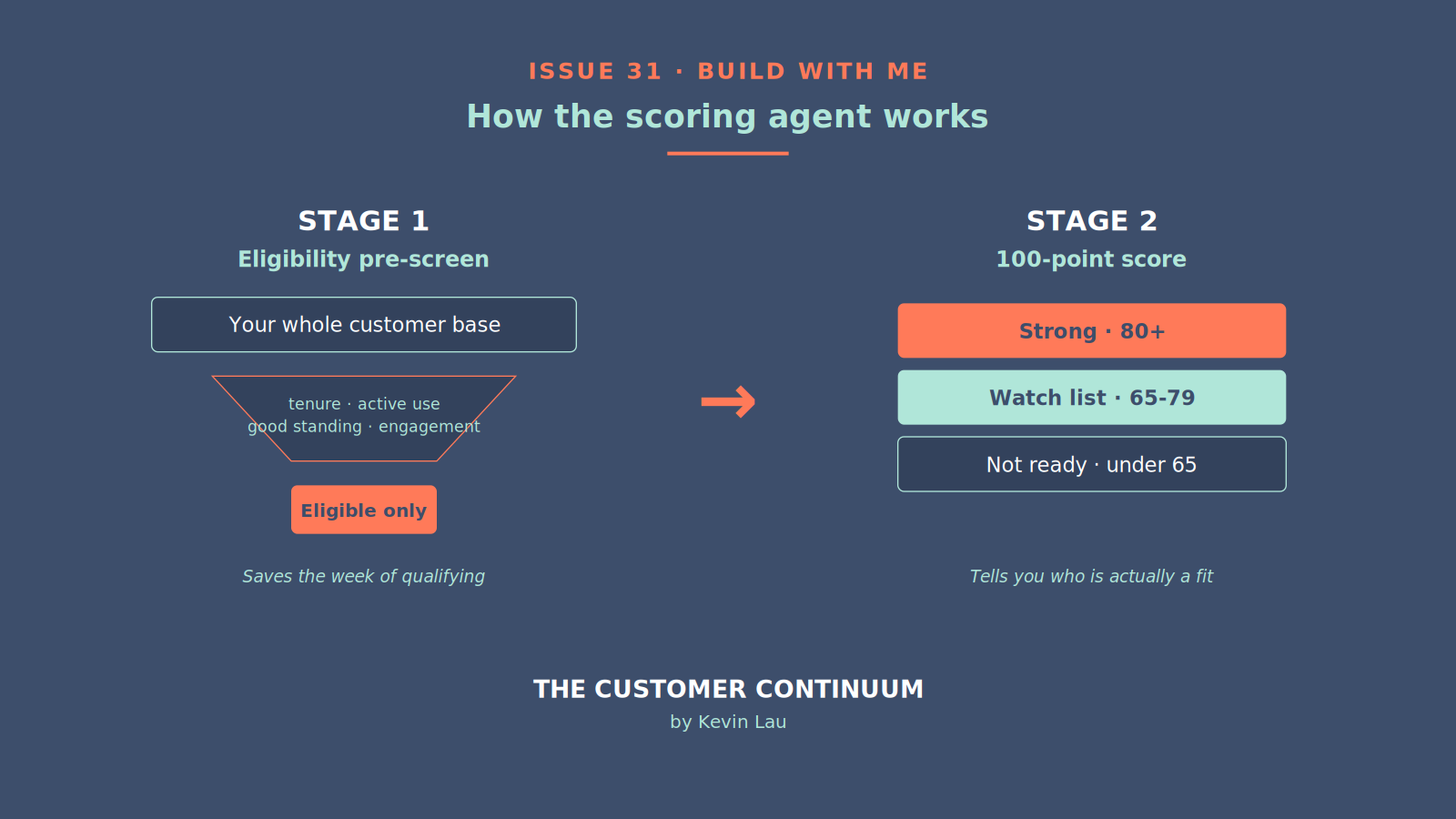
I didn’t invent the scoring criteria for it. I gave it the actual hundred-point rubric I’ve used to build these programs, the same one paid subscribers already have in the Champion Program Blueprint. It scores each customer across ten things: past advocacy, the strategic value of their brand, whether they were referred by an existing champion, how long they’ve used the product, how deep their expertise runs, their role, their multi-product footprint, and three cohort-balance factors. The agent runs in two stages, and the two-stage design is the point. First it screens out anyone who isn’t eligible yet, the dormant accounts, the ones with an open escalation, the ones too new to have a track record. Then it scores only the ones who survive that screen. The first stage is what saves you the week of qualifying; the second is what tells you who’s actually a fit.
The full agent is this week’s free starter, so you can fork it and run it on your own accounts.
Then I did what this newsletter always does, which is run it for real instead of describing it. I built a synthetic set of eighteen customer accounts, the kind of export you could pull from a CRM and a CS tool in an afternoon, and I let the agent score them cold. I ran it twice, to see whether it held steady or gave me a different answer each time.
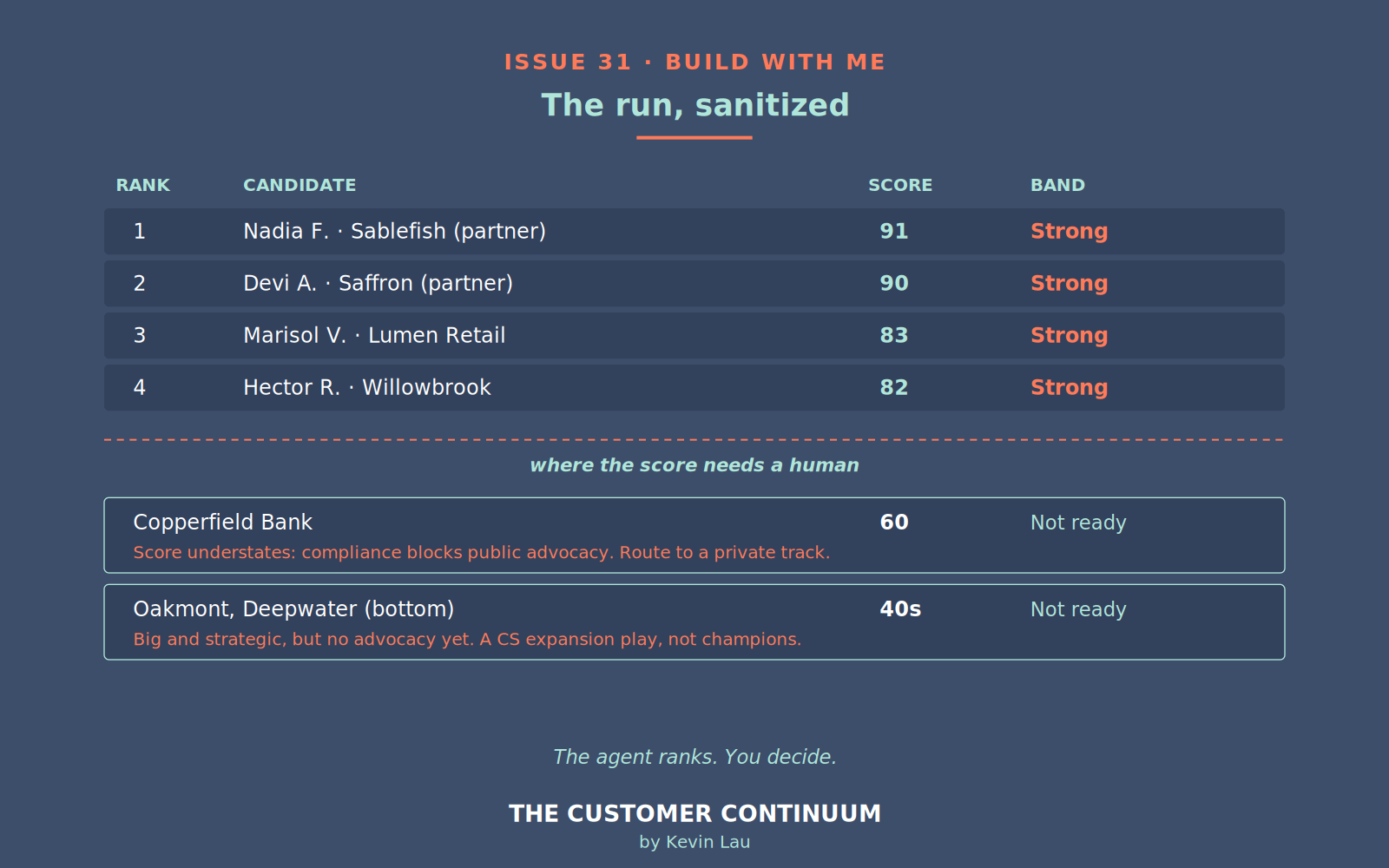
It held steady. Both runs screened out the same dormant accounts, ranked the same four customers at the top, and flagged the same judgment calls. For a team of one, that first stage alone is the afternoon of Slack archaeology collapsed into about a minute, and the consistency means it’s a read you could actually run a cycle on rather than a one-time guess.
The top of the list made immediate sense. The strongest candidates were the ones who’d been referred by an existing champion and already had a real advocacy track record, which is exactly what the rubric weights most heavily. That’s the agent doing the volume work correctly.
If the issue stopped there, it would be a tidy automation story. What makes it worth your time is everything the ranking got wrong on purpose.
The part you can’t hand off
Three things the agent surfaced are the reason you never recruit straight off the ranking.
The first is a bank. Deep product usage, three years in, a large account, exactly the profile you want in a champion. It scored near the bottom and the agent labeled it “not ready.” The reason is that banks in regulated industries can’t post in public communities, write reviews, or speak at your conference. Compliance bars it. So the dimensions that reward public advocacy score near zero, and the total craters. By the number, this excellent customer looks like a weak candidate.
A team of one moving fast trusts the ranking and skips it. That’s the expensive mistake, because the agent itself caught what the number was hiding. In its own notes it wrote that the score “is lying to you,” that the low advocacy points reflect a compliance wall rather than a lack of passion, and that this customer is a poor public advocate and potentially an excellent private one, right for a closed-door advisory or product-council track. It scored the account low and then argued against its own score.
The second is a pair of accounts sitting at the very bottom, both large, both strategically important, both with an executive pushing for adoption. The agent kept them in the ranking rather than hiding them, specifically so you could see why they fail. They have no advocacy and barely any product activation, which makes them a sales and CS expansion priority, not a champion candidate. The lesson it’s teaching is that a big account an executive loves is not the same thing as a customer ready to advocate, and a score that sorts on readiness will correctly rank them last even though they matter enormously.
The third is the one I didn’t see coming, and it’s the best argument for keeping a human in the loop. The agent’s two top-ranked candidates were both agency partners rather than direct customers. It gave them full marks and then flagged, on its own, that a champion cohort skewing partner-heavy can drift away from real end-user voice, and that both carried a potential client-conflict question I’d need to clear before recruiting either. That’s a composition decision the rubric can’t make, so the agent handed it back to me: here’s the ranking, but whether you want two partners in your top cohort this cycle is your call, not mine.
That’s the whole lesson of this issue. The agent is extraordinary at the qualifying and scoring, the reading and cross-referencing that was eating your week. It doesn’t decide. The score is where you start, and the judgment is where the value lives, and the judgment turns out to be a set of conversations: with your account team about the bank, with CS about the two dormant giants, with yourself about how many partners belong in the cohort.
The agent doesn't save you from those conversations but it does save you from the half-week of grunt work that used to keep you from having them. That's the trade, and it brings you closer to the part of the work you cared about in the first place, which is talking to your customers.
What this means for your week
You’re not going to automate your way to a champion program. You’re going to build one because it’s the highest-return thing you can do, and use an agent to clear the one obstacle that makes it feel too heavy to start.
Run the scoring agent on your accounts. Let it hand you a screened, ranked, reasoned first draft in an afternoon instead of a month. Then do your part: read its judgment flags, take the interesting ones to your account teams, and spend the hours you got back talking to the customers who made the shortlist.
That’s a champion program a team of one can actually launch, and it’s the program I’d build before any other.
This week’s free starter: the champion scoring agent
The full agent, ready to fork. It runs the two-stage screen: first it filters out the accounts that aren’t eligible yet, then it scores the rest on the hundred-point rubric, ranks them, and sorts them into strong candidate, watch list, or not ready. Most importantly, it writes you a human-judgment section that flags where its own ranking shouldn’t be trusted, including the accounts whose score understates them and the cohort-balance calls only you can make. Paste in an account export and it runs. Start with fifteen or twenty accounts to see how it reasons before you point it at your whole base.
You found your champions. Now what?
The scoring agent tells you who to pursue. It doesn’t run the program. Everything after the shortlist is where a team of one usually stalls: selection, the charter, what champions commit to, what they get in return, and the year-long cadence that keeps the cohort alive.
That’s why I pulled every champion piece into one place: the Champion Program Toolkit. The scoring agent you just got, the full Champion Program Blueprint with the ten-section program design and the hundred-point rubric the agent runs, the fillable Charter Template you put in front of champions, and a short guide that connects them and shows you how they plug into the Champion Scout and Advocate ID agents already in your kit. Score, select, formalize, run, all from files you own in one folder.
This is what a paid subscription gets you: the assembled system to run the highest-return program in customer marketing as a team of one.
Here’s your Champion Program Toolkit, everything in one folder.
Start with the guide labeled “Start Here.” It walks you from the scoring agent to the Blueprint to the Charter in sequence, and shows you how the whole thing connects to the Champion Scout and Advocate ID agents already in your kit.
Next week, we build the outreach engine that turns this shortlist into actual nominations. The scoring agent found your champions. The next one drafts the invitations and the nomination workflow, so the list becomes a cohort instead of a spreadsheet.
— Kevin
P.S. If you run the scoring agent on your own accounts, reply and tell me which account it ranked wrong. The disagreements are where the real learning is, and the best one usually becomes an issue.