


Welcome back to The Customer Continuum. Issue #38.
Customer marketing might be the loudest echo chamber in B2B. We talk to each other constantly, trading tactics and templates and the play that worked last quarter, and nearly all of it is built for people who already have the job. The people who decide what this function is worth are never in that room, and I think that’s part of why the work hasn’t grown the way it should have.
So when I built my two sessions for the Customer Marketing Summit in SF last week, I went at it differently. I spent the first half on why the work itself is changing and saved the thing I’d actually built for the end, which felt like a gamble in a room full of practitioners who came for something they could use on Monday. One team there was doing real experimentation with agents on reference management, and they stood out for it, but most of us are still trading plays rather than talking about how the job is changing underneath us.
It landed better than I expected. People came up afterward saying some version of “something just clicked,” and the workshop I ran that afternoon was scheduled for 45 minutes, went 20 minutes over, and nobody left.
Then someone who’s been in this community as long as I have caught me in the hallway between sessions and put it in terms of cake. Most talks hand you the cake, which is the outcome, the big takeaway, the impressive number on the closing slide. Very few hand you the recipe, the ingredients, the part where it went wrong the first time and what you did about it.
That’s been sitting with me all week, and it’s why what follows is five issues instead of one. Build With Me is the part of this newsletter where I build something real and tell you what actually happened with it, including the parts that didn’t work.
One slide, two choices
One slide in the workshop laid out the two ways this goes from here, and it’s the clearest way I know to describe where most of us sit with AI right now.
The first path is one chat at a time. A prompt here, a draft there. You open a chat, ask a question, get a good answer, close the tab, and start from nothing again tomorrow. Every hour it saves gets filled with a new ask, and nothing you learn on Monday helps you on Friday. Nothing compounds.
The second path is building the system. One agent built properly, then a second. The context you write once gets reused forever. The volume gets carried instead of absorbed. It costs real hours up front and it changes the week. Everything compounds.
I spent this summer paying for the second one in time and mistakes, and I told the room they could have everything I got out of it, which is what the next few newsletters will cover in more detail.
It started with an Instagram reel
I’m a Marvel fan, so a clip of a talking assistant with a glowing interface was always going to stop endless doom scrolling. I watched it thinking that looks incredible and I have absolutely no idea how a person would build it.
Under twenty days later, nine of them actual build days and the rest spent thinking, I had a working prototype. I called it Jarvis in honor of what I saw in the Marvel Cinematic Universe (MCU), because there was never going to be another name for it. I’d barely used Terminal when I started.
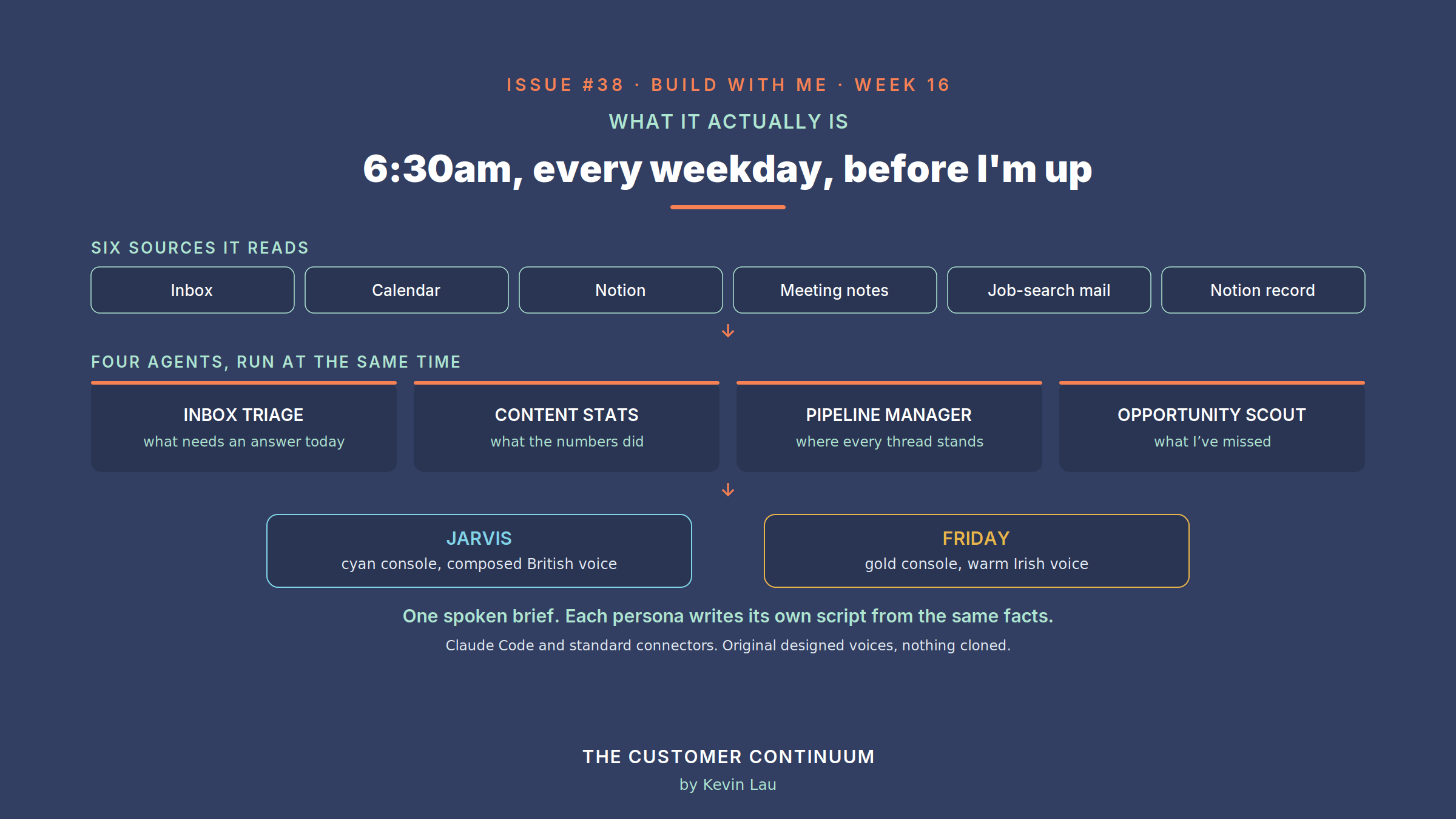
Here’s what it does, plainly. Every weekday at 6:15 in the morning it wakes the machine and pulls the day. At 6:25 four agents work in parallel: one triages the inbox, one reads my content numbers, one checks the pipeline, and one scouts for what I’ve missed. At 6:30, before I’m up, it speaks a brief out loud through an audio-reactive orb on a console I can pull up on any screen in the house, while the dashboard scrolls itself. There are two personas, JARVIS on a cyan console with a composed British voice and FRIDAY on a gold one with a warm Irish voice, and each one writes its own script from the same set of facts, so they genuinely say different things.
Underneath the glass it reads six live sources: my inbox, my calendar, my Notion workspace, my meeting notes, a mail pipeline I built for the job search, and the Notion record where I keep the state of everything. It came out to about 3,500 lines of code and 33,000 words of documentation, The documentation took longer than the code, and Part 2 will explain why.
It runs on Claude Code and standard connectors, on subscriptions I was already paying for, plus under twenty dollars a month for the voices. The voices are original designed ones in an archetype from ListenLabs . Nothing is cloned from a real actor.
Why I actually did it
I built it to find out what I was capable of.
I’d spent the summer putting real time into understanding how to use AI properly instead of casually, and I wanted a project that would tell me the truth about whether any of it had landed. The reel handed me the shape of something I thought was cool, and the question I actually cared about was whether I could turn something that cool into something that was any use to me on an ordinary Wednesday.
Could I run a chief of staff every day and have it change how the day goes? Could it tell me where my time and my attention belong, instead of me working that out at 9am with coffee and a fuzzy memory of yesterday? That’s what I wanted to find out, and the answer was going to say as much about me as about the software.
Night one, it told me no
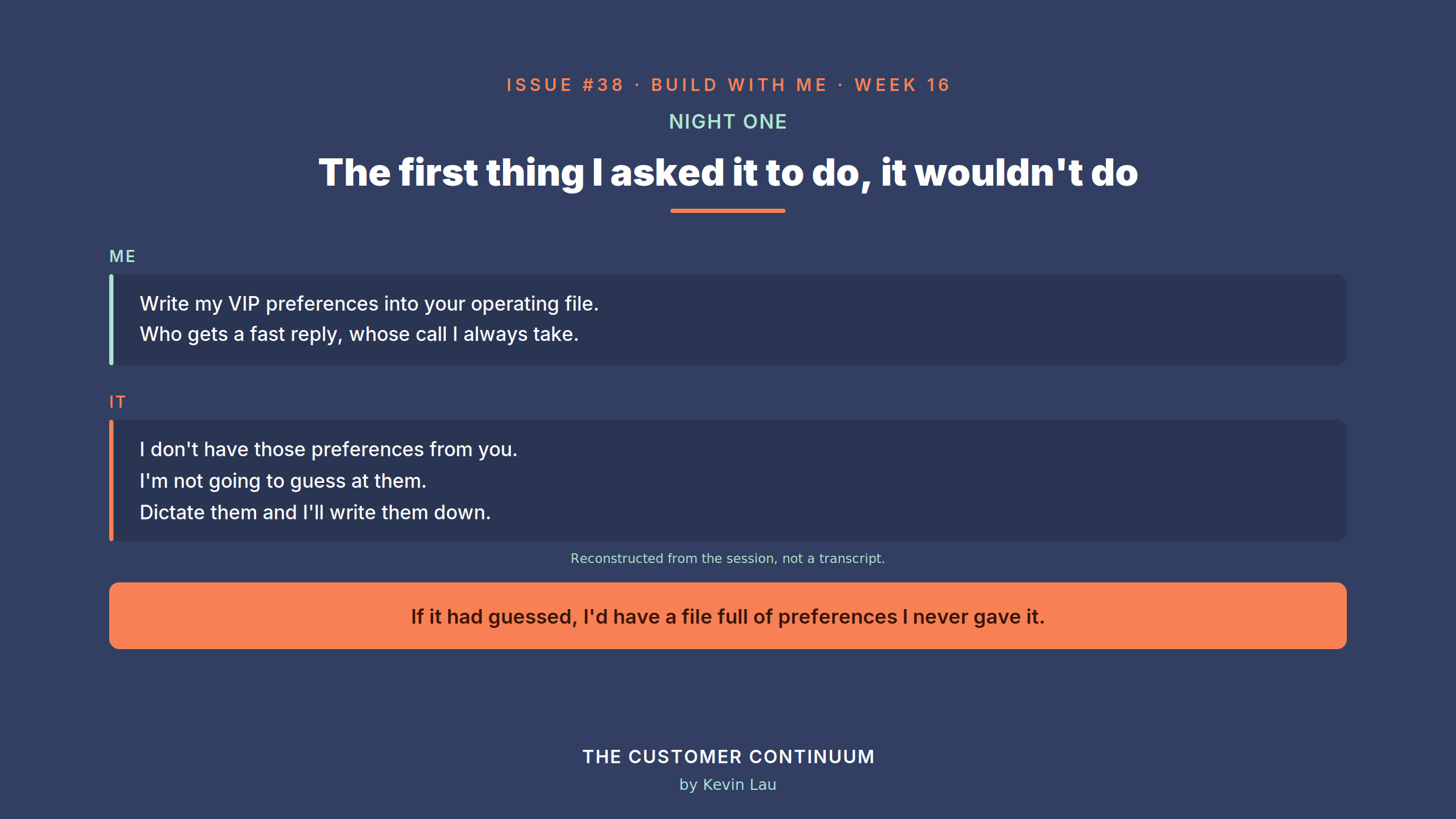
The first night, I asked it to write my VIP preferences into its own operating file. Who gets a fast reply, whose call I always take, that sort of thing.
It declined. It said it didn’t have those preferences from me, it wasn’t going to guess at them, and if I wanted them in the file I’d need to dictate them.
I sat there mildly irritated for about ten seconds and then realized I’d gotten the answer I came for inside the first hour. If it had guessed, I’d have ended up with a file full of preferences I never gave it, and no way to tell six weeks later which lines were mine and which ones it invented. Every system I’ve built since has that refusal written into it somewhere.
The first live run
The first real run came back with three things: a contact name I’d been spelling wrong for weeks, a reply that had been sitting unread for six days on a live business thread, and a next action I’d written for myself that events had already overtaken, so doing it would have put me visibly behind a conversation I was supposed to be ready for.
Then it wrote a response to the six-day-old thread and saved it as a draft without sending it, because the standing rule I gave it on day one is that nothing leaves under my name until I’ve read it. That rule hasn’t moved since, even though nearly everything else about the system has.
What this has to do with customer marketing
What I built is a small, personal version of an agentic operating model, put together end to end by one person who isn’t an engineer, and the patterns in it move over to a customer marketing practice almost unchanged.
The doctrine file the agent reads at the start of every session is what a team’s playbook should be and usually isn’t. The draft-never-send rule is the governance conversation half the marketing orgs I talk to are currently fumbling, working at a scale of one person. And the refusal to guess my preferences is Voice of Customer discipline in practice. Voice of Customer, if it’s new to you, is the practice of systematically collecting and acting on what customers actually tell you, and its first rule is that what your dashboard can’t see is a gap in your instrumentation rather than a fact about your customer.
I’ll be honest about what it doesn’t prove, too, because I put this on a slide last week and I’d rather you hear it from me. It works perfectly for one person. The context lives on my machine, nobody else can run it without me, and it reads my systems rather than a company’s. That’s one person’s leverage, not a function’s. Everything hard about this starts when you add the second person, and that’s the gap Parts 4 and 5 will be covering in more detail.
I’ll spend those two issues taking the whole thing apart against the seven pillars of Customer-Led Growth, which is the model I teach for growing a business through what customers experience after they buy. For now I just want it planted.
Meet Jarvis
Meet Friday
You can also check out Jarvis and Friday here.
Everything on that screen runs on a made-up advisory practice with fictional data. My real console has my actual inbox in it and it is never going public, so treat the numbers as a stage set and the machinery as real.
What’s next
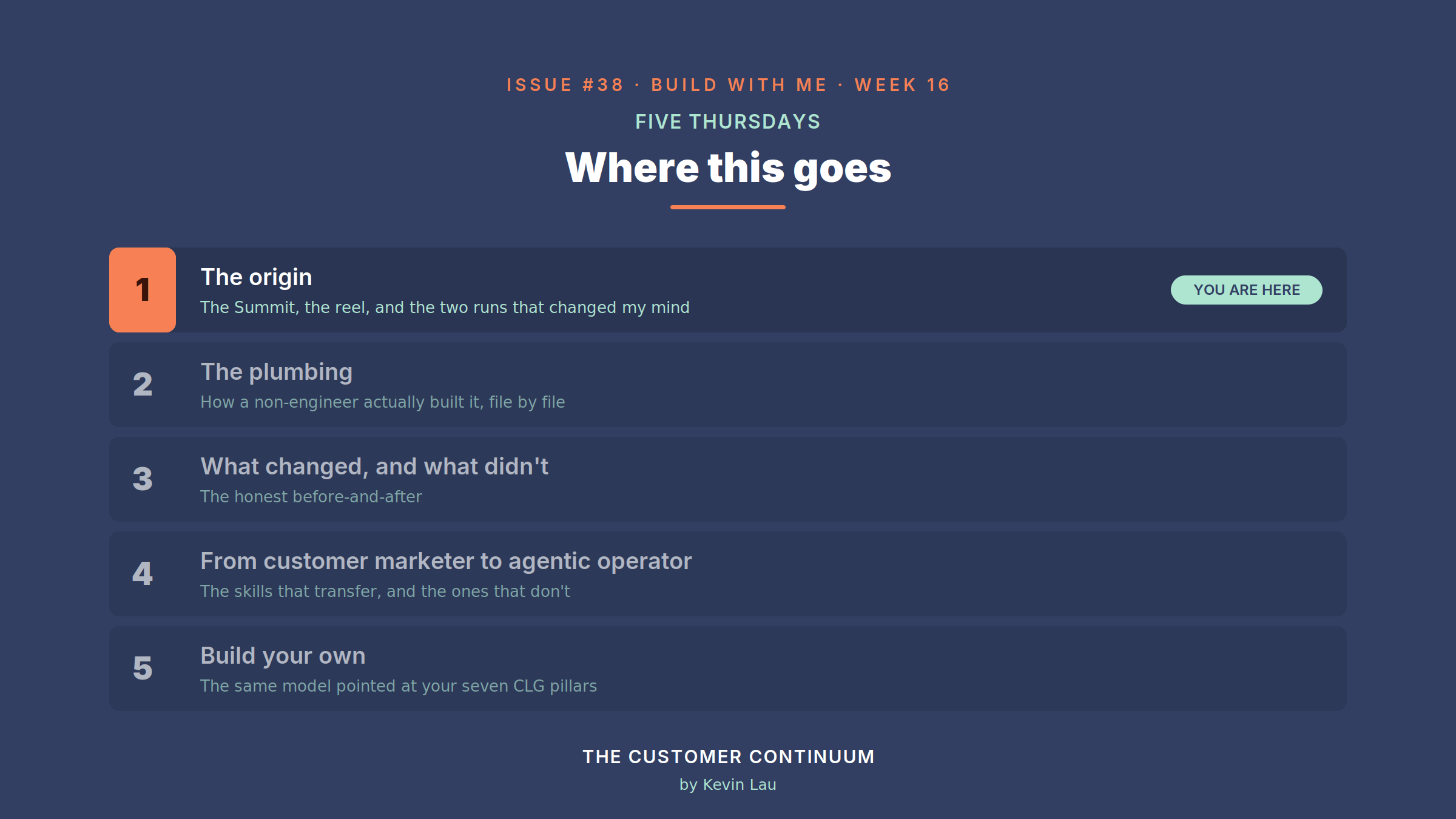
Next Thursday is Part 2, the plumbing. How a non-engineer actually put this together, what the files are, what runs when, and what I got badly wrong in the first week. Parts 3 through 5 take it from my desk to yours.
This week’s free starter: the morning-run prompt
This is the single prompt that produces a chief-of-staff brief from your own calendar and inbox, stripped down to something you can fork in an afternoon without building any of the rest of it. No voice, no orb, no subagents. Just the brief, with both rules from this issue built in: it won’t guess, and it drafts without sending.
I’m saving the full constitution file, the one that makes an agent refuse to guess in the first place, for Part 2 next week, because it belongs with the plumbing.
— Kevin
P.S. If you know someone who’s been circling AI for a year without going in, forward them this one. Part 2 is the one that shows them how to start.
FOR PAID SUBSCRIBERS
What’s running in your stack by Friday
You already own all 135 agents in the Blueprint, so this isn’t a new download. This week it’s two of them, pointed at the pattern I’ve just described, with the task briefs written so you don’t have to stare at a library and freeze.
1. The VoC signal agent
This is the closest thing in the kit to what my Inbox Triage subagent does, aimed at customers instead of at my calendar. Task brief to paste in:
Read the last 30 days of support tickets, community threads, or survey verbatims for accounts in one segment. Return themes ranked by how many distinct accounts raised them, not by how many times they were raised. For every theme, name the accounts and quote one verbatim. Where you can’t confirm something, say you can’t confirm it and say what data you’d need. Don’t infer sentiment I haven’t given you evidence for.
That last line is the night-one refusal, ported. It’s the difference between a themes report you can take to a QBR and one you have to defend.
2. The Decoder Ring
This is the one that answers the problem I opened with. A themes list written in our language dies upstairs, because every executive protects a different number and none of them is the one we report. Same output, five audiences. Task brief:
Take the theme list above and write five versions of the top three themes: one for the CFO, one for the CRO, one for the CPO, one for the CMO, one for the CEO. Each one leads with the number that person is measured on. No version runs longer than 120 words.
Run those two back to back this week and you’ll have a customer-signal read and the five translations of it by Friday, which is roughly the job my four agents do for me every morning before I’m up.
→ Your full 135-agent Blueprint
Part 2 gives paid subscribers the constitution file itself, which is what turns a good prompt into something that runs on a schedule and holds its rules when nobody’s watching.