


Welcome back to The Customer Continuum. Issue #45.
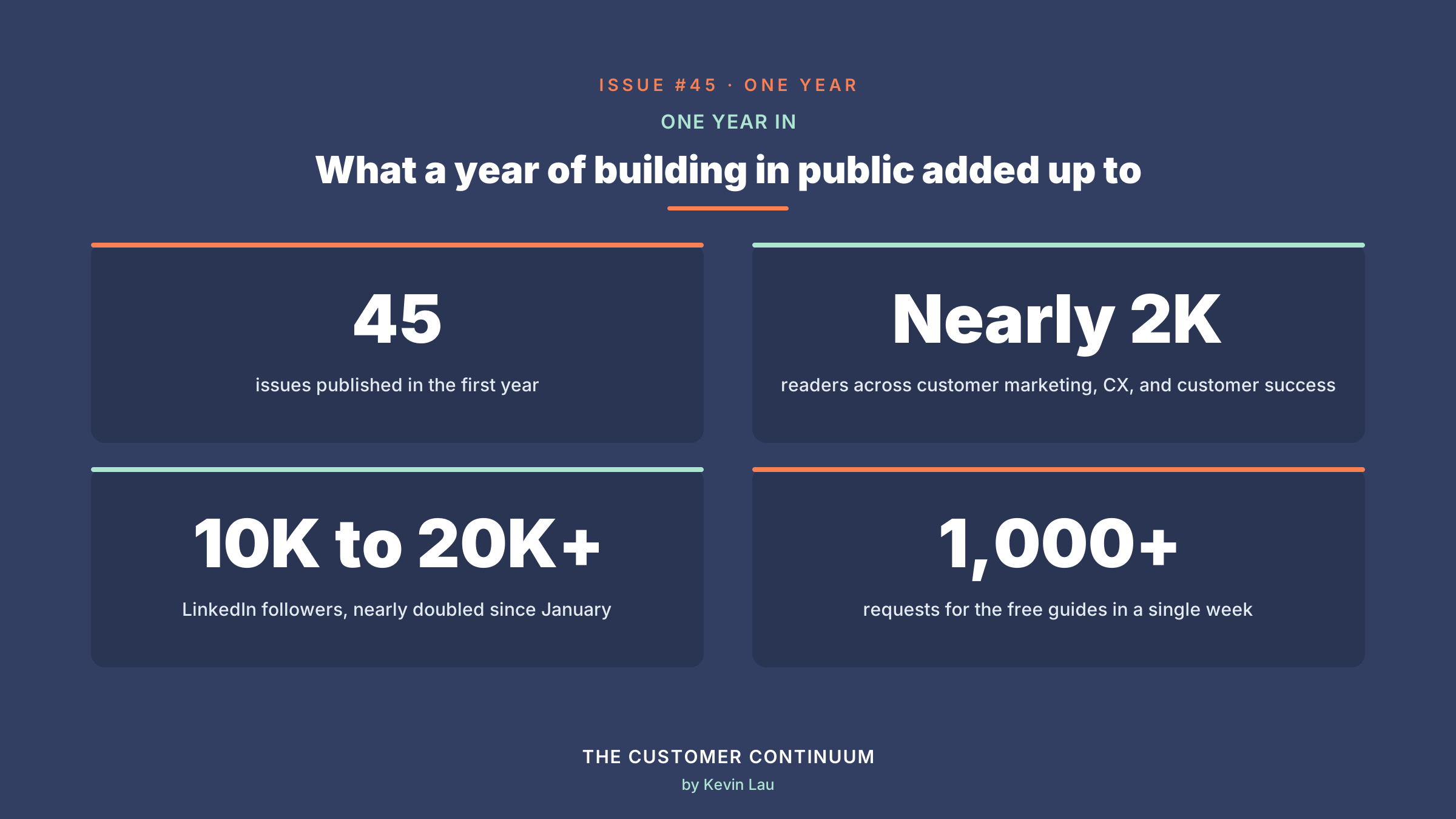
One year ago this week, I sent the first issue of this newsletter. If you’re one of the nearly 2,000 people reading it now, thank you. This week I want to tell you why this newsletter exists, who it’s for, and where it’s going.
I thought about it for years
I’d wanted to write something like this for a long time, and I always had a reason not to. Work was busy. I had too much to say and no idea where to start. There was always another quarter to get through first.
What finally pushed me was something I’d watched happen over and over as I went from individual contributor to VP. The work we do is often invisible. Customer marketing, customer success, and CX teams do a huge amount of the work that keeps customers around, and most of those teams never get the recognition. It’s often quiet work. They don’t get the chance to share what they’ve built, to measure it against their peers, or to earn a real seat at the table where decisions get made.
I felt that nearly every time leadership changed. A new leader would arrive, and we’d have to sell what we did all over again, to them and to everyone under them. One VP never quite got it. To that VP, our work was a nice-to-have, something that couldn’t be measured, and customer marketing was treated like a stepchild. I spent a lot of energy proving we belonged in the same rooms as our peers in demand generation, and that marketing deserved a seat at the table on the post-sale side, working alongside customer success on adoption and retention. Too often it came down to battles over who owned what, while everyone lost sight of the customer.
What changed how I fought those battles came from two places. At a startup, I got leaders to see that your best customers can be your best salespeople. At Adobe, I saw how much a grassroots community and ecosystem could build, and how much we were spending to win new customers when the ones we already had could help us close more business, and buy more themselves, if we showed them why and how. That’s when I realized revenue and a great customer experience don’t have to be at odds.
I’d learned how to get that seat the hard way, through broad agreements with other teams, through building trust one relationship at a time, and through a lot of trial and error. I wanted to give that away to people who were still figuring it out.
Who it’s really for
Early on I wrote down the person I was writing for. She’s a director at a growing software company, leading customer marketing or CX, with a team of one or two people and a shared analyst, under constant pressure to prove her team matters. She doesn’t have a big budget, an agency, or a playbook. She’s trying to figure it out on her own.
Plenty of other functions have more resources than they know what to do with: books, conferences, communities, certifications. Ours has had very little, especially for the person doing the work without much support. That’s who I write for, every week.
Building in public
I also wanted this newsletter to be honest about how the work actually goes, so over the past several months it’s become a record of me building with AI in public. I’ve built voice of customer agents, an app that maps all seven pillars of customer-led growth, a library of 135 agents, and an AI chief of staff, and I’ve told you what happened each time, including the night it refused my first instruction and the week it made something up while I was on vacation.
Doing it in public changed how it landed. When I walked through those builds at the Customer Marketing Summit, my workshop ran 20 minutes over and nobody left, and people kept reaching out afterward to keep the conversation going. Over the same stretch, my LinkedIn following nearly doubled, from about 10,000 in January to more than 20,000 this week, and the free guides we’ve been publishing for customer marketing and customer success teams drew more than 1,000 requests in a single week in late October. That’s the part I’d do again without thinking twice: showing the work, mistakes included, so you don’t have to start from nothing.
And it’s given me a place to do what I love most, which is teaching.
Where it goes next
I’ve been in customer marketing and experience since before it had much of a name. I’ve watched it grow into customer advocacy, then customer-led growth, and now I’m watching AI change it again, from a separate tool into something built into the work itself.
The biggest shift I see coming is in how post-sale work gets organized. Customer success, customer marketing, and customer experience have mostly grown up as separate teams, and the experience customers have after they buy is going to be shaped more and more by the outcomes those teams deliver together.
So in year two, this newsletter is for all of you: customer marketing, CX, and customer success, anyone responsible for what customers experience after the sale. You’ll keep getting real builds, honest results, and stories from the work, with more of them aimed at helping you prove what that work is worth.
An anniversary thank-you
This week someone messaged me to say he’d just realized he’d been following my work for a decade. Another reader told me on a call how much the newsletter has helped their career. I’ve had hundreds of messages like those this year, and they’re a big part of why I keep writing it.
First, a gift for everyone. The Complete Claude Customer Marketing Department is the guide that drew all those requests last month: 69 ready-to-use resources, including six Claude agents, 24 skills, 30 prompts, six workflows, and three playbooks, covering every stage from onboarding to renewal. It’s free.
→ Get the Claude Customer Marketing Department
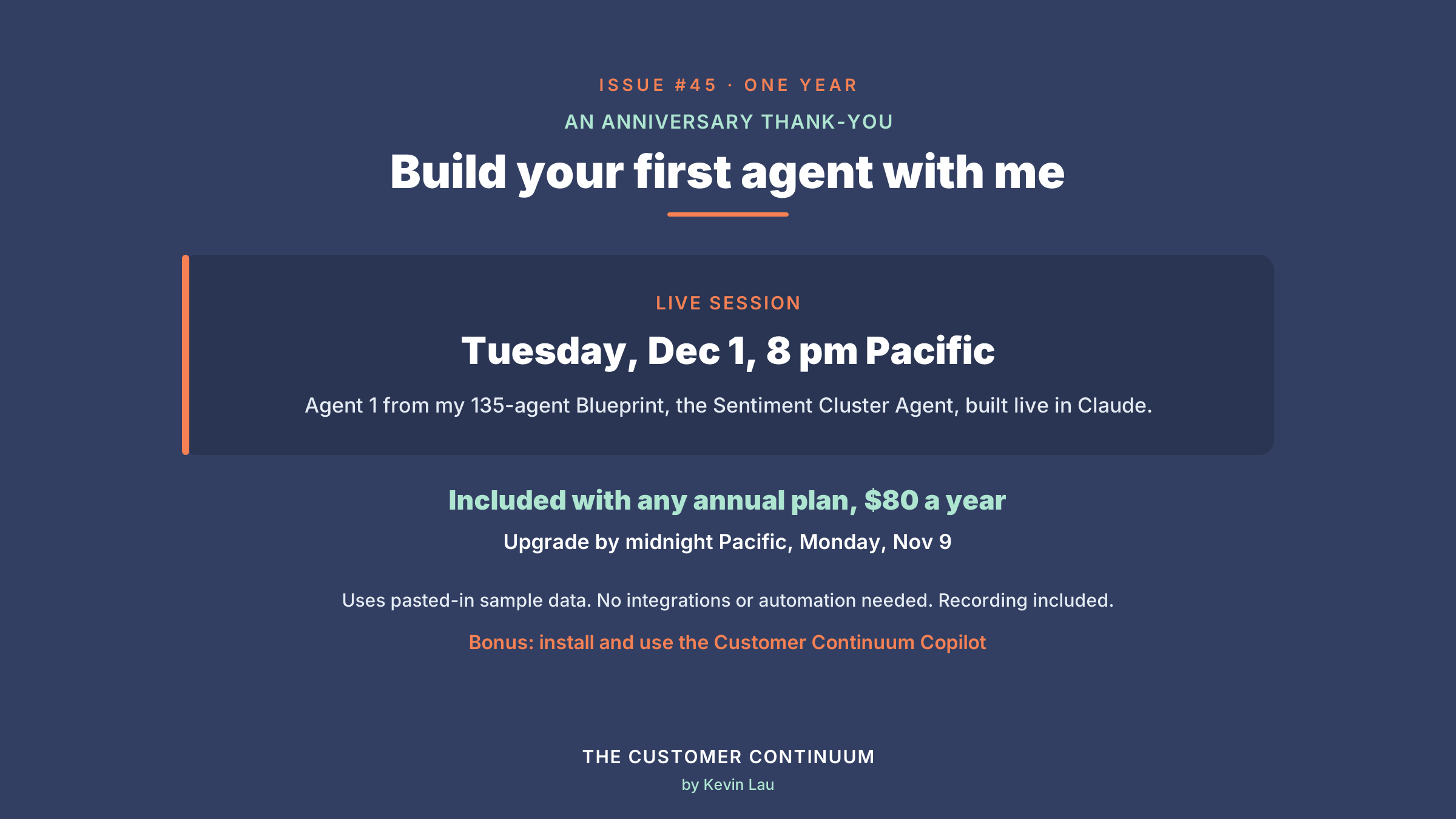
And for the anniversary, anyone who upgrades to an annual subscription by midnight Pacific on Monday, Nov 9, gets a seat in a live session with me on Tuesday, Dec 1, at 8 pm Pacific. We’ll build Agent 1 from the Voice of Customer pillar of my 135-agent Blueprint, the Sentiment Cluster Agent, which groups customer feedback like survey comments, support tickets, and reviews into ranked themes.
We’ll build it live in Claude using sample data you paste in, so there’s nothing to connect and no automation to set up. You’ll leave with the agent’s instructions, the sample data, and a short guide to running it on your own feedback, plus the Blueprint’s notes on connecting it to your survey and ticketing tools when you’re ready.
As a bonus, I’ll show you how to install the Customer Continuum Copilot that comes with your paid subscription and use it, so you leave with the whole toolkit set up.
Can’t make it live? You’ll get the recording. The annual plan is $80 a year.
If you want more hands-on help, the founding membership at $240 a year includes two one-on-one coaching sessions with me each year, plus early access to every new toolkit I build.
If you’re already a paid subscriber, thank you for being here from the start. The session is open to you too.
— Kevin
P.S. If this newsletter has helped you at all this year, the best gift you could give it is a forward to one person on your team.