


Welcome back to The Customer Continuum.
Issue #5.
Today, we’re tackling Customer Advisory Boards.
But not the way you’re expecting.
THE CAB PARADOX
Here’s the uncomfortable truth about Customer Advisory Boards:
They’ve been around for 40+ years.
Almost every B2B company runs one.
And most executives have sat in at least one as a customer at some point in their career.
So naturally, every executive thinks they know how to run one.
“Just invite our top 20 customers. Get their feedback on the roadmap. Build some relationships. How hard can it be?”
Sound familiar?
It’s the same logic as: “Just create some content and post it on social. Marketing isn’t rocket science.”
People think marketing is easy because it doesn’t require a PhD. Because it’s not engineering. Because everyone consumes marketing, so everyone thinks they can create it.
CABs suffer from the same problem.
Everyone has an opinion. Few have actual expertise.
And that’s exactly why most CABs fail to deliver the right expectations.
THE DANGEROUS OBSESSION
Here’s what happens at most companies:
An executive discovers Customer Advisory Boards exist.
Or worse - they sat in a great one as a customer somewhere else.
They come back and declare: “We need a CAB!”
Suddenly, CABs become the answer to everything:
“How do we retain our top accounts?” → CAB
“How do we get product feedback?” → CAB
“How do we prove we listen to customers?” → CAB
“How do we build customer relationships?” → CAB
The company pours resources into building the “perfect” CAB.
They invite 15-20 strategic customers. They create a fancy agenda. They rent a room. They present the roadmap.
And those 15-20 customers become the voice of the entire customer base.
Meanwhile, what’s happening to your other 9,980 customers?
They’re being ignored.
Your proof system is broken. Your community doesn’t exist. Your adoption programs are nonexistent. Your education resources are outdated.
But hey, you have a CAB.
You’ve confused one program for an entire strategy to solve your biggest retention and churn challenges.
And here’s the worst part: those 15-20 customers in your CAB? They may not be entirely representative of your broader base.
They’re your biggest contracts. Your most mature accounts. Your longest tenured customers.
They have dedicated CSMs. Custom implementations. Executive access on speed dial.
They are not telling you what your mid-market or even SMB customers need. They’re not telling you what your newest customers are struggling with. They’re not telling you why your practitioners can’t get adoption.
You’re optimizing for 15 voices while 10,000 others churn in silence.
WHAT CABS ACTUALLY ARE (THE MARKETO-ADOBE STORY)
Let me tell you about a CAB that actually worked.
And why it worked.
We had our Marketo Customer Advisory Board planned for months.
Agenda set. Invitations sent. Venue booked.
Then Adobe acquired us.
The news hit one week before our scheduled CAB meeting.
We had to pivot. Fast.
The entire goal shifted.
Before the acquisition: Our agenda was about product roadmap feedback. Feature prioritization. Standard CAB stuff.
After the acquisition announcement: Our goal became: re-earn trust.
Our strategic customers were nervous. Really nervous.
They were asking questions we couldn’t fully answer yet:
“Will Adobe still invest in Marketo?”
“Are you going to kill the product and force us onto Adobe’s platform?”
“Should we start evaluating alternatives?”
We needed to show them:
We had a plan
We knew what we were doing
They had a friend seated at the table as this transition played out
The CAB became our extended leadership team.
Not just a feedback forum. An advisory council helping us navigate one of the most volatile transitions a software company can face.
We gave them:
Direct access to Adobe executives (not just Marketo leadership)
Early visibility into the integration roadmap
Transparent conversations about what was changing and what wasn’t
Real influence on how we prioritized post-acquisition
It worked.
We retained those strategic accounts during the transition.
That CAB became the foundation for how we evolved advisory programs across both Marketo and Adobe.
We started with one solution-focused CAB. Then industry-specific CABs. Then broader strategic councils.
Today, Adobe runs dozens of advisory boards across the portfolio.
But here’s what people miss about this story:
This was a strategic, executive-level CAB.
15-20 of our most influential customers. High-touch. White-glove service. Long-term commitment.
That’s ONE flavor of CAB.
There are others:
Self-service CABs (product-specific, practitioner-level feedback)
Panels and roundtables (one-off, topic-focused discussions)
Strategic councils (executive relationships, navigating transitions)
Each serves a different audience. Each solves a different problem.
Our strategic CAB gave us depth with executives.
But here’s what it didn’t do:
It didn’t tell us what SMB customers needed during the transition.
It didn’t tell us what practitioners were struggling with day-to-day.
It didn’t tell us how to drive adoption at scale across thousands of accounts.
It didn’t inform our content strategy, our community programs, or our education roadmap.
It gave us depth with a few. Not breadth across many.
And that’s exactly what it was designed to do.
CABs are a microcosm of your broader community. Not a mirror.
The risk is over-rotating on those 15-20 voices and forgetting your other 9,980 customers.
The real value of a CAB isn’t what they tell you in isolation.
It’s how you translate their insights across your entire ecosystem of programs:
→ What they say informs your proof system → What they need shapes your education strategy → What they fear guides your lifecycle programs → What they want drives your community initiatives
A CAB is one input. Not the only input.
The CAB solved a specific problem: retaining strategic executive relationships during uncertainty.
It was one tactic in a much bigger customer retention and growth strategy.
Not the entire strategy itself.
THE REAL VALUE (WHAT THEY DON’T TELL YOU)
Here’s what I learned from that post-acquisition CAB:
The best insights didn’t come from the main session.
They didn’t come from the executive Q&A.
They didn’t come from the roadmap presentation.
They came from the peer breakout sessions.
When we broke customers into small groups and gave them space to talk to each other - without us in the room - that’s when the truth came out.
They weren’t sugarcoating their fears.
They weren’t giving us polite feedback.
They were brutally honest with each other:
“Are you staying or looking at alternatives?”
“How are you explaining this acquisition to your executive team?”
“What’s your backup plan if this goes sideways?”
That’s the signal we needed.
Not the polished feedback they gave us to our face.
The raw, unfiltered conversations they had with each other when we weren’t listening.
We had someone facilitating those breakouts. Taking notes. Reporting back themes without attributing specific comments to specific customers.
And THAT intelligence - what customers were really thinking, really fearing, really planning - that’s what informed our entire post-acquisition customer strategy.
Your CAB’s value isn’t in what customers tell you.
It’s in what they tell each other.
If you’re designing your CAB agenda around what YOU want to present, you’re already doing it wrong.
THE MINDSET SHIFT
Stop asking: “How do I build the perfect CAB?”
Start asking: “What role does a CAB play in my broader customer strategy? And which type of CAB do I actually need?”
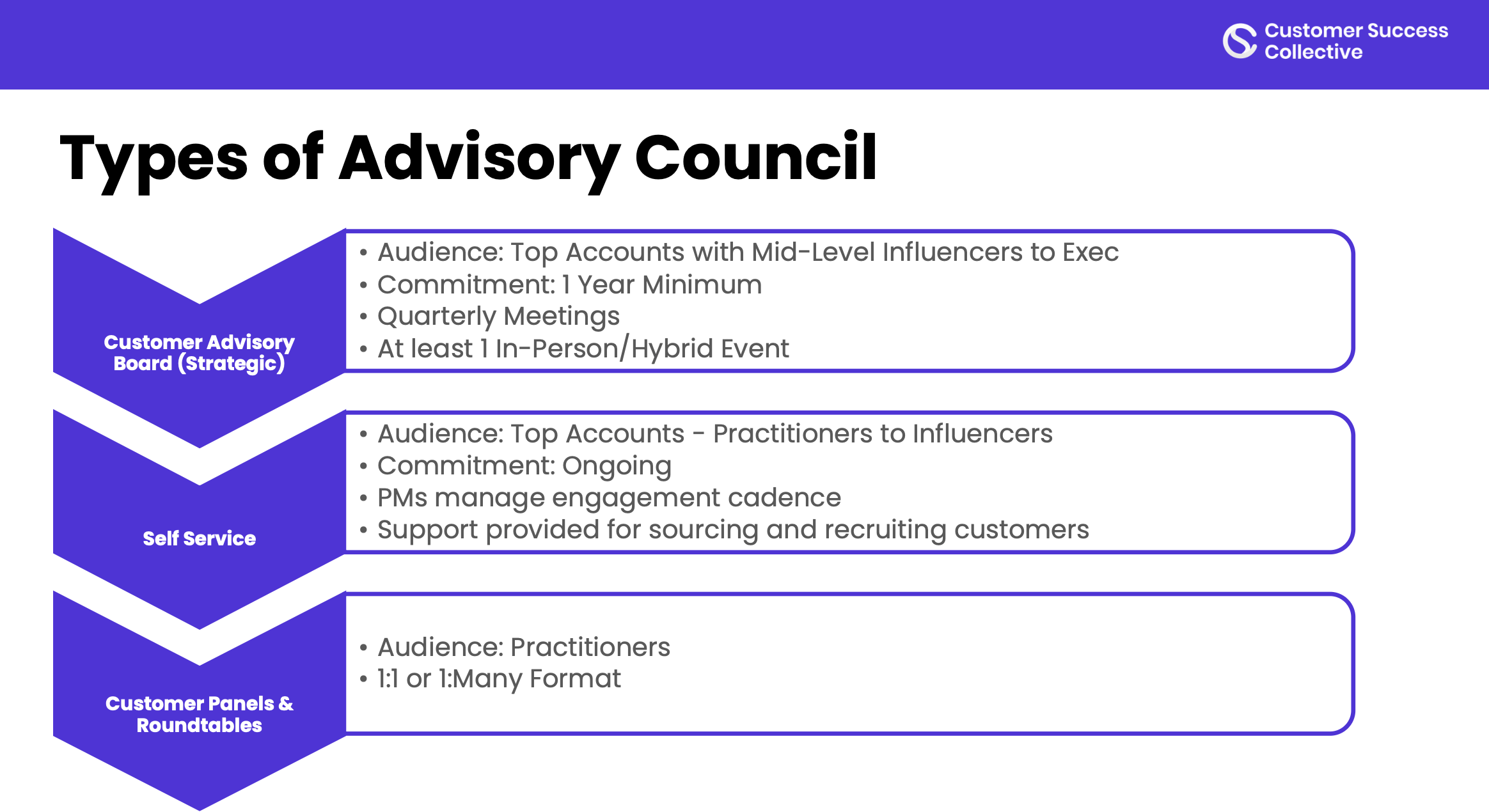
There are three types of CABs. Each serves a different audience:
TYPE 1: STRATEGIC CAB (Executive Advisory Board)
Audience: Top 15-20 accounts, executive-level
Purpose: Strategic direction, executive relationships, navigating transitions
Commitment: High-touch, white-glove service, long-term (1+ years)
Example: Our Marketo post-acquisition CAB
TYPE 2: SELF-SERVICE CAB
Audience: Practitioners across your customer base
Purpose: Product-specific feedback, feature input, beta testing
Commitment: Lighter touch, product managers can own relationships
Example: Product-specific councils for practitioner insights
TYPE 3: PANELS & ROUNDTABLES
Audience: Varied - can be practitioners, executives, or mixed
Purpose: One-off discussions, specific topics, testing ideas
Commitment: Single sessions, no ongoing expectation
Example: Topic-specific roundtables on specific challenges
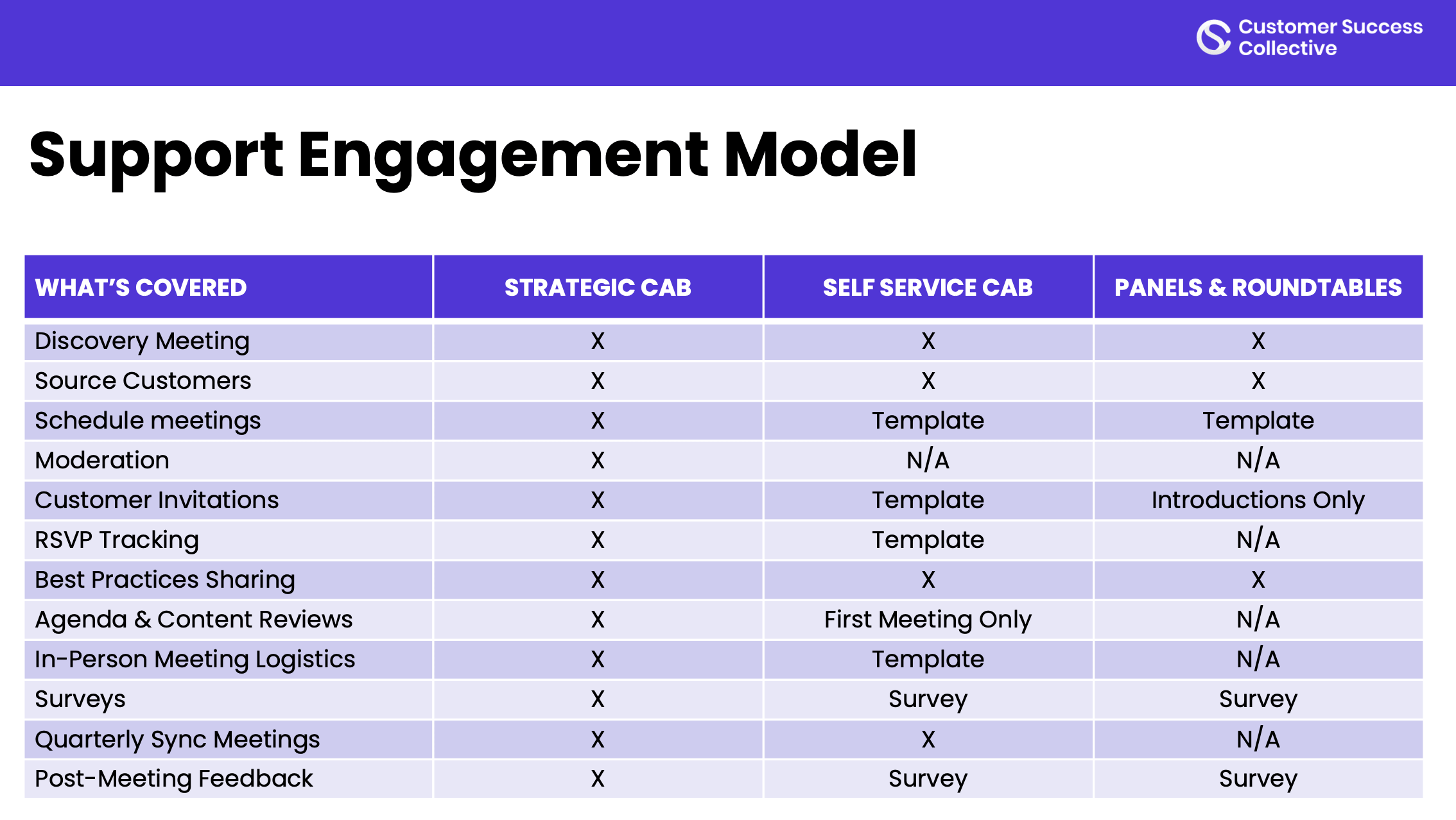
Here are some visual examples from my Customer Marketing Masters course I created a few years ago that helps illustrate what I’m referring to on how you can design your programs to serve your broader customer base:
The mistake most companies make:
They build the wrong type of CAB for their goals.
Or worse - they build ONE CAB and expect it to serve every audience and solve every problem.
Our strategic CAB at Marketo served executives navigating an acquisition.
It couldn’t speak for practitioners struggling with day-to-day adoption.
It couldn’t speak for SMB customers with different needs than enterprise.
It couldn’t replace our community, education programs, or lifecycle marketing.
Each CAB type serves a specific audience. None can speak for everyone.
CABs are for:
Strategic executive relationships (Strategic CAB)
Navigating transitions and major changes (Strategic CAB)
Product-specific feedback from practitioners (Self-Service CAB)
Topic-specific discussions and quick feedback (Panels & Roundtables)
Building peer networks among your most influential customers (Strategic CAB)
CABs are NOT for:
Understanding your full customer base (too small a sample)
Driving adoption at scale (that’s education and lifecycle programs)
Building practitioner-level advocacy (that’s community and champions programs)
Proving ROI to your board (too narrow a focus)
Replacing your proof system (case studies serve a broader audience)
Replacing your community strategy (CABs are exclusive by design)
Replacing your lifecycle programs (CABs don’t scale to thousands)
CABs are one pillar in your Customer-Led Growth system.
Not the entire system.
If you’re a team of one with limited resources, a CAB is probably the wrong place to start.
Build programs that serve your broader base first:
Proof systems (case studies, testimonials, references) - serves Sales, Marketing, Product
Community (peer connections at scale) - serves practitioners across all segments
Customer education (enabling adoption) - serves the full customer base
Lifecycle marketing (onboarding, engagement, expansion) - automated, scalable
Add a CAB when you have:
A specific problem a CAB can solve (executive retention, strategic feedback, transition navigation)
The right audience identified (15-20 strategic accounts OR practitioners for product feedback)
Resources to deliver the appropriate service level (white-glove for Strategic, templated for Self-Service)
Executive sponsorship and commitment (especially for Strategic CABs)
A foundation of programs already serving your broader base
Don’t build a CAB because “everyone has one” or your CEO just says “do it.”
Build it because it solves a specific strategic problem for a specific audience you actually have.
BUILDING FOR EXCLUSIVITY (NOT SCALE)
If you do decide to build a CAB, here’s the shift that changes everything:
Stop optimizing for scale.
Start optimizing for exclusivity.
The best CABs feel like a privilege to be part of.
Not a participation trophy.
Here’s how you build for exclusivity:
START IMPOSSIBLY SMALL
Don’t invite 20 customers because “that feels like the right number.”
Start with 10.
Test the model. See what resonates. Iterate.
You can always expand. You can’t easily contract.
BUILD FOR GRADUATION, NOT RETENTION
Set clear term limits. 2 years maximum.
Then customers graduate out.
This does two things:
First, it keeps the group fresh. New perspectives. New challenges. New peer connections.
Second, it creates urgency. Customers know their time is limited. They show up. They engage. They make the most of it.
When customers fear losing their seat, that’s when you know it’s working.
CREATE TRANSPARENT SELECTION CRITERIA
Don’t make selection mysterious.
Tell people exactly what it takes to get invited:
Strategic account (define what that means)
Actively using the product (not shelf-ware)
Executive-level participation (not delegates)
Willingness to provide honest feedback (not just nice feedback)
Commitment to the full term (not hit-or-miss attendance)
Make the criteria public.
This does two things:
First, it makes selection feel fair. Not arbitrary.
Second, it creates aspiration. Other customers see what it takes. They work toward it.
You build a waitlist without even asking.
OFFBOARD WITH INTENTION
When customers hit their term limit, don’t just ghost them.
Graduate them with recognition:
Public acknowledgment of their contribution
“Alumni” status with continued (lighter touch) engagement
First access to a new executive community of peers
Invitation to mentor new CAB members or customers (we’ll talk about that in the future)
Make graduation feel like an honor, not a rejection.
This keeps them advocates even after they’re no longer in the active CAB.
If everyone’s an insider, no one is.
Exclusivity creates demand.
THE MEASUREMENT SHIFT
Stop measuring what’s easy to count.
Start measuring what actually matters.
DON’T JUST MEASURE:
Attendance rates (vanity metric)
Survey completion (doesn’t mean they care)
Number of feedback items collected (volume ≠ value)
DO MEASURE:
Peer connections made (did they exchange contact info?)
Strategic relationships deepened (are they introducing each other to their networks?)
Trust indicators (are they sharing challenges they wouldn’t share in a larger forum?)
Retention of CAB members (would they fight to keep their seat if you said it was ending?)
Impact on business outcomes (are CAB accounts growing faster, churning less, advocating more?)
The ultimate test:
Ask yourself: “If I told this customer their CAB seat was ending, would they fight to keep it?”
If the answer is no, your CAB isn’t valuable enough.
If the answer is yes, you’ve built something worth protecting.
Relationship depth, not attendance theater.
THE PRACTICAL REALITY
Here’s what I want you to take away from this:
IF YOU’RE A TEAM OF ONE: Don’t build a CAB. Build programs that scale without you: proof systems, self-service community, lifecycle email programs. Save CABs for when you have the resources and the specific strategic need.
IF YOUR EXEC IS DEMANDING A CAB: Push back with questions. “What problem are we solving? What audience are we serving? Which type of CAB makes sense for our goals?” If the answer is “everyone has one,” that’s not a strategy.
IF YOU’RE DECIDING WHICH TYPE TO BUILD:
Strategic CAB = you have 15-20 accounts worth deep executive investment and need to navigate transitions or retain key relationships
Self-Service CAB = you need product-specific feedback from practitioners at scale
Panels = you want to test ideas before committing to ongoing programs
IF YOU HAVE THE RIGHT AUDIENCE AND GOALS: Then yes, build a CAB. But start small. Choose the right type. Build for exclusivity. Measure relationship depth, not attendance.
IF YOUR CAB ALREADY EXISTS AND IT’S BROKEN: Audit it. Are you building peer value or vendor value? Are you measuring attendance or relationships? Did you build the right type for your audience? Are you treating it like a strategy or a tactic?
MOST IMPORTANTLY: Tie your CAB to your broader Customer-Led Growth system.
It’s one pillar. Not all seven. There’s a reason why I created my team charter this way so that every program and function weaves into the other to support our customers.
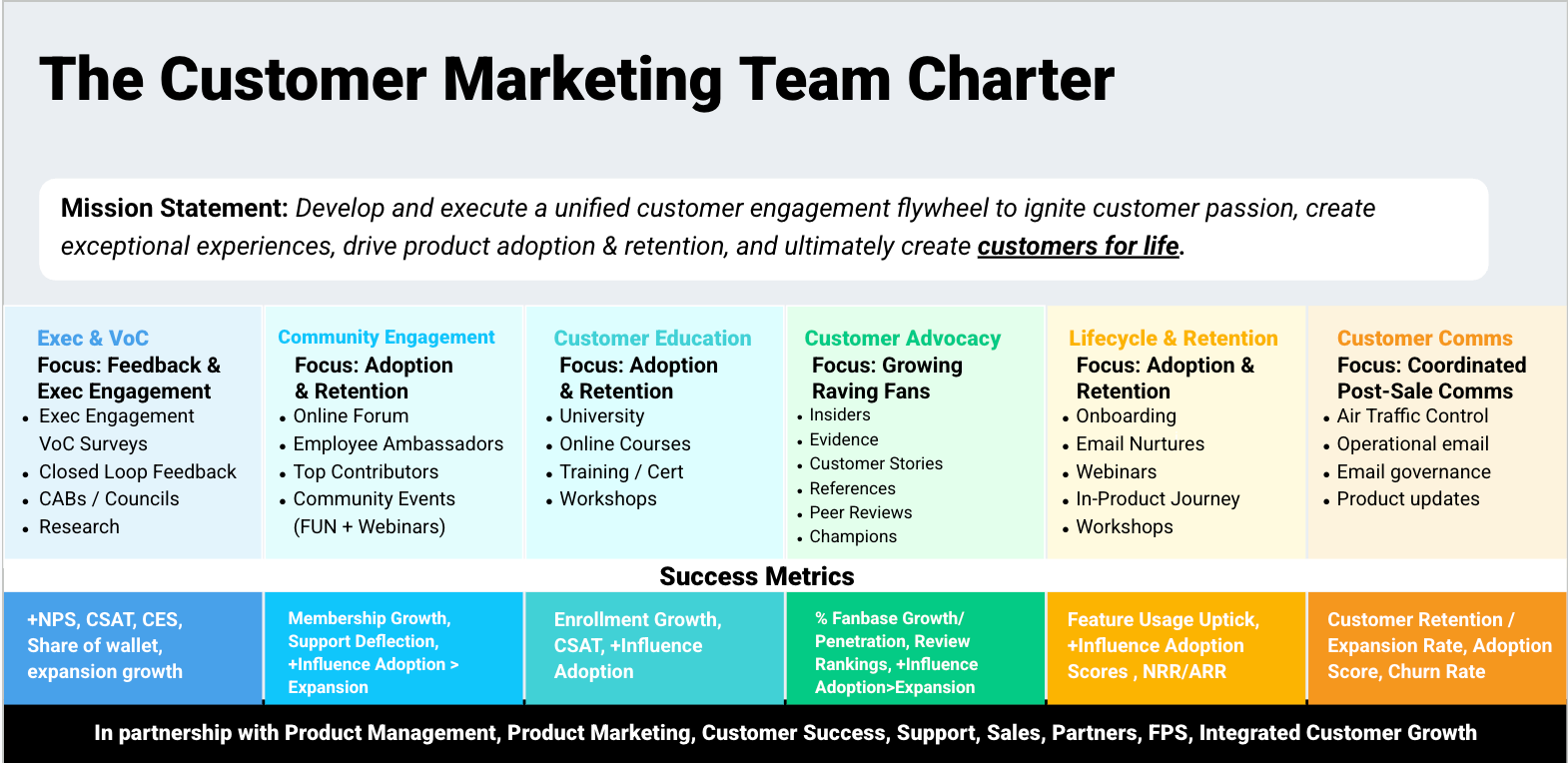
CABs live in Executive Engagement (Strategic CABs) or Voice of Customer (Self-Service/Panels).
They don’t replace the other pillars.
Build the system. Then decide where a CAB fits - and which type makes sense for your goals and audience.
USE MY CUSTOMER-LED GROWTH GPT TO THINK THROUGH YOUR MODEL
If you’re trying to figure out whether you should build a CAB - or how to fix the one you have - the Customer Marketing GPT can help you think through it.
Here are some conversation starters:
PROMPT #1:
“I’m a team of one at a Series B company with 500 customers. My CEO wants me to build a CAB. Should I push back? What should I build instead?”
PROMPT #2:
“Help me decide which type of CAB to build. I have 20 strategic enterprise accounts and 200 mid-market customers. What’s the right model for my goals?”
PROMPT #3:
“My exec wants a CAB with 50 customers so we ‘don’t exclude anyone.’ How do I explain why that defeats the purpose of exclusivity and why we need to choose the right CAB type?”
PROMPT #4:
“I’m running my first Strategic CAB meeting next month. My stakeholders want to present the roadmap for 90 minutes. How do I reframe the agenda to create peer value instead of vendor value?”
PROMPT #5:
“What does graduation look like for CAB members who hit their 2-year term? How do I offboard them without making it feel like rejection?”
PROMPT #6:
“How do I measure relationship depth instead of attendance? What metrics actually matter for a strategic CAB?”
PROMPT #7:
“How do I translate insights from my Strategic CAB (15 executives) to my broader customer base of 10,000? What programs should those insights inform?”
Don’t just ask one question. Keep the conversation going.
The GPT gets smarter the deeper you go.
I’M OPENING 3 MENTORSHIP SPOTS GOING INTO JANUARY 2026
Here’s the thing:
You can read every newsletter. You can use the GPT. You can consume every framework.
But if you’re still stuck - if your programs aren’t getting traction, if you’re leading a team of one with no roadmap, if you can’t get executive buy-in - you need personalized guidance.
That’s why I’m opening 3 spots in my Customer Marketing Mentorship program starting January 2026.
And you’re hearing about it first.
I’m announcing this to newsletter subscribers before posting it anywhere else.
You get first access.
Here’s what you get:
3 months of 1:1 mentorship (monthly sessions, 30-60 minutes each)
Personalized guidance on your biggest challenges
Direct access to frameworks I’ve built over the past 15 years
Accountability to actually implement what you learn
This mentorship is designed for people who want to build holistic customer-led growth strategies.
Not just check the CAB box.
Not just launch one program and call it done.
But build systems that compound across all seven pillars: Voice of Customer, Advocacy, Community, Education, Adoption, Communications, and Executive Engagement.
This is not for everyone.
I’ve maintained a 20% acceptance rate because I only work with people who are ready to take action.
If you’re serious about making 2026 your breakout year - if you want to hit the ground running in January instead of spinning your wheels - apply here:
Limited to 3 spots. Applications close December 31st.
I’ll be announcing this publicly on LinkedIn, but newsletter subscribers get first shot.
NEXT WEEK
How to build advocacy programs that scale without hiring an army.
The systems. The workflows. The automation that actually works.
Until then, try the GPT prompts above. Question whether you actually need a CAB. Build the foundation first.
— Kevin
P.S. If this newsletter made you rethink your entire approach to CABs, forward it to your exec who keeps asking for one. They’ll thank you for it.