


Welcome back to The Customer Continuum.
Issue #6.
Yesterday I shared a story about a customer marketer drowning in 60-hour weeks.
She was building proof systems that Sales wouldn’t use. Chasing reps to adopt her work. Hand-holding through every reference request.
An org chart won’t fix that alone. But structure determines whether you’re set up to fight every battle or build programs that scale.
I know because I’m in the middle of it right now. The past two weeks, my team has been in offsites planning our 2026 structure.
We’re optimizing for scale—figuring out what we need to own, where we need operations support, and how to build flexibility into the system so we can evolve without breaking.
Today, I’m sharing what’s coming out of those conversations. Not theory; real thinking about how to structure a customer marketing org that can grow.
The 2026 Org Design Framework for Customer-Led Growth.
Why Most Teams Are Organized Wrong
Most customer marketing teams are set up to fail from day one.
Here’s what I see when I audit CM orgs:
Organized by product line:
One CM per product
Each person duplicating the same work
No leverage across the customer base
Organized by channel:
“Events person”
“Content person”
“Community person”
Reactive tasking, not strategic programs
Organized by whoever asks loudest:
Sales needs a reference → you drop everything
Marketing needs a speaker → you scramble
Product needs feedback → you survey on the fly
None of these structures build leverage. They build chaos.
The Shift: Organize by Customer-Led Growth (CLG) Pillars
Customer-Led Growth isn’t a buzzword. It’s an operating system.
It’s how you organize your team so every program compounds instead of expires.
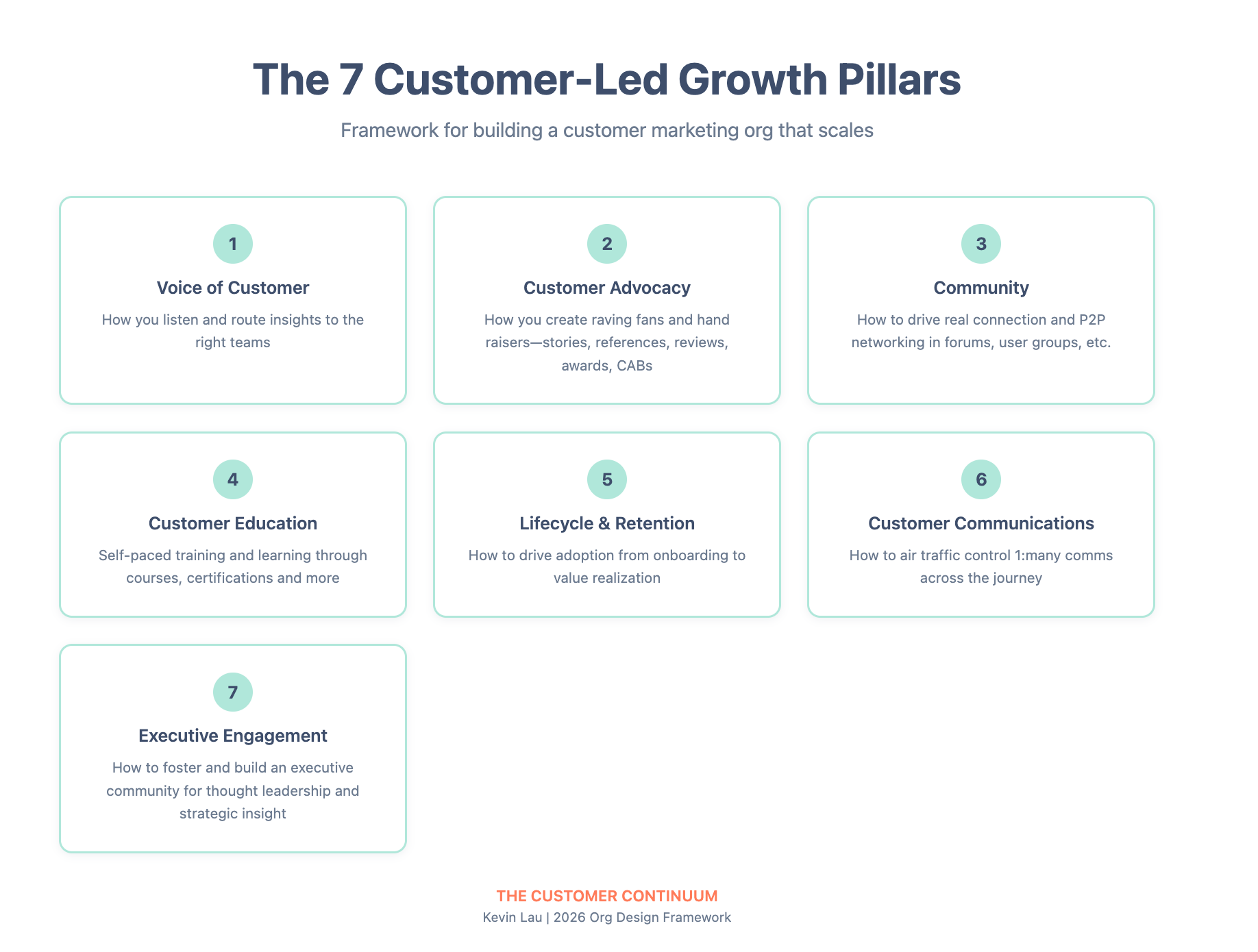
The 7 CLG Pillars:
Voice of Customer (VoC) - How you listen and route insights
Customer Advocacy - How you create raving fans and hand raisers ie. stories, references, reviews, awards, CABs
Community - How to drive real connection and P2P networking in forums, user groups, etc.
Customer Education - Self paced training and learning through courses, certifications and more
Lifecycle & Retention Marketing - How to drive adoption from onboarding > value realization
Customer Communications - How to air traffic control 1:many comms across the journey
Executive Engagement - How to foster and build an executive community of like-minded professionals for thought leadership, strategic insight and more
Why this matters:
When you organize by pillar instead of product/channel, you build:
Systematic programs that scale across all customers
Proof systems that make references findable in 5 minutes, not 5 hours
Compounding leverage where each program feeds the next
Instead of “find me a reference,” you have 50 active references tagged by industry, use case, and deal size.
Instead of “we need a webinar speaker,” you have a trained speaker pool of 30 customers who opt into opportunities quarterly.
Instead of random acts, you have systems.
The Framework: 3 Org Chart Models for 2026
Before we dive in, a critical truth:
Your org chart is not a fixed blueprint. It’s a living system.
The models below are starting points: thoughtfully designed structures that give you clarity on roles, dependencies, and sequencing. But they will evolve as your business changes.
What makes org design work:
Planned dependencies: You can’t scale lifecycle programs without a proof system. You can’t run a CAB without VoC infrastructure. Map these connections upfront.
Clear sequencing: Build advocacy before community. Establish operations before regional coverage. Know what unlocks what.
Built-in flexibility: Market shifts. Priorities change. Execs leave. Your structure needs room to adapt without breaking.
Regular evaluation: Review your org every 6 months. Are roles still aligned to outcomes? Are dependencies creating bottlenecks? Where’s the friction?
The goal isn’t perfection. It’s intentionality.
You’re building an org that can evolve without chaos. Adding a new hire doesn’t mean rebuilding everything, and shifting priorities doesn’t leave programs orphaned.
Here’s how to structure your team based on size, with AI built in from day one.
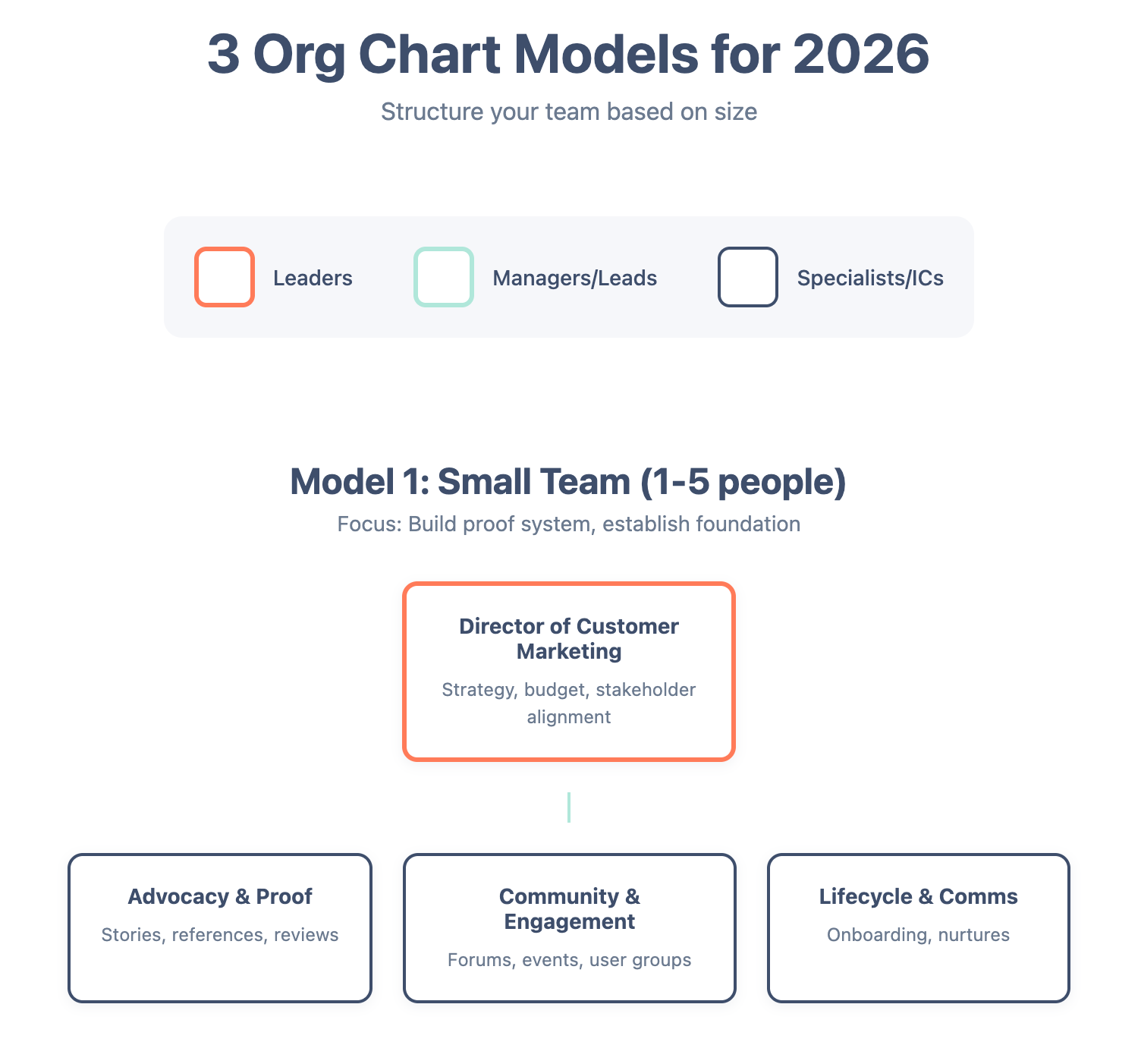
Model 1: Small Team (1-5 people)
Structure:
Director of Customer Marketing
Specialist: Advocacy & Proof (stories, references, reviews)
Specialist: Community & Engagement (forums, events)
Specialist: Lifecycle & Comms (onboarding, nurtures)
What you build:
Proof system (stories + references)
Community forum or Slack group
Pre-90 day onboarding program
AI Integration:
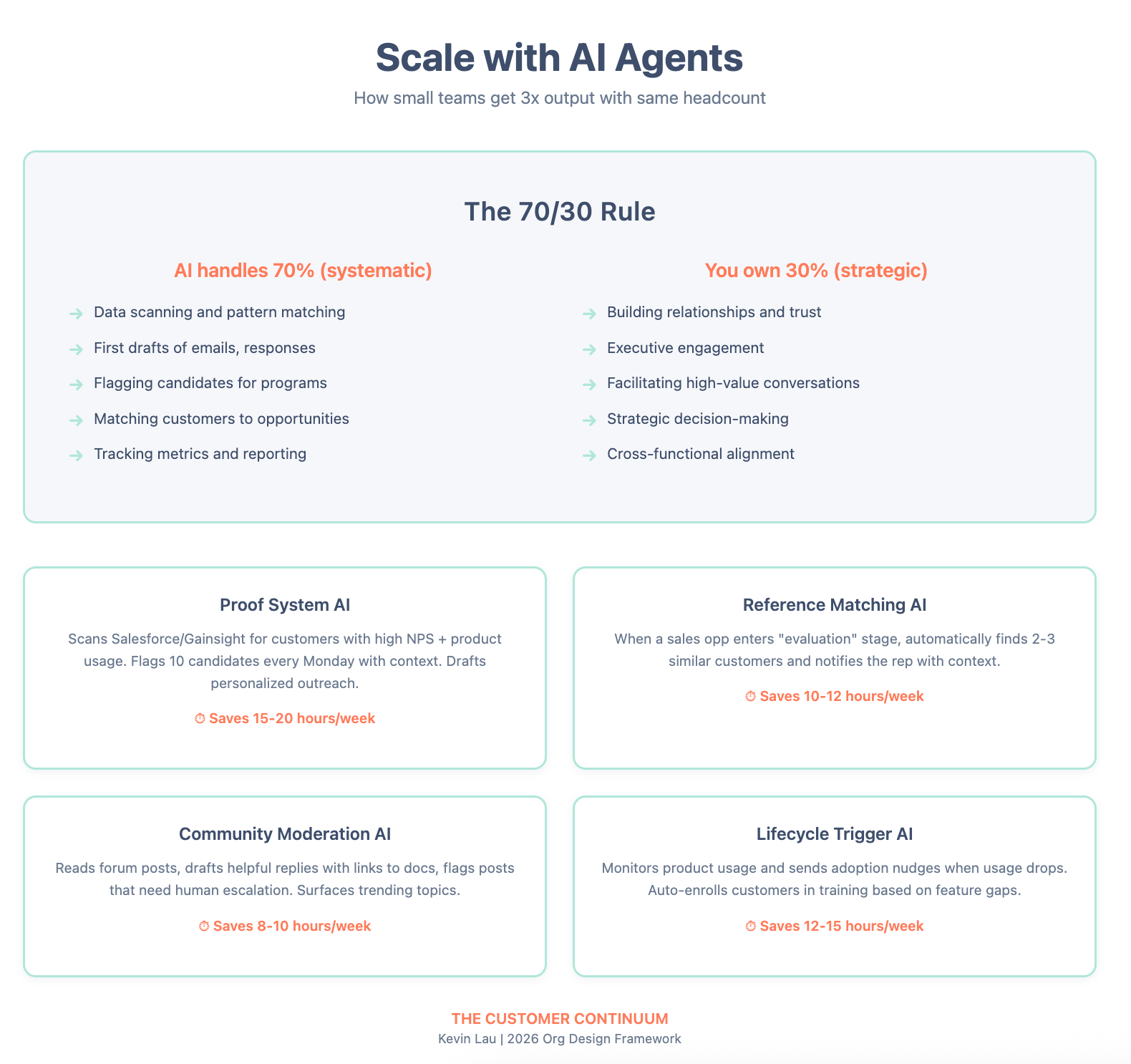
Proof System AI: Scans Salesforce/Gainsight for high-NPS customers, flags reference candidates
Community Moderation AI: Drafts replies to common questions, flags escalations
Time saved: 15-20 hours/week across the team
When to hire next: When your reference request turnaround is <24 hours and you’re capturing 10+ stories per quarter consistently.
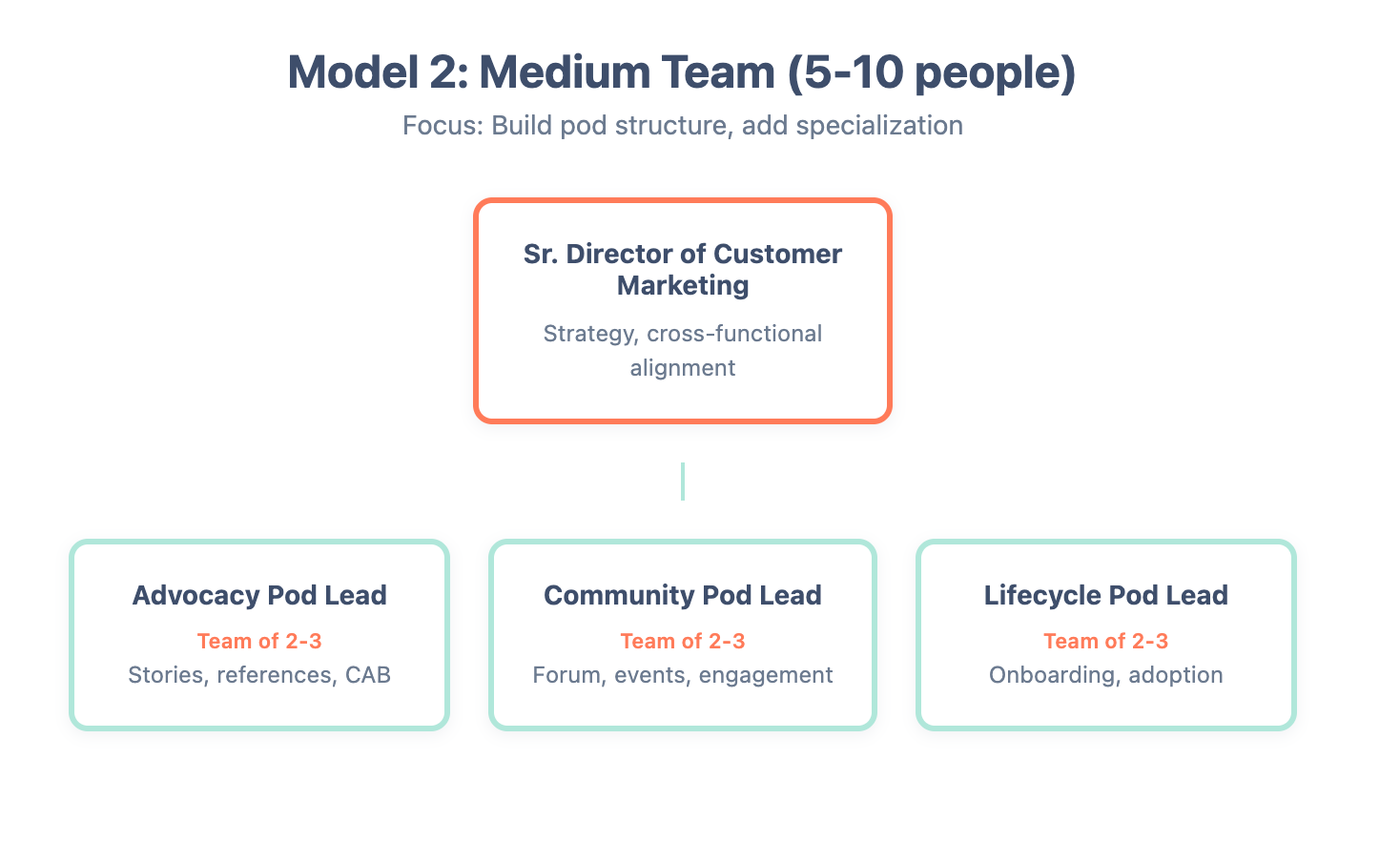
Model 2: Medium Team (5-10 people)
Structure:
Sr. Director of Customer Marketing
Advocacy Pod Lead (team of 2-3: Stories, References, CAB/Awards)
Community Pod Lead (team of 2-3: Forum, Events, Engagement)
Lifecycle Pod Lead (team of 2-3: Onboarding, Adoption, Retention)
What you build:
Full advocacy engine (CAB, reference panels, awards program)
Scaled community with regional user groups
Lifecycle nurture tracks by persona/use case
AI Integration:
Reference Matching AI: Auto-matches customers to sales opps in “evaluation” stage
Community Analytics AI: Surfaces trending topics, identifies power users
Lifecycle Trigger AI: Sends adoption nudges based on usage data
Time saved: 30-35 hours/week across pods
When to hire next: When you have clear pod ownership and each pod has documented playbooks that new hires can execute.
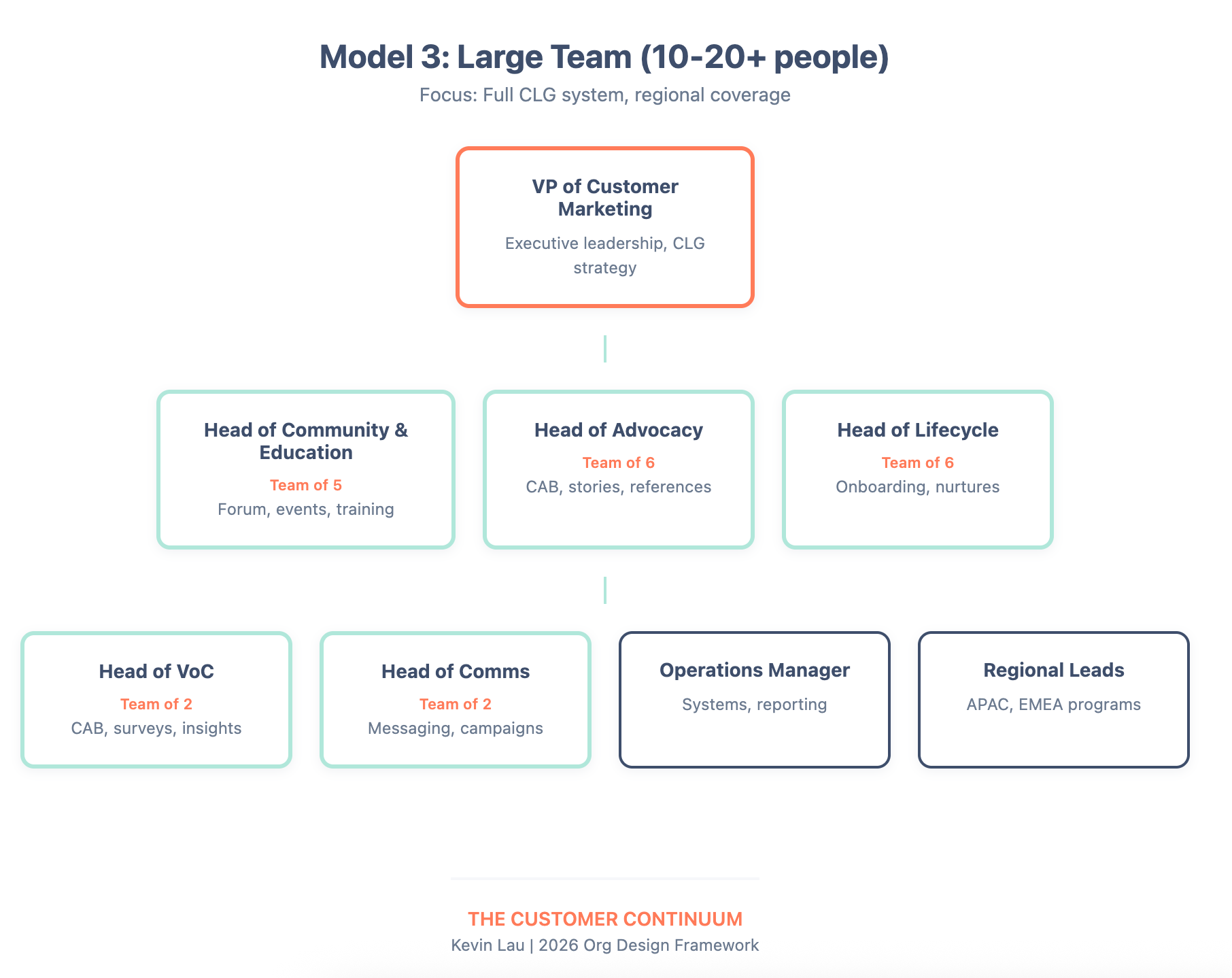
Model 3: Large Team (10-20+ people)
Structure:
VP of Customer Marketing
Head of Community & Education (team of 5)
Head of Advocacy (team of 6)
Head of Lifecycle (team of 6)
Head of VoC (team of 2)
Head of Customer Comms (team of 2)
Operations Manager
Regional Leads (APAC, EMEA)
What you build:
Global CLG system spanning all 7 pillars
Regional programs with local relevance
Executive engagement layer (CABs, exec briefings, strategic accounts)
Operations function to manage systems, reporting, and workflows
AI Integration:
Full AI-powered proof engine with auto-tagging, matching, and outreach
Predictive churn AI feeding lifecycle programs
VoC routing AI sending insights to right teams automatically
Community AI handling tier-1 questions, escalating complex issues
Time saved: 60+ hours/week enterprise-wide
When to hire next: When you’re hitting 80%+ of your OKRs consistently and regional coverage is limiting growth.
The 70/30 Rule: What AI Handles vs What You Own
AI handles the 70% (systematic work):
Data scanning and pattern matching
First drafts of emails, responses, content
Flagging candidates for programs
Matching customers to opportunities
Tracking metrics and reporting
You own the 30% (strategic work):
Building relationships and trust
Executive engagement and navigation
Facilitating high-value conversations (CABs, panels)
Strategic decision-making
Cross-functional alignment
The math:
If your team spends 40 hours/month on systematic work (searching Salesforce, manual matching, data entry), automating that = gaining a full week back every month.
That’s 12 weeks a year you get back for strategic work.
This is how small teams compete with big budgets in 2026.
Understanding Org Dependencies: Why Sequence Matters
Your org chart isn’t just boxes and lines. It’s a dependency map.
Here’s what I mean:
Advocacy unlocks everything else:
You can’t build community without proof to celebrate
You can’t run lifecycle programs without stories showing value
You can’t launch CABs without existing reference relationships
You can’t scale VoC without customers who trust you
Community enables scale:
Peer-to-peer support reduces your team’s manual load
Power users become your advocate pipeline
Trending topics surface product insights automatically
Regional user groups create local networks
Lifecycle drives expansion:
Onboarding programs reduce time-to-value
Adoption campaigns prevent churn
Retention plays create upsell opportunities
Data from lifecycle feeds back to advocacy and VoC
Operations makes everything systematic:
Without ops, you’re manually tracking everything
With ops, programs run on autopilot
Reporting proves value to executives
Workflows scale beyond one person’s memory
The mistake most teams make:
They don’t map their dependencies before they hire. They add headcount based on whoever asks loudest, not what the business actually needs to scale.
You launch a community without figuring out if you have the operations capacity to sustain it. You hire for advocacy when the real bottleneck is lifecycle adoption. You add regional leads when the problem isn’t coverage—it’s that your playbooks don’t exist yet.
Then when someone leaves or priorities shift, everything breaks because the dependencies weren’t mapped to what you’re actually trying to solve for.
The right approach:
Map your dependencies to what you’re solving for (if the goal is retention, what infrastructure needs to exist first?)
Sequence your hiring based on business priorities, not a generic playbook
Document what you build so programs outlive people
Build flexibility into the structure so you can pivot when priorities change
The models above show common patterns, but your sequence should be dictated by what your business needs to scale.
How Your Org Will Evolve (And That’s OK)
Your 2026 org chart will not be your 2027 org chart.
Here’s what typically changes:
Year 1 → Year 2:
You prove value with advocacy, add community specialist
Lifecycle programs mature, need dedicated ownership
Operations formalizes as team hits 5+ people
Year 2 → Year 3:
Community scales, needs regional coverage
VoC emerges as dedicated function (was embedded in advocacy)
Pod structure forms around the 3 core pillars
Year 3+:
Functional heads replace pod leads
Regional structure expands (APAC, EMEA, LATAM)
Customer comms splits from lifecycle
AI agents replace 2-3 FTE worth of systematic work
What stays constant:
The CLG pillars (you’re always building around these 7 pillars)
The 70/30 rule (AI handles systematic, you own strategic)
The dependency sequence (advocacy → community → lifecycle)
The proof requirement (show impact before asking for headcount)
What changes:
Who owns what (roles consolidate or split based on volume)
Reporting structure (flat → pods → functional heads)
Geographic coverage (centralized → regional)
Level of specialization (generalists → specialists → sub-specialists)
The key is reviewing your org every 6 months and asking:
Are current roles aligned to outcomes?
Where are the bottlenecks?
What dependencies are creating friction?
What new capabilities do we need based on business priorities?
Then adjust. Thoughtfully. With clear communication.
An org chart that never changes is an org chart that isn’t responding to reality.
Your Next Steps (Based on Team Size)
If you’re a team of 1-3:
View the infographic below and identify which model fits your stage
Map your current programs to the CLG pillars: where are the gaps?
Start building your proof system first (advocacy unlocks everything else)
Explore AI tools like Trusted to move from manual spreadsheets to systematic workflows
If you’re a team of 3-8:
Audit your current structure: are you organized by pillar or by channel/product?
Build pod leads around the 3 core pillars: Advocacy, Community, Lifecycle
Document your playbooks so new hires can execute without starting from scratch
Implement AI agents for your highest-volume systematic work
If you’re a team of 8+:
Evaluate whether you have clear functional heads for each pillar
Build your operations function. You can’t scale without systems and reporting
Add regional coverage based on where your customer concentration is
Integrate AI across all pillars to free up 60+ hours/week for strategic work
The Infographic: Your 2026 Org Design Playbook
Below is the complete visual framework showing:
The 7 CLG pillars explained
How to structure your first 90 days
All 3 org chart models with reporting lines
AI integration at each stage
The 70/30 rule visualized
Final Thought: Structure Determines Outcomes, But It Must Evolve
Random acts of customer marketing = pushing energy uphill.
You’re always reacting. Convincing. Hand-holding. Starting over every week.
Systematic customer marketing = going where the energy is.
You’re building for the people who care. Creating leverage. Letting proof of impact do the selling.
The shift starts with structure.
But remember: your org chart is a tool, not a monument.
It should be thoughtfully planned (clear roles, mapped dependencies, intentional sequencing) and flexible enough to evolve (as priorities shift, as people grow, as the business changes).
The best customer marketing orgs don’t have perfect structures. They have structures that can adapt without breaking.
If you don’t have a clear charter, you fight every battle.
If you’re organized around programs that compound, you know which fires to let burn.
If you’ve mapped your dependencies, you know what to build next.
If you’ve built flexibility into your structure, you can evolve without chaos.
You don’t need more people.
You need better systems.
And those systems need room to grow.
What’s Next
I’m opening 3 mentorship spots for January 2026.
If you want 1:1 guidance on:
Building your CM org from scratch
Proving ROI when budgets are tight
Making the shift from random acts to systematic programs
Apply for my mentorship program here.
P.S. Next week’s newsletter: “Customer marketing is the loudest echo chamber in B2B, and that’s exactly why we can’t get budget.”
Why we’re invisible to executives and how to fix it. Subscribe if you want the real talk.