


Welcome back to The Customer Continuum.
Issue #7.
I walked into planning season at a past company with a “proven” program.
Champions. Advocacy. Community. A playbook everyone loved.
The customer team loved it. Marketing peers loved it. Other customer marketers cheered it on.
Then the exec review happened.
The CEO nodded politely. The rest of the leadership team was looking at their phones.
No fight. No debate. No real interest.
I walked out labeled as a “nice to have.”
Not because the work was weak.
Because I hadn’t enrolled them in the vision.
I was talking to the wrong people about the wrong things.
The Real North Star
Before I get into what’s broken, let me ground us in what we’re actually solving for.
When I joined Freshworks, one of the first things I did was present to our CEO and senior leadership team.
I didn’t lead with programs. I didn’t lead with tactics.
I led with this simple question: “Why is customer obsession important?”
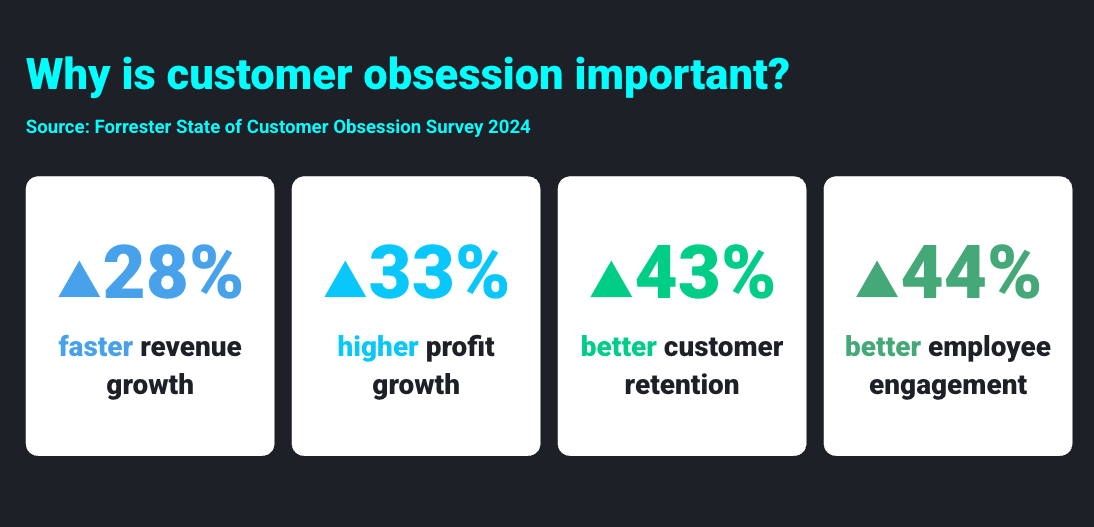
(Source: Forrester State of Customer Obsession Survey 2024. Shoutout to Amy Bills for the help on these frameworks.)
I told them: What’s at stake here is the relationship we’re building with customers.
To build more loyalty and fans, we need to change how we approach it.
We need to empower our employees to champion the customer. To care about how customers are using our products. To shift from being just a function to a company rallying cry.
This isn’t about customer marketing. It’s not about customer success. It’s not about sales.
It’s about customer obsession. Plain and simple.
And customer obsession isn’t one team’s job. It’s how teams lock arms to solve a bigger problem than themselves.
Then I showed them this:
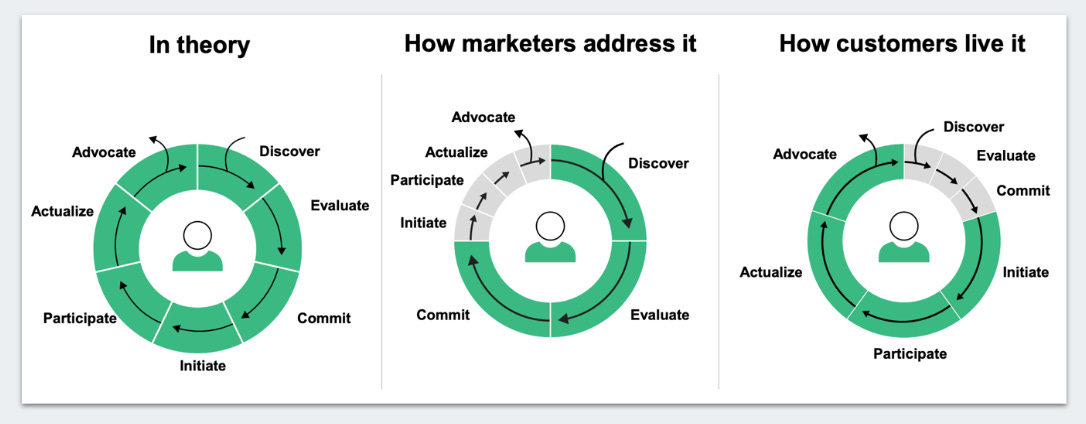
In theory, the customer journey is a nice, neat cycle.
How marketers address it? We chop it up and optimize our piece.
How customers actually live it? It’s messy, nonlinear, and they don’t care about our org chart.
This was a level set. Where we are. What the objective really is.
It changed the conversation.
Suddenly we weren’t talking about programs. We were talking about a company imperative.
That’s the shift.
And that’s where the echo chamber becomes a problem.
Because most customer marketers never have this conversation with leadership.
The Echo Chamber Problem
Here’s the uncomfortable truth about our industry:
Customer marketing is the loudest echo chamber in B2B.
We talk to each other all day.
LinkedIn. Slack communities. Conferences. Podcasts. Awards. Spotlights.
We swap frameworks. Templates. Benchmarks.
We clap for each other’s wins.
And I’m not saying that’s bad. Community matters. Learning from peers matters.
But while we’re talking to each other, leadership is making budget decisions without us.
Think about it.
When’s the last time your CEO read a customer marketing post on LinkedIn?
When’s the last time your CFO asked about your Champions program?
When’s the last time your board mentioned customer advocacy as a strategic priority?
For most of us? Never.
And it’s not their fault.
We’ve built an incredible community of practitioners.
We’ve failed to enroll leadership in why customer obsession should be a company imperative - and why customer marketing is the engine that drives it.
Why This Keeps Happening
Three patterns I see over and over:
1. We market to practitioners, not power.
Our posts land with other customer marketers.
Our internal updates land with our manager.
Our story never reaches the people who control headcount.
Executives aren’t reading threads about “Champions program tiers.”
They’re scanning for:
Revenue
Risk
Retention
Efficiency
Forecast confidence
If your work doesn’t map to those words, it disappears.
2. We report activity, not outcomes.
Most customer marketing updates sound like:
“We launched a community.”
“We ran a webinar.”
“We shipped a referral program.”
“We published 12 case studies.”
That reads like a task list.
Execs hear: Nice work. Keep supporting the field. No need for more budget.
What they need is the business result.
Not: “We launched a CAB.”
But: “CAB members influenced $4M in pipeline and renewed at 12% higher than non-members.”
Same work. Different visibility.
3. We pitch programs instead of enrolling leadership in the vision.
We walk into budget meetings with program names.
Champions. Advocacy. Community. Education.
Leadership hears: Tactics.
What they need to hear: Why customer obsession is a company imperative - and why customer marketing is how we operationalize it.
Show them the Forrester data. Show them what’s at stake.
If you haven’t enrolled them in that vision, you’re just asking for money for “stuff.”
The Cost of the Echo Chamber
This isn’t just a frustration. It has real consequences.
Budget cuts hit us first.
When leadership needs to reduce headcount, they cut what they don’t understand. Customer marketing is often at the top of that list.
Not because the work isn’t valuable. Because they were never enrolled in why it matters.
We get boxed into “nice to have.”
When executives don’t understand customer marketing’s strategic value, they see us as a service function.
“Can you get me a reference?”
“Can you write a case study?”
“Can you run a survey?”
Order-takers. Not strategic partners.
Career growth stalls.
If leadership doesn’t see customer marketing as essential to customer obsession, there’s no path to the executive table.
The ceiling isn’t your skills. It’s their understanding.
How to Break Out of the Echo Chamber
Here’s what I’ve learned works:
1. Anchor everything to customer obsession.
Stop leading with your programs. Lead with the business outcome.
Customer obsession drives 28% faster revenue growth and 43% better retention.
Your job is to show how customer marketing operationalizes that.
Champions program? That’s how we turn happy customers into revenue.
Community? That’s how we increase retention and reduce support costs.
Advocacy? That’s how we shorten sales cycles and reduce CAC.
Same work. Bigger frame.
2. Run smart experiments tied to their problems.
Not: “Let’s try a community.”
But: “Let’s test if peer connections reduce churn in our mid-market segment.”
Not: “Let’s launch a Champions program.”
But: “Let’s see if customer proof shortens sales cycles in competitive deals.”
Executives don’t fund programs. They fund solutions to problems they already care about.
Frame your work as an experiment with a hypothesis tied to a business outcome. Then prove it.
3. Partner closely with others to solve bigger problems.
Customer marketing dies when it floats alone.
It wins when it’s bolted to something bigger.
I stopped pitching my programs.
I started asking Sales, CS, and Product: “What’s broken that I can help fix?”
Then I built experiments around their problems. Not mine.
When you solve a problem that Sales or CS owns, you inherit their visibility.
Suddenly you’re not “support.”
You’re a partner solving revenue problems.
4. Enroll leadership in the vision.
This is the piece most customer marketers skip.
We report results. We share updates. We present at QBRs.
But we never step back and enroll leadership in the bigger picture.
Here’s the vision I use:
“In a world where acquisition costs are rising and buyers trust peers more than ads, the companies that win are the ones that turn customers into a growth engine. That’s customer obsession. That’s what customer marketing operationalizes.”
When leadership understands the vision, they start repeating it in rooms you’re not in.
That’s when budgets change.
5. Translate everything into outcomes.
Before:
What We Say: ”We increased NPS by 12 points”
What Execs Hear: “So what?”
After:
What We Say: NPS promoters renew at 94% vs 67% for detractors. Our NPS lift projects to $1.2M in retained revenue.”
What Execs Hear: Now I’m listening.
Before:
What We Say: ”We collected 45 customer stories”
What Execs Hear: “Nice.”
After:
What We Say: Stories attached to $8M in pipeline. Deals with stories closed 18% faster.”
What Execs Hear: That’s strategic.
Before:
What We Say: ”Community engagement up 30%”
What Execs Hear: “And?”
After:
What We Say: Active community members have 40% higher retention. That’s $600K in protected ARR.”
What Execs Hear: “Keep investing.”
This isn’t spin. It’s translation.
The impact was always there. You’re just making it visible.
6. Build a one-pager your CEO can repeat.
Every quarter, create a single page that answers three questions:
What did customer marketing drive this quarter? (2-3 bullets, tied to revenue)
What’s at risk if we don’t invest? (1-2 bullets, specific and quantified)
What do we need to unlock the next level? (1 clear ask)
One page. Three sections. Sixty seconds to read.
The goal isn’t just to inform. It’s to arm your executives with a story they can repeat to the board, to their peers, to new hires.
If they can’t repeat your value, you’re still invisible.
The Opportunity
Here’s what I believe:
Customer obsession has never been more important.
Acquisition costs are rising. Retention is the new growth. Customers trust peers more than ads.
The Forrester data proves it. Companies that get this right grow faster, retain better, and profit more.
Customer marketing is how we operationalize customer obsession at scale.
But we won’t get there by talking to each other.
We’ll get there by:
Anchoring everything to customer obsession, not just our programs
Running smart experiments tied to real business problems
Partnering with other teams to solve bigger problems together
Enrolling leadership in the vision
Translating our work into outcomes they care about
The echo chamber is comfortable. It feels good to be understood.
But the real work is enrollment.
Getting leadership to believe that customer marketing isn’t just a function.
It’s how we operationalize customer obsession.
That’s how we go from cost center to company imperative.
That’s how we get the budget, the headcount, and the seat at the table.
That’s how we stop being the best-kept secret in B2B.
What’s Next
Next week I’m closing out the year with my FY25 Year in Review - the wins, the hard lessons, what surprised me, and what I’m taking into 2026.
Then I’m taking a break for the holidays. The newsletter returns in January with my predictions for customer marketing in the new year.
Until then, I’d love to hear from you:
Have you experienced the echo chamber problem?
How have you enrolled leadership in your vision?
Reply to this email. I read every one.
P.S. If this resonated, share it with a customer marketer who’s fighting for visibility. We’re all in this together.