


Welcome back to The Customer Continuum.
Issue #9.
7 predictions that will define customer marketing in 2026.
The Playbook Is Changing
Everything is changing.
AI is rewriting playbooks overnight. Budgets are tighter than ever. Leadership is finally asking about retention instead of just acquisition.
The customer marketing playbook you’ve been running? It’s becoming obsolete in real-time.
But this isn’t a story about customer marketing getting harder.
It’s about customer marketing finally becoming what it was always supposed to be: strategic.
From case study factory to growth engine. From random acts of advocacy to orchestrated systems. From a cost center to a function you cannot scale without.
Personally, I’m more excited than I’ve been in years.
Here’s what’s coming.
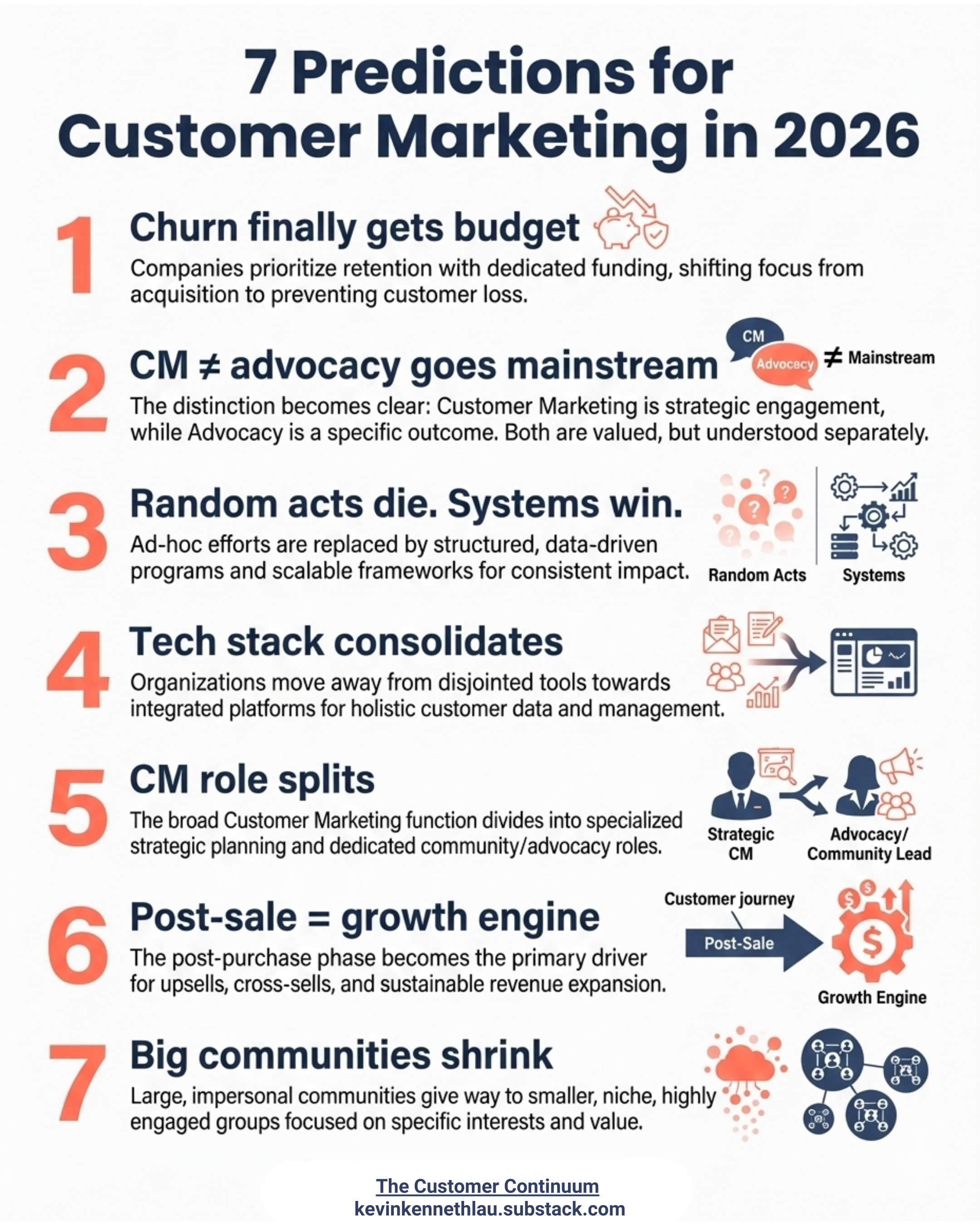
1️⃣ Churn finally gets the budget it deserves.
For years, we’ve been screaming: “Retention is cheaper than acquisition.”
Leadership nodded. Then funded another SDR team.
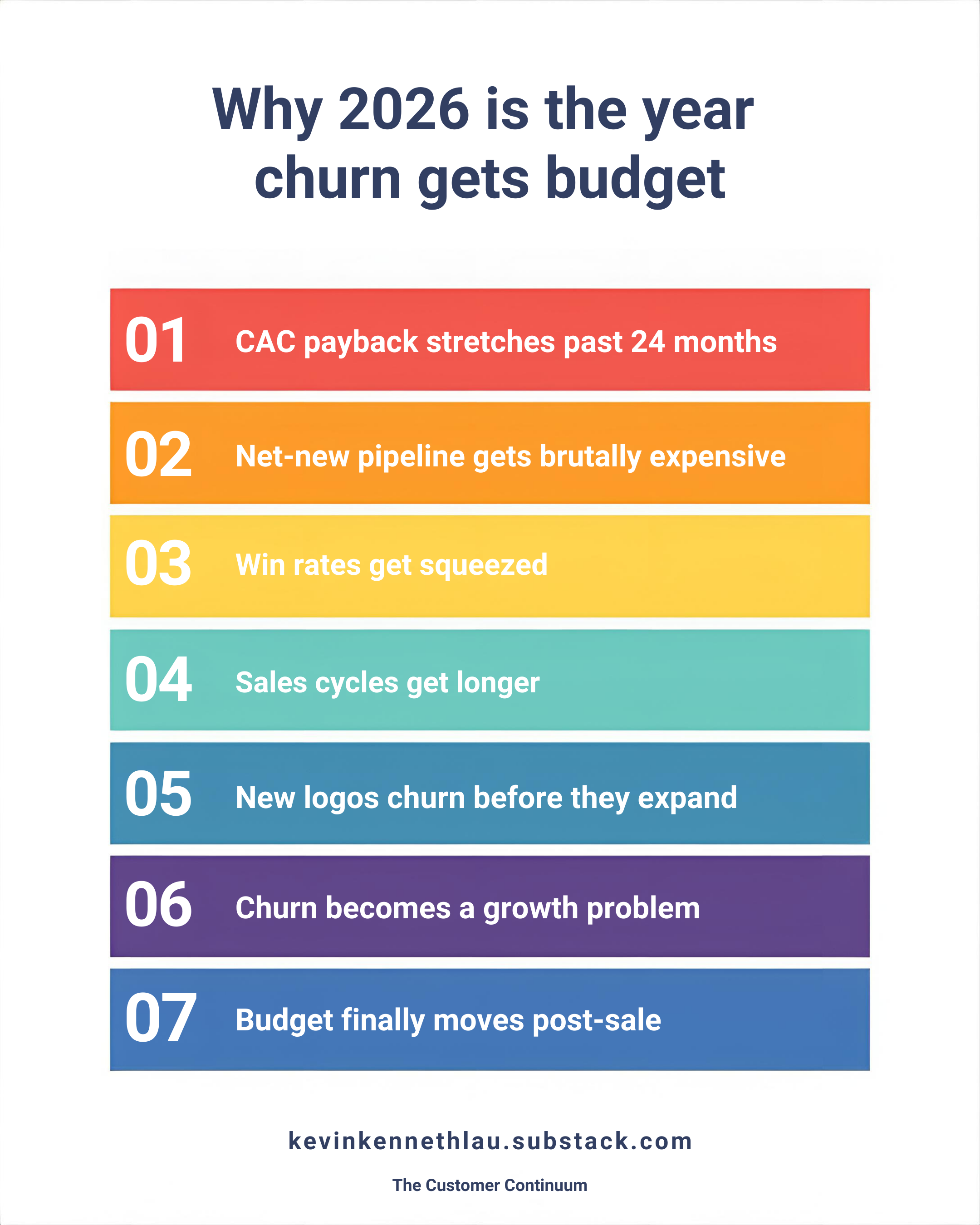
But the math has changed.
CAC payback periods have stretched past 24 months. Net-new sales in B2B SaaS are down 3.3% (ProfitWell’s Q4 2024 SaaS Market Report). And NRR is emerging as the single most important health metric for SaaS businesses.
The 2026 shift: Companies finally invest in post-sale like they mean it. Customer marketing gets real headcount, real budget, and real executive attention.
Not because leadership suddenly “gets it.” Because the economics leave no other choice.
The numbers back this up: median NRR for B2B SaaS is 106%, with top performers exceeding 120% (Wudpecker 2025 Retention Benchmarks). Top-quartile companies achieve 113% NRR—growing 13% without adding new business (McKinsey, November 2025). That gap is where growth happens—and it’s funded by retention, not acquisition.
What winners do: They’ve been building retention muscle for years. Everyone else will scramble to catch up.
2️⃣ Customer marketing ≠ advocacy becomes mainstream.
Ask most executives what customer marketing does. They’ll say “case studies” or “references.”
Ask most marketers. Same answer.
Even customer marketers themselves conflate the two. “I run advocacy” has become shorthand for “I run customer marketing.”
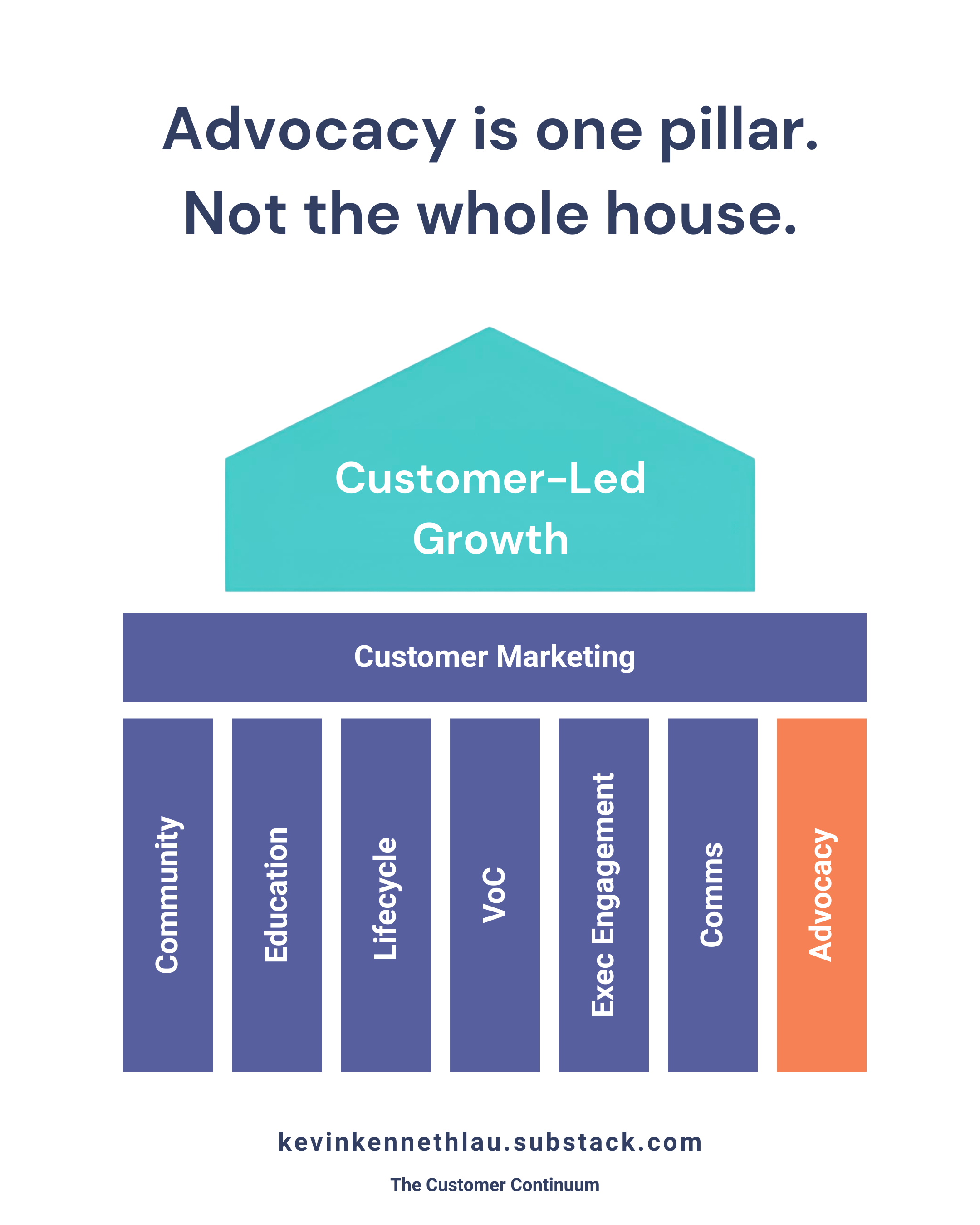
But advocacy is one pillar. Not the whole house.
Part of this is on us.
Let’s be honest: “customer marketing” is a confusing term. It means different things to different people.
CEOs hear “marketing to customers” — like email campaigns and upsell promos.
Sales hears “case studies and references.”
Product hears “customer feedback.”
Everyone’s right. And everyone’s wrong.
We’ve let the ambiguity persist for too long. And that ambiguity has cost us budget, headcount, and credibility.
The 2026 breakthrough: The industry finally gets clear on the hierarchy.
Customer-Led Growth is the operating system.
Customer Marketing is one engine inside it.
Advocacy is one pillar inside Customer Marketing.
This distinction matters because words shape budgets. Words shape headcount. Words shape what your leaders think you’re for.
The term “customer marketing” isn’t going away. But the confusion around it has to.
What winners do: They stop assuming leadership understands. They define the function clearly — what it includes, what it delivers, and how it connects to growth. They articulate the hierarchy before someone else defines it for them.
3️⃣ Random acts of customer marketing die. Orchestrated systems win.
Most customer marketing teams operate in reactive mode.
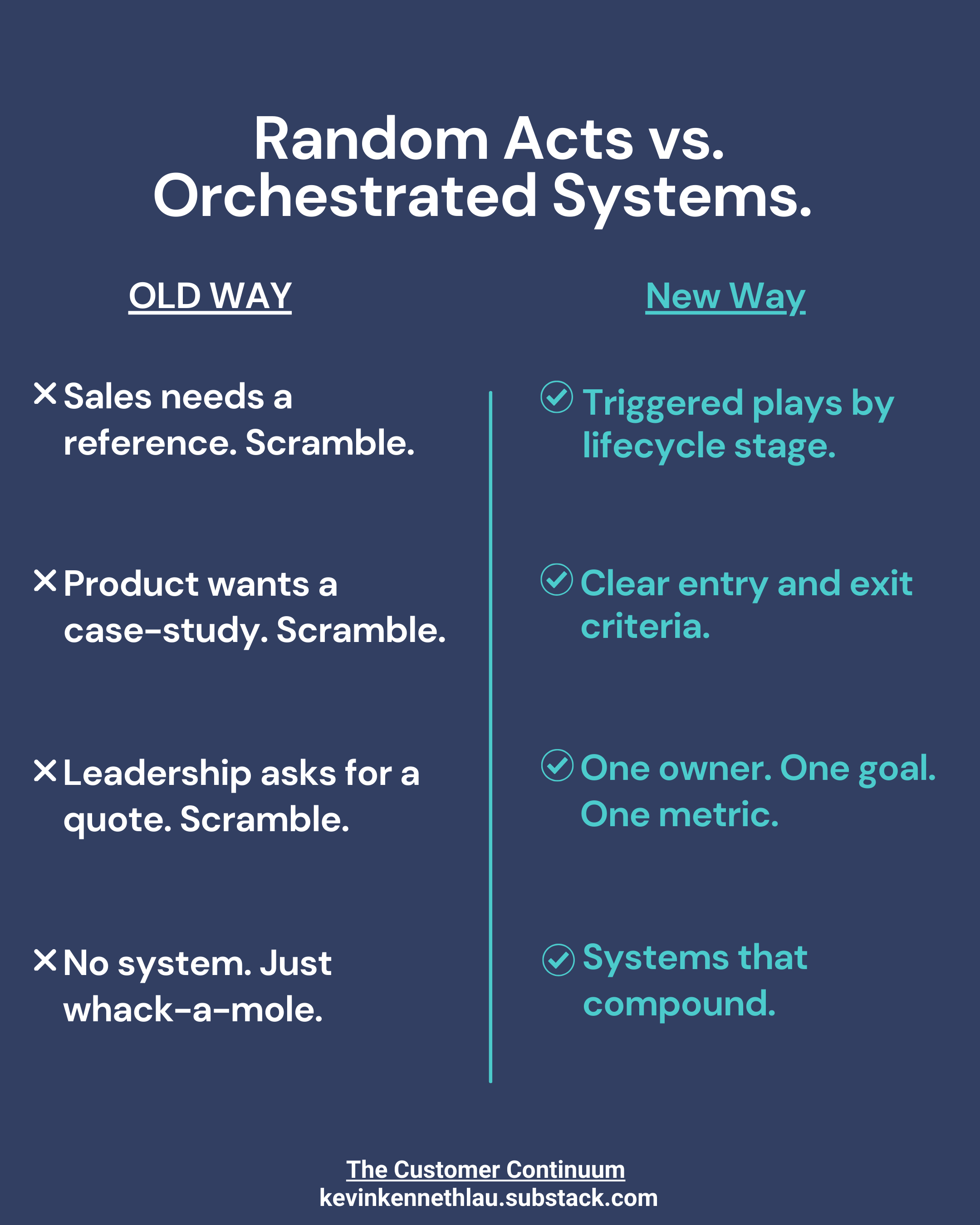
Sales needs a reference. Scramble. Product wants a case study. Scramble. Leadership asks for a customer quote. Scramble.
No system. No prioritization. Just whack-a-mole.
The 2026 opportunity: AI enables true orchestration. Not generic chatbots—purpose-built systems that predict next-best-action across the customer lifecycle.
The research confirms this: by 2026, 40% of enterprise applications will include integrated AI agents, up from less than 5% in 2025 (Gartner, September 2025). The focus is orchestration, not just automation.
Which customer should get a QBR invite? Who’s ready for an advisory board? Which account is primed for a case study?
What winners do: They build systems that tell them exactly where to focus. They stop working harder and start working smarter.
4️⃣ The customer marketing tech stack consolidates.
Right now, your tech stack is probably a mess.
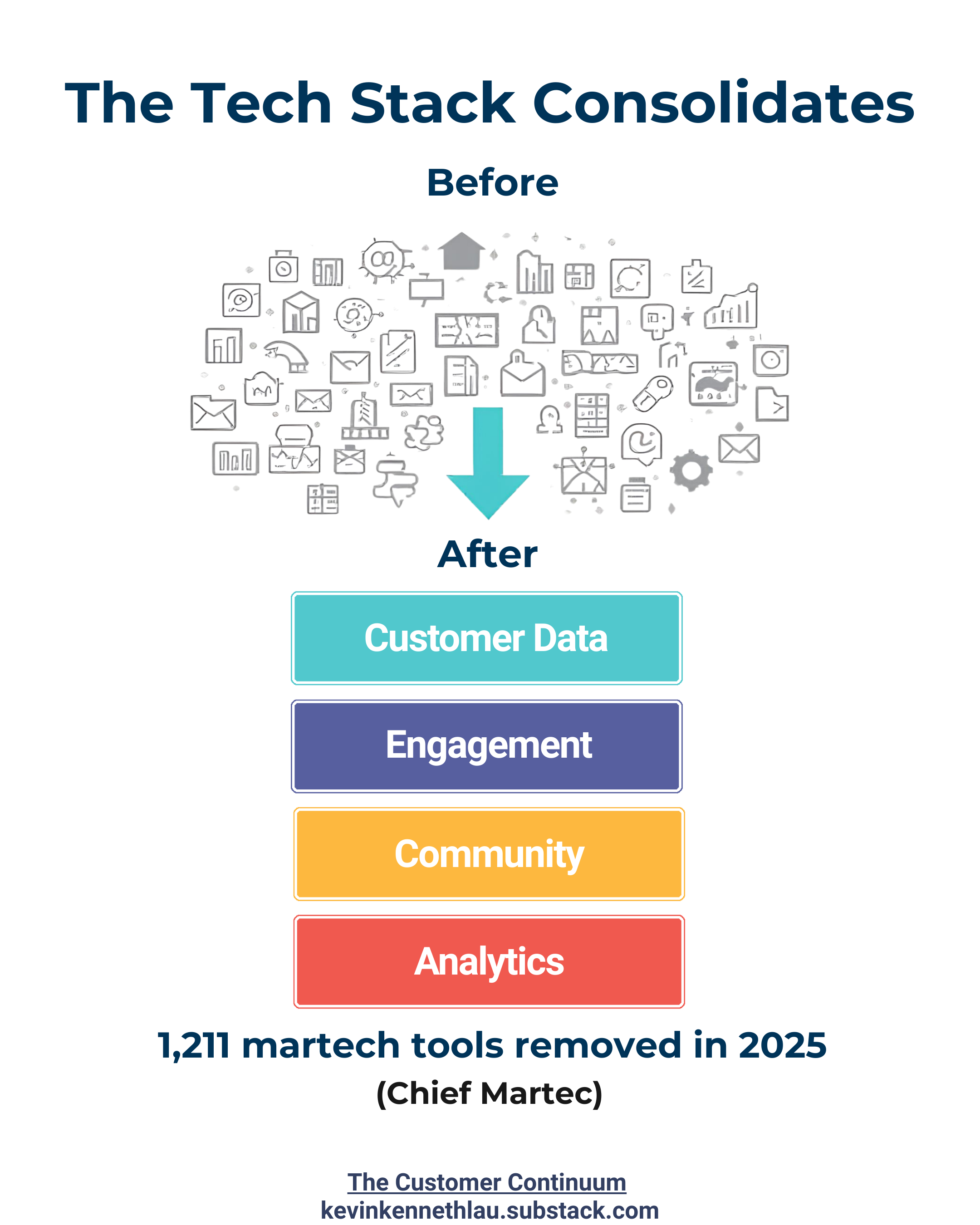
One tool for references. Another for reviews. A community platform here. An advocacy hub there. A lifecycle tool that doesn’t talk to any of them. And a Frankenstein of spreadsheets holding it all together.
The 2026 evolution: Consolidation accelerates. The 15 point solutions become 3-4 integrated platforms.
The data backs this up: in 2025, 1,211 martech products were removed—an 8.6% churn rate—as consolidation accelerates (Chief Martec, State of Martech 2025). And 65.7% of marketers cite data integration as their biggest stack challenge, pushing teams toward unified platforms (MarTech.org, 2025).
The contrarian take: This won’t be even. Tool sprawl may actually continue as AI creates more specialized apps. Some stacks will bloat before they shrink.
What winners do: They consolidate early, move faster, measure better, and waste less budget on integration duct tape.
5️⃣ The CM role splits: strategist or orchestrator.
The jack-of-all-trades customer marketer is burning out.
You hired them to be strategic advisors, program managers, content creators, data analysts, community builders, and executive whisperers. Simultaneously.
It’s an impossible job description. And it’s breaking people.
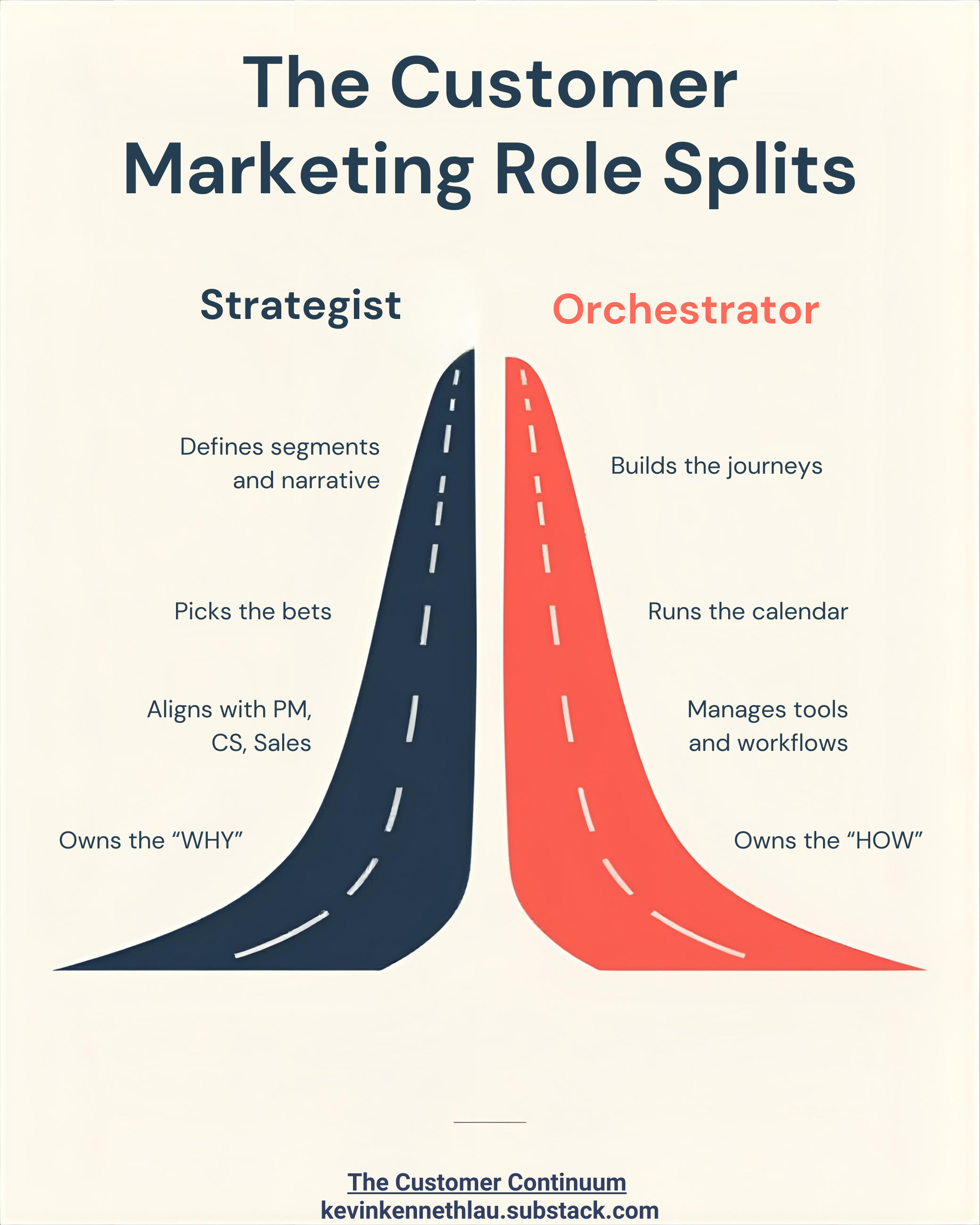
The 2026 reality: Two distinct tracks emerge.
Strategic CMs focus on executive relationships, proof strategy, and cross-functional influence. They’re in fewer programs but driving long-term value and visibility.
Orchestrator CMs run the systems, manage the automation, and ensure programs scale without manual heroics.
This mirrors what’s already happening in Customer Success. AI is freeing CSMs to focus on strategic guidance, with platforms handling tactical tasks and enabling role specialization (Forrester, October 2025).
The caveat: At smaller orgs (~300 employees), this split is aspirational. Headcount constraints mean roles stay hybrid. But the direction is clear.
What winners do: They create clear career paths for both tracks. They hire for specific skills instead of searching for unicorns.
6️⃣ Post-sale becomes the primary growth engine.
Net-new acquisition isn’t dead. But it’s on life support.
The cost to acquire a new customer keeps climbing. The channels are saturated. The buyers are skeptical. And the CFO is asking why CAC payback takes two years.
Meanwhile, your existing customers already trust you. They’re already using the product. They already know your team.
The 2026 model: The companies that win will generate more pipeline from customers than from outbound.
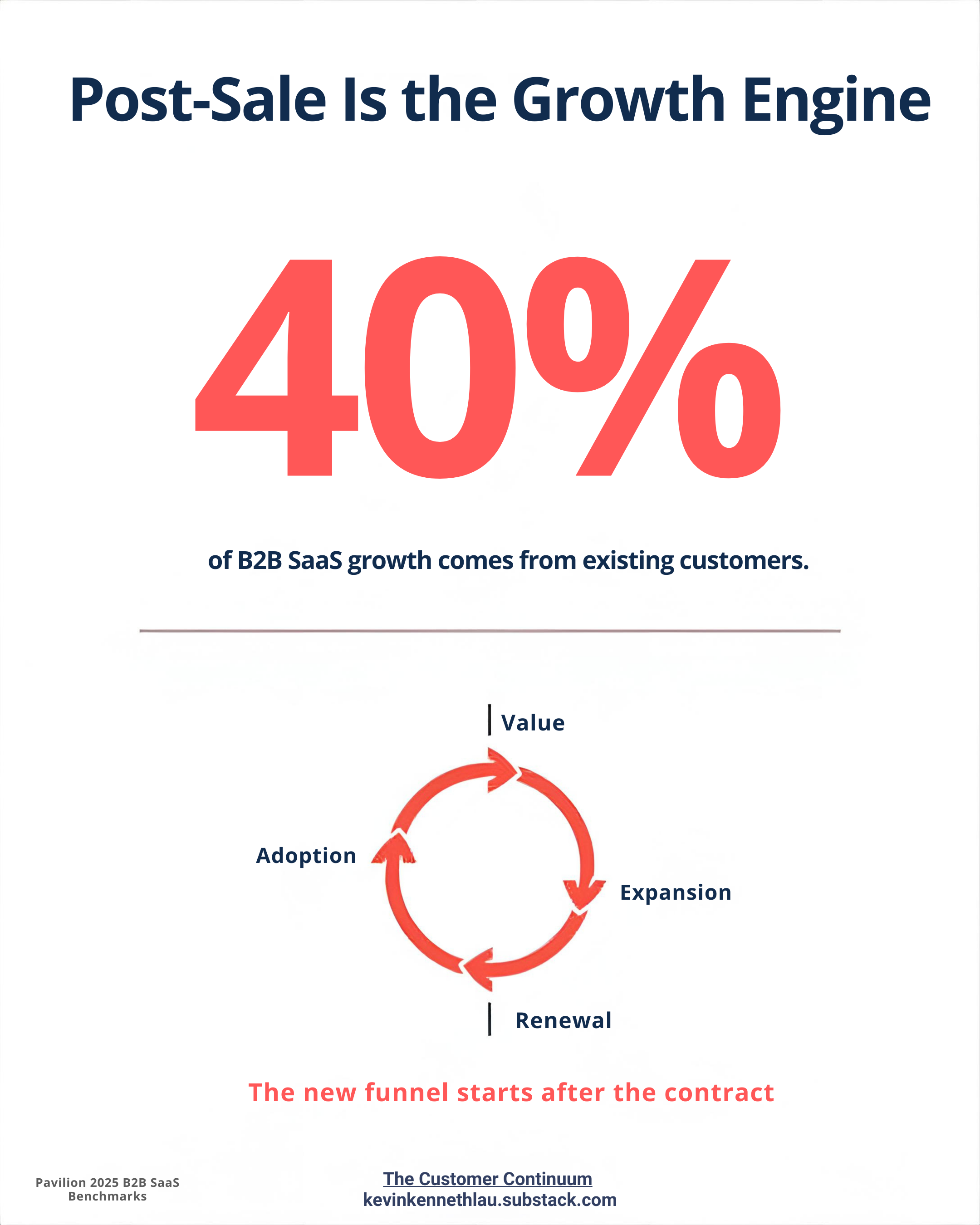
In 2025 B2B SaaS benchmarks, expansion from existing customers drives 40% of growth amid rising acquisition costs (Pavilion 2025). Best-in-class companies achieve NRR above 110%, with post-sale expansion and referrals becoming the primary revenue driver over outbound (Breakthrough3x, August 2025).
Customer-Led Growth stops being a philosophy and becomes the operating model.
What winners do: They treat post-sale like a revenue function, not a support function.
7️⃣ Big communities shrink. Curated micro-circles win.
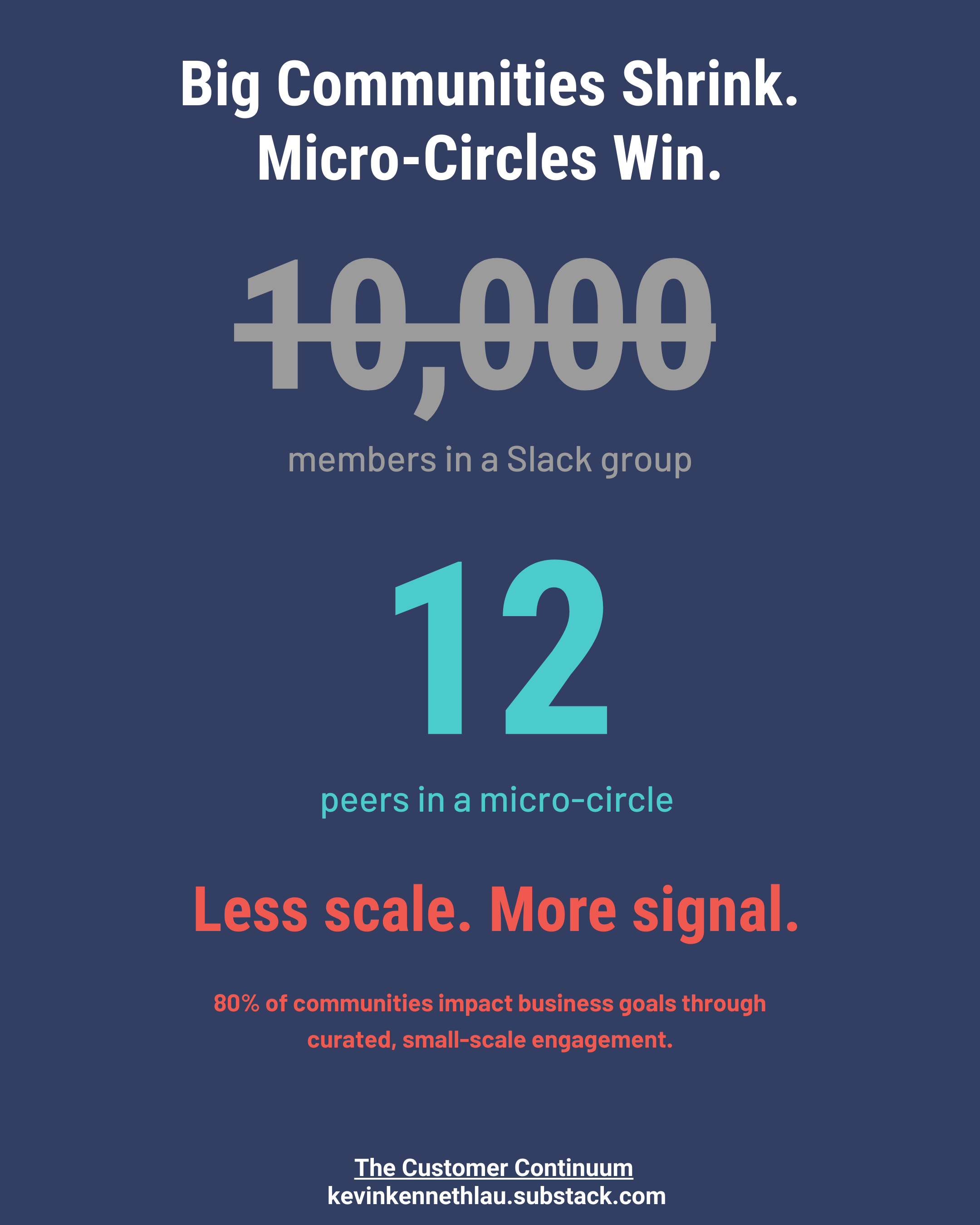
That 10,000-member Slack community you built?
It’s becoming a ghost town. A few brave souls posting. Tumbleweeds everywhere else.
Big communities face what researchers call “slop”—low-quality content, declining engagement, and members who join but never participate.
The 2026 shift: Small, invite-only peer groups of 6-12 similar customers become the model.
The data supports this: 80% of communities now impact business goals like retention, with trends favoring curated, small-scale engagement over large platforms (Bettermode, April 2025). The Circle 2025 Community Trends Report confirms the rise of niche communities and in-person events, as broad online forums face declining engagement.
The contrarian take: Big communities won’t disappear. They’ll evolve with better moderation and AI-powered curation. But the highest-value relationships will happen in smaller rooms.
What winners do: They build curated micro-circles. Customer advisory boards. Executive peer dinners. Invite-only working groups. Quality over quantity.
A Note on What Doesn’t Change
I’ll be honest: some of these predictions sting a little.
In 2021, I created a course on customer advocacy. I was proud of it. It helped people.
And now? Parts of it are already outdated. The tactics have evolved. The tools have changed. The playbooks need refreshing.
That’s the reality of this moment. What worked two years ago might not work tomorrow.
But here’s what I keep coming back to:
The tactics evolve. The fundamentals don’t.
AI can automate a reference request. It can’t build the relationship that makes a customer say yes.
AI can surface data. It can’t sit across from an executive and earn their trust.
AI can write a case study draft. It can’t feel the moment when a customer’s eyes light up because they finally feel seen.
What makes customer marketers stand out has never been the tools. It’s the ability to connect. To listen. To make customers feel like partners, not assets.
So yes — these predictions require us to evolve. To let go of outdated practices that don’t serve us anymore. To be more innovative. To build systems instead of just programs.
But this isn’t about AI taking your job.
It’s about AI handling the systematic work so you can focus on what humans do best: relationships.
The customer marketers who thrive in 2026 won’t be the ones who resist the change.
They’ll be the ones who use it to become even more human.
The Future Is Already Being Built
Customer marketing is finally becoming what it was always meant to be.
The teams who embrace these changes will see:
Retention rates that seemed impossible
Influence that spans the entire company
Careers that break through the ceiling
And they’ll do it by building systems that compound instead of programs that expire.
2026 will define the future of customer marketing.
Let’s build it together.
Which prediction resonates most?
Which one do you disagree with?
Reply to this email. I read every one.
P.S. If this resonated, share it with a customer marketer who’s ready for what’s next. We’re all in this together.