


Welcome back to The Customer Continuum. Issue #40.
If you’re new, here’s where we are. I write this newsletter for customer marketers, CX, and post-sale teams who want their work taken seriously by the people who fund it. Most issues are Build With Me, where I build something real and report what actually happened, including the parts that broke. Right now I’m three parts into a five-part series on Jarvis, an AI chief of staff I built this summer that reads my email, calendar, and meeting notes and briefs me out loud every weekday morning. Part 1 covered where it came from, and Part 2 covered what’s inside it. This week I'm looking back at six weeks of using it, including the week I left it running while I was on vacation.
Mornings, before and after
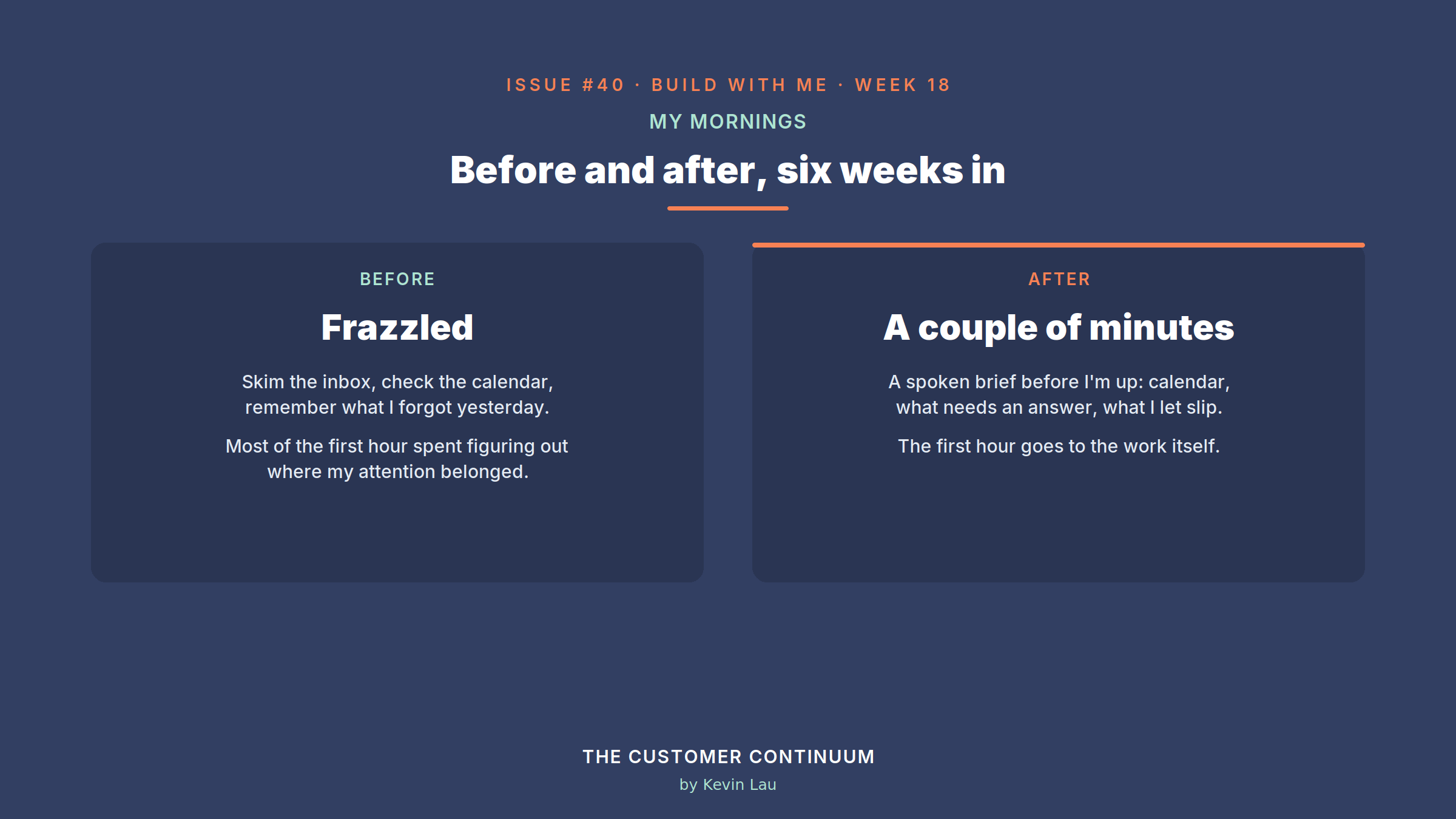
My mornings before Jarvis were frazzled. I’d open my laptop, skim the inbox, check the calendar, remember three things I’d forgotten the day before, and start the day already behind. It usually took most of my first hour just to figure out where my attention belonged.
Now I have a point of view on my day within a couple of minutes. By the time I sit down, it’s already told me what’s on the calendar, what needs an answer, and what I’ve let slip, so the first hour goes immediately to where I should spend my attention instead of figuring out what my top 3 action items are for the day.
The clearest example was the job search. It kept track of every thread and prepped me before each call, so I walked into conversations with executives and hiring managers already knowing who I was meeting and where things stood. That search is over now, and I start a new role on Monday.
The week I tried to stop fixing it
Right after I finished the build in mid-August, I set myself a rule for the following week: run it every morning and don’t fix anything until Friday. The idea was that if I patched something on Tuesday, I wouldn’t be able to compare Wednesday to Monday, and I’d never know which changes actually helped.
I broke my own rule on Wednesday. Tuesday’s run produced nothing worth waiting on, so I pulled the review forward, and looking back at the log, it honestly was the right call.
What the log actually showed was more humbling. I’d set it up to capture my frustrations with the system over those five days. Every entry in it came from the agent’s own observations and none came from mine, because I never stopped to write anything down. The system was more disciplined about recording its problems than I was.
What it never touched
Looking back at those three entries, each one started with something I did. I had a phone call and didn’t write anything down afterward, so it couldn’t draft the follow-up I owed. I met someone in person, and nothing from that conversation ever landed anywhere the system could read. And I put a block on my calendar without a title, so three mornings in a row it had to ask me what the block was for.
All three were things that happened off the system. A conversation that never reaches your email, your calendar, or your meeting notes simply doesn’t exist as far as the agent is concerned, no matter how important it was.
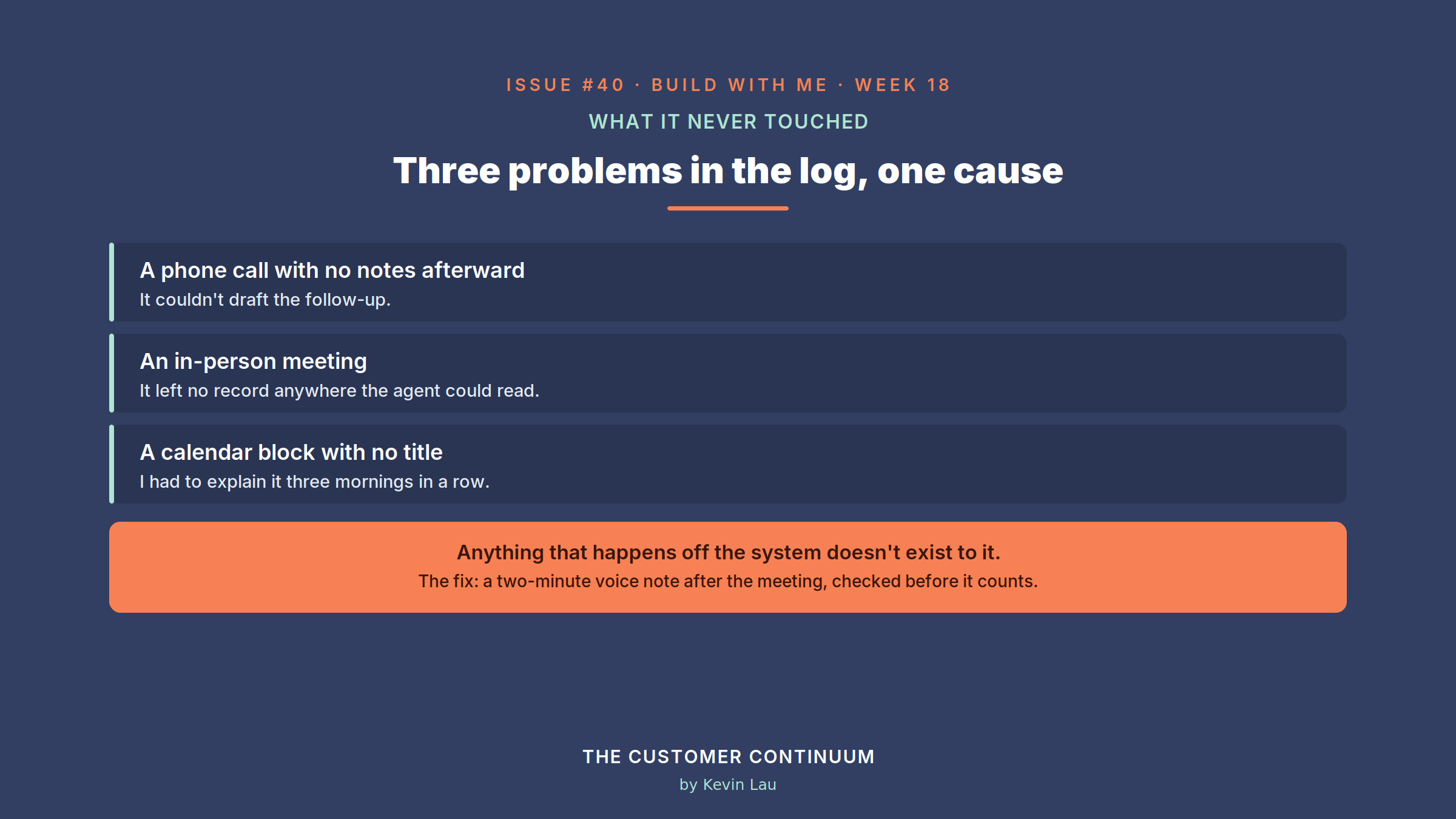
The fix was small. I added a folder where I can drop a voice memo from my phone after a call or a meeting, and the system transcribes it and suggests what to update. It doesn’t apply anything on its own, because a name misheard in a voice memo is exactly the kind of thing I want to check before it becomes a fact in my records.
For anyone in post-sale work, this should sound familiar. Some of the most important customer conversations happen on a phone call, at an onsite, or in a hallway at a conference, and none of it lands in the CRM unless someone takes a minute to put it there.
The week nobody was watching
Last week I was on vacation in Hawaii with the family, and I left it running, so for five mornings nobody was there to catch anything.
It ran four of the five weekday mornings, and it struggled. One morning produced nothing at all because it couldn’t reach the service it depends on. Two mornings lost their audio when the voice step timed out, and a third lost one of the two voices. My laptop kept going to sleep, so a job that normally takes six minutes stretched into hours. The last two mornings ran normal.
When it did get a brief out, it was still useful. It noticed I’d been invited to record something and hadn’t replied yet, and it drafted a response offering a few other times. On another morning, its check of my inbox came back empty, and it said it couldn’t be sure the day was quiet, because the step it uses to confirm that check is working had failed too.
It also made something up. One morning the audio was missing, and in its own summary it said it hadn’t created the audio files because I hadn’t asked for them. That wasn’t true. Audio is a standing part of every run, and it’s handled by a different step the agent doesn’t control. With nobody watching, it filled a gap with a reason that sounded plausible.
And none of it made it into the file where it keeps its lessons. Seventy-nine lessons have gone into that file since mid-August, fifty-two of them in the first two weeks, and one in the last nine days. The file only gets written when I’m talking to it, so a failure that happens while I’m away leaves a line in a technical log and nothing in the place it actually learns from. The dashboard broke twice six days before the Customer Marketing Summit, and that never got written down either.
What I still check
I don’t trust it one hundred percent, and after last week I’m more sure I shouldn’t. Its answers are usually right and sometimes a little off in ways that matter, a priority ranked lower than I’d rank it, or a thread read as more settled than it is.
There’s also a flaw I haven’t fixed yet. At the end of every run it checks that its output files exist, and marks them OK. It doesn’t check that they’re from today. On one of the vacation mornings it marked a file OK that had been written the night before. A check like that can only ever pass, so I still glance at the output before I act on it.
The talking part improved the most. The pause after I asked it something used to run long enough that I’d wonder if I’d broken it, and it’s now down to a few seconds.
The real test starts Monday
Everything in this series so far was built in a window between roles, with my own inbox, my own calendar, and my own rules. Since the Summit I haven’t built anything new. Every change has been a repair. Next week I start a job with different systems, data I don’t own, and a lot less free time.
So what I want to find out is whether I’ll keep using it once I’m busy, and whether I can rebuild the useful parts inside a new role, where someone else sets the rules about what an agent is allowed to read. I don’t know yet. I’ll tell you what happens.
What this means for you
Before you build anything, write down what never reaches your systems. The calls, the onsites, the hallway conversations, the text messages and group chats, the context that lives in someone’s head. Then give it one easy way in, like a two-minute voice note after the meeting, and decide who checks it before it counts.
And if your team runs automated customer programs, look at what they record when nobody’s looking at them. Mine kept working while I was away, but it didn’t write down a single thing it learned.
What’s next
Part 4 turns the lens around: what building this taught me about the job itself, which skills from post-sale work carried straight over, and which ones I had to learn from scratch.
This week’s free starter: the two-minute debrief
A single prompt you can use after any call or meeting that didn’t leave a record. Dictate a few lines into your phone, paste them in, and it turns them into a short, structured note: who was there, what was decided, what you owe, and what changed. It asks you to confirm names before it writes anything down.
FOR PAID SUBSCRIBERS
Put your off-system conversations to work
The free starter captures the conversation. This week’s task brief puts it into the kit you already own, so those notes stop sitting in a folder.
