


Welcome back to The Customer Continuum. Issue #42.
If you’re new, here’s where we are. I write this newsletter for customer marketers, CX, and post-sale teams who want their work taken seriously by the people who fund it. Most issues are Build With Me, where I build something real and report what actually happened, including the parts that broke. For the last five weeks I’ve been writing about Jarvis, an AI chief of staff I built this summer that reads my personal email, calendar, and meeting notes and briefs me out loud every weekday morning. Part 1 covered where it came from, then what’s inside it, what six weeks of using it changed, and what building it taught me about the job. This is the last part, and it’s about your work.
What it actually does for me now
This week I didn’t touch the newsletter once. Between the new job and everything that comes with starting one, I hadn’t opened my drafts or the Substack course I’ve been working through, and Jarvis brought both up in my brief every morning until I did.
That’s become the part I value most. The brief lands in my inbox every weekday, and I can keep refining how it talks to me as my week changes. Right now it’s keeping track of the newsletter, the people I owe a follow-up, appointments, family plans, and my Pokémon card collecting, which is a bit of a passion project and obsession at the moment. It’s also great because it flags the emails I missed or didn’t give enough time to. Going back to work, it’s also helped me get structured about the basics, from thinking through budgeting and wealth building to which benefits to select.
What started as a summer experiment has turned into the system I lean on to run my personal life.
Every agent I built has a twin in post-sale work
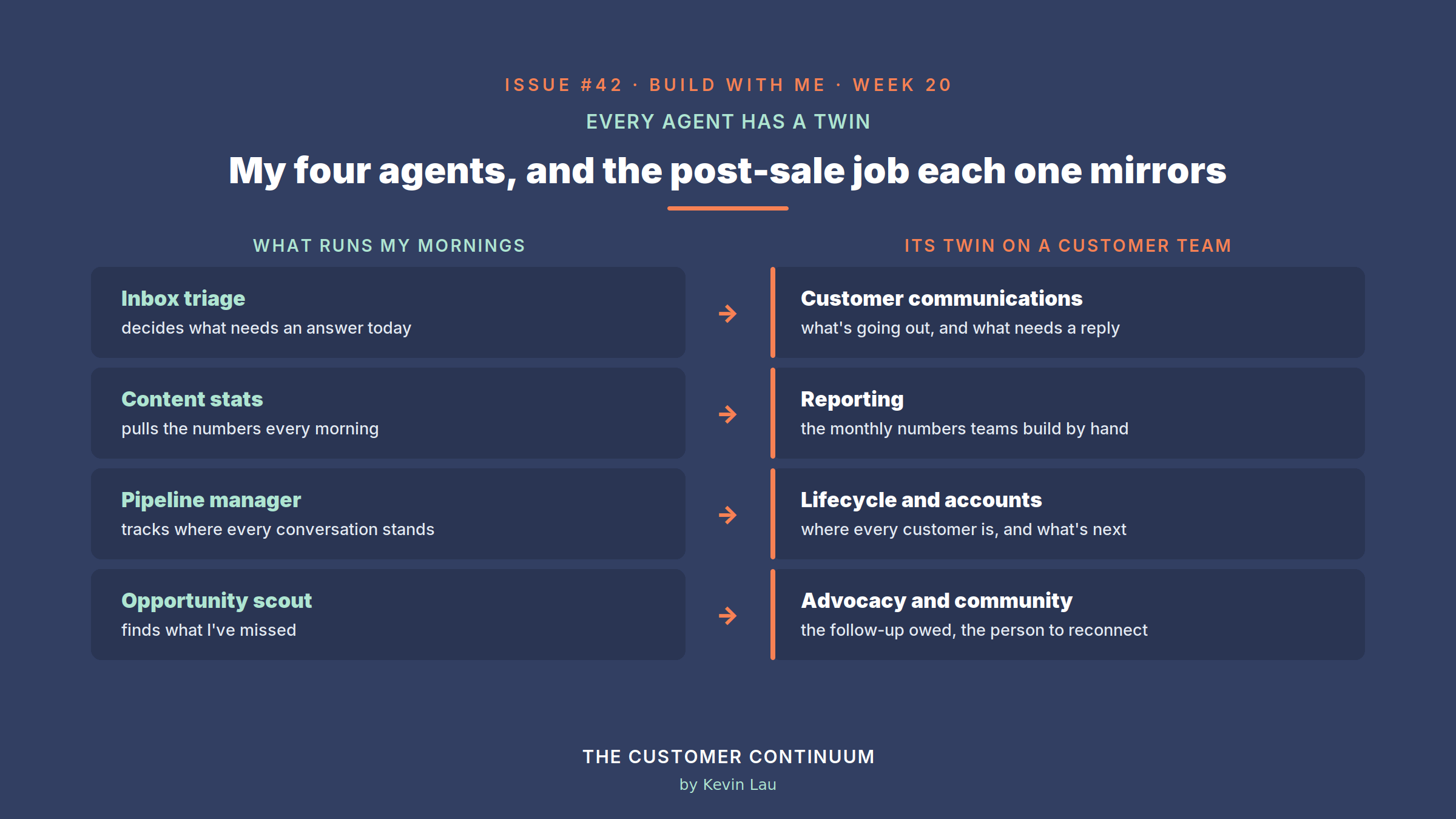
Looking at the four agents behind that brief, I realized each one is doing a job that already exists on a post-sale team.
One reads my inbox and decides what needs an answer today, which is what a customer communications lead does with every message going out to customers at scale. One pulls my content numbers each morning, which is the reporting a customer marketing team spends hours assembling every month. One keeps track of where every open conversation stands, which is account and lifecycle work. And one looks specifically for anything I’ve missed, the follow-up I owe or the person I should reconnect with, which is most of what good advocacy and community managers do by instinct.
I built them around my own week without thinking about any of that, and they ended up looking like the org chart of a customer team.
The seven pillars, and what an agent could take off your plate
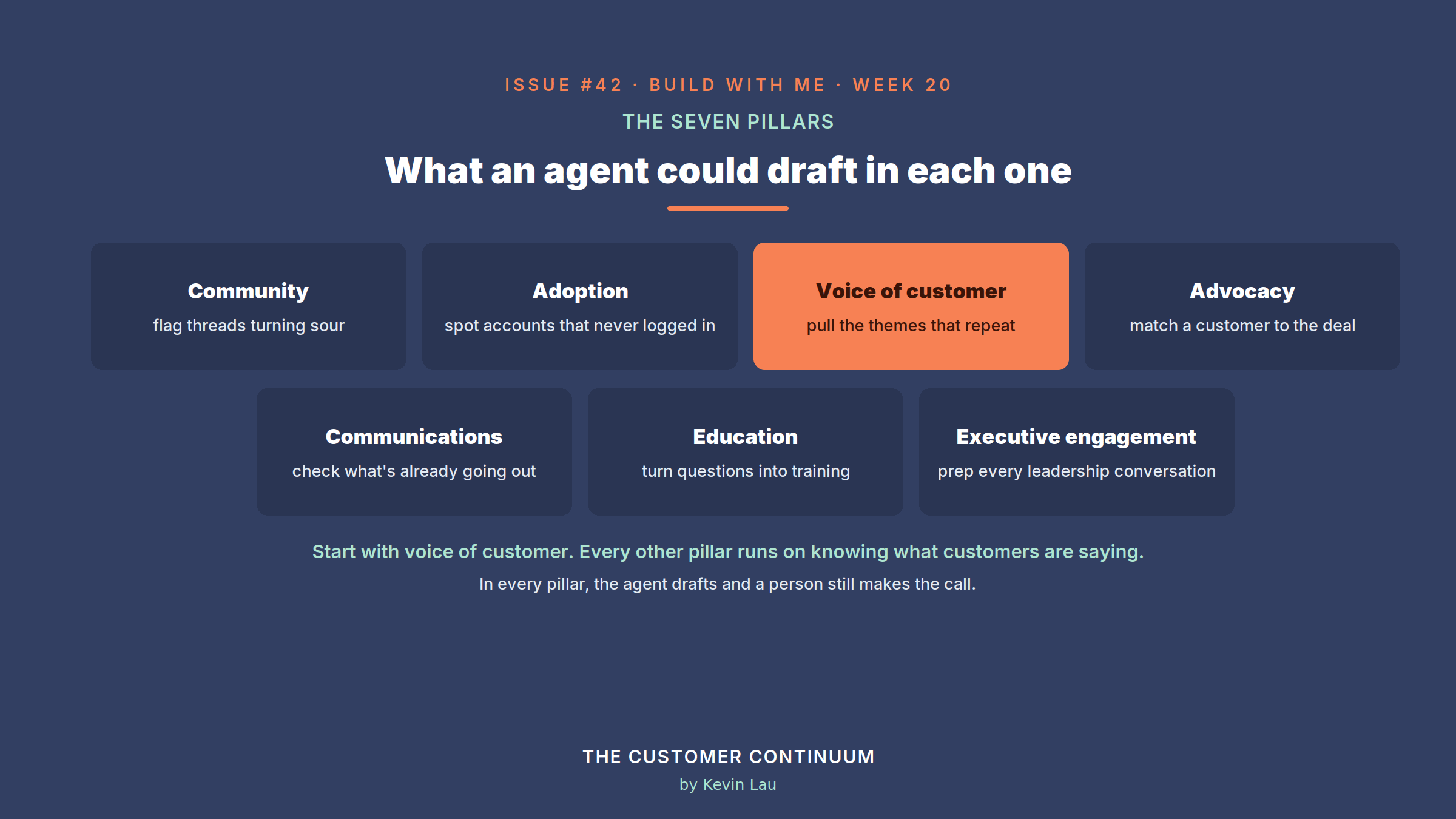
Customer-Led Growth is the operating model I’ve used at several companies for post-sale work, the idea that a business grows through what customers experience after they buy. It breaks into seven pillars: community, adoption, voice of customer, advocacy, communications, education, and executive engagement.
Each one has repetitive work an agent could draft, and in every case a person still makes the call. You don’t need all seven at once, and depending on your business, some of them probably belong inside another team.
Here’s what I’d build first
If I were walking into a post-sale role tomorrow, I’d start with voice of customer.
Every other pillar runs on knowing what customers are actually saying, and that information already exists in your calls, tickets, and community. It’s just scattered across different teams who rarely take the time to compare notes.
I’ve watched too many companies make a big decision off a dipstick test, a quick read from a handful of customers, and then wonder after the fact why the launch missed. At one startup I worked at, we kept asking why customers weren’t adopting something we’d shipped. When we went back to the data, most of them didn’t know we’d launched it at all. The launch plan had been built on a guess about what customers cared about, and nobody had bothered to check.
The best example I’ve seen of getting it right was at Adobe, when I introduced the idea of revamping our whole education practice, with certification at the center. We had a rough sense of what customers wanted from a certification, and that changed once we brought in our champions, customers who gave their own time to help create the course material. They showed us what a marketing operations professional’s world actually looked like, and what it took to go from where they were to mastering their craft. The certification ended up earning money for the business. For the customers who earned it, it made them heroes inside their companies, helped some of them get promoted, gave them credibility they could show on LinkedIn, and brought them closer to the team that built it.
If you don’t have direct conversations with customers, what are you even doing? An agent that reads across your calls, tickets, and community posts every week can show you which of those conversations to have first.
I built that agent this summer for an earlier issue, and the honest run showed both sides. It caught a revenue theme a survey would have missed, and it also over-read a single incident as a trend. Both lessons carry straight into the rules I built Jarvis on.
What carries over from Jarvis
Five weeks of building and running Jarvis came down to a handful of rules, and every one of them applies to an agent pointed at your customers.
Write down how you work before you build anything, with the reason behind every rule. Keep a running list of what it gets wrong, with the date, and never delete the old entries. Let it draft and never let it send until it’s earned your trust. Make sure it knows the difference between silence and good news, because a quiet customer isn’t always a happy one. And give the conversations that never reach your systems, the calls, the onsites, the hallway chats, one easy way in.
I’ve also kept one line firm since starting my new role: Jarvis runs on my personal accounts, and anything for work runs on my employer’s tools. If you build something like this for your job, build it where your company’s rules say it belongs.
What comes next
In two weeks I’ll be launching the seven-pillar assessment, a short way to find out which of the seven pillars needs your attention first. It’s the question I’d want answered before I built anything, and it’ll be in your inbox at the end of the month.
Next week, though, I’m going back to the story that started all of this for me, the customer champion program I built years ago and what it taught me about turning customers into your strongest advocates.
This week’s free starter: the whole series in one place
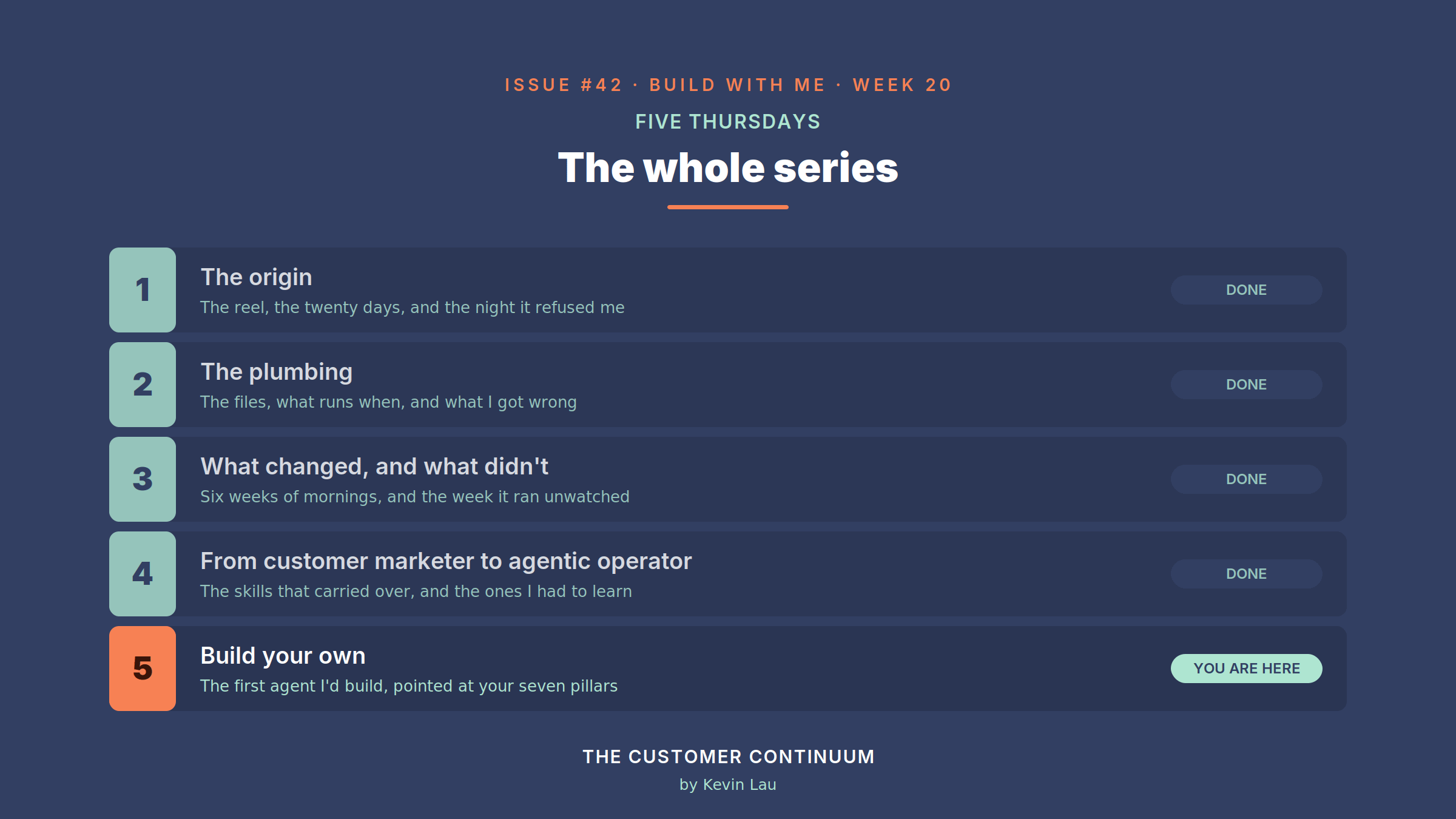
Every free starter from the five parts, collected into a single page so you can work through them in order: the morning-run prompt, the constitution skeleton, the two-minute debrief, the 90-day experiment plan, and the pillar-to-agent map.
→ Get the Building Jarvis starter kit
FOR PAID SUBSCRIBERS
Stand up your first pillar agent this week
You already have agents for every pillar in your Blueprint. This week’s job is to pick one and run it properly, with the rules from the series in place.
Start with the voice of customer agent
Load the redacted constitution from Part 2 into the same project, cut it down to the five rules that matter for your team, and then run this:
Read the last 30 days of support tickets, call notes, and community threads for one customer segment. Return the top themes, ranked by how many distinct accounts raised each one. For every theme, name the accounts and quote one example. Mark any theme that rests on a single account as something to watch. Where you can’t see a source, say so instead of assuming it’s quiet.
Run it once this week, keep a dated note of everything it gets wrong, and run it again next week with those corrections added to the file. By the second run you’ll have something you’d show your leadership.
→ Your full 135-agent Blueprint
— Kevin
P.S. If you’ve been following along and thinking about building something for your own team, forward this one to whoever you’d build it with. It’s easier to start with two people than one.