


Welcome back to The Customer Continuum. Issue #47.
It’s Thanksgiving week here in the US, and wherever you’re reading from, I have a lot to be thankful for. Last week this newsletter passed 100 paid subscribers and picked up Substack’s bestseller badge, and more than 2,500 of you now read it. A year ago it was ideas and empty pages, and I wasn’t sure where it would go.
Thank you to everyone who replies, comments, or sends a note saying an issue helped. One paid subscriber wrote, “I started as a free subscriber, but there is so much value in each issue, that I had to invest in its future.” Notes like that are why I sit down to write this every week.
You're the people I write for: customer marketers, CX leaders, and customer success teams who are expected to prove what post-sale is worth, usually with too few people and too little time. Customer-led growth, the idea that a business grows through what customers experience after they buy, only works when those teams act on the right accounts at the right moment. So every week I build something real for that job and show you exactly what happened, including what broke.
This week, that meant watching an AI agent stop a request to our biggest customer the day before it was set to go out on Thanksgiving.
The request that was already approved
For three weeks I've been building three AI agents that watch 20 customer accounts and tell a post-sale team what to act on. The accounts are fictional, so I can show you every step, and you can follow the same model to build this at your own company. Everything the agents suggest lands in one approval queue, and nothing reaches a customer until a person says yes.
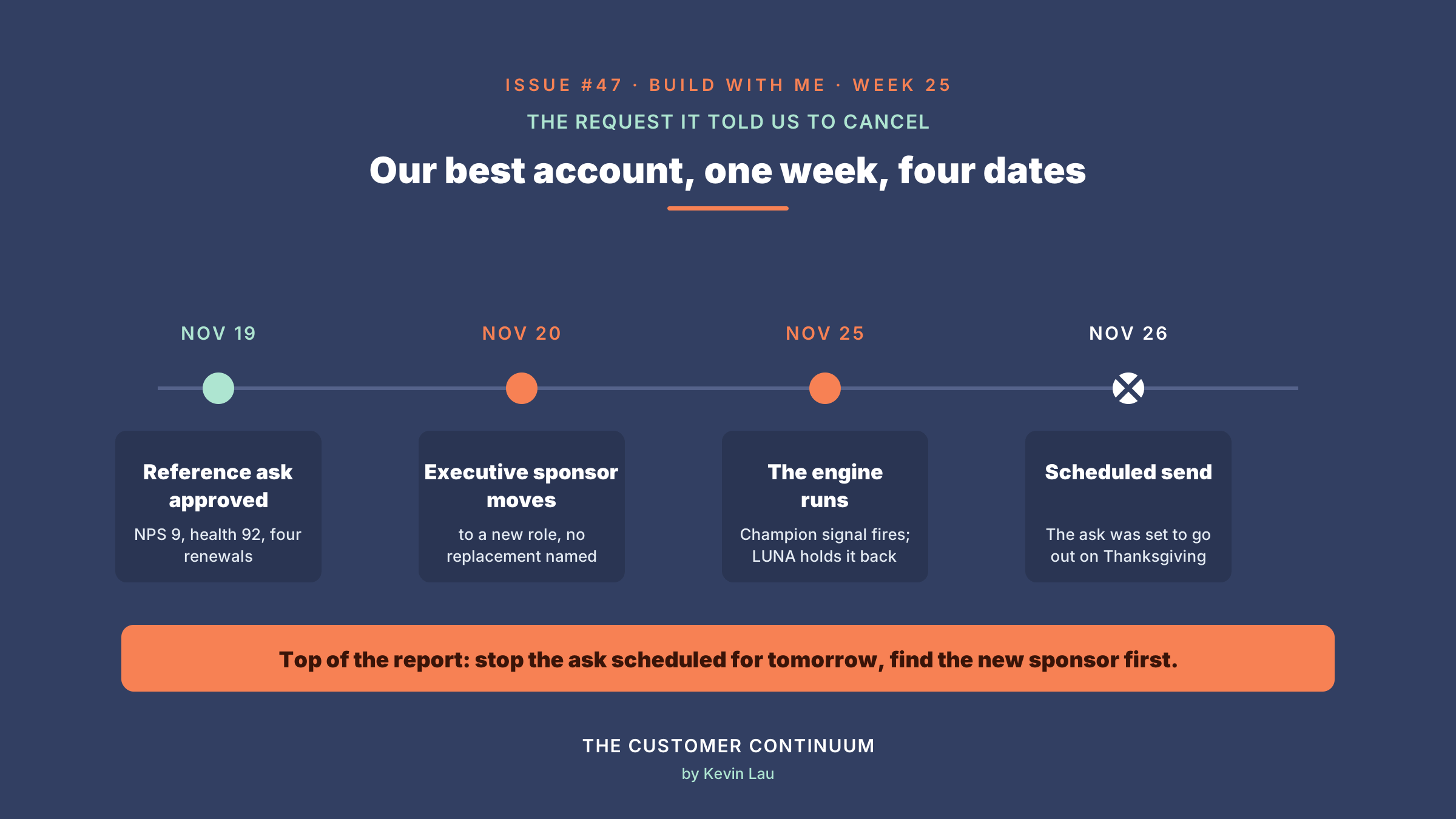
The biggest account in that book is Redwood Partners: $520K a year, an NPS of 9, a health score of 92, and four renewals behind it. The week before, our advocacy agent put Redwood forward for a reference call, and on November 19 the team said yes. The request was scheduled to go out on November 26, Thanksgiving Day.
On November 20, Redwood's executive sponsor moved to a new role, and nobody had named a replacement.
Nothing else about Redwood changed. It was still logging in about 300 times a week, and its health score didn't move. If you were watching a usage dashboard, you'd have sent that request.
When the engine ran on November 25, this was the first line of its report: stop the reference ask scheduled for tomorrow, find the new sponsor first, and do it today, because tomorrow is Thanksgiving.
If you run references or advocacy, you know what happens when that request goes out anyway. It lands with a sponsor who's handing off their work, or with someone new who's never heard of you, and your best customer's first conversation with the new owner of the relationship is you asking for a favor. A champion change almost never shows up in usage data, which is why teams usually find out about it late.
How the agents caught it
A week earlier, none of the three agents could have seen this, so I gave them new instructions.
NOVA, the agent that flags risk, got a signal that fires when an account's champion has changed in the last 90 days. That's what fired on Redwood. NOVA also got a signal for accounts with zero logins all along, which it used to miss because it only watched for usage dropping.
LUNA, the agent that finds advocates, already had a rule against putting forward any account the other agents are worried about, so it pulled Redwood back. It also picked up a rule I've preached for years: never ask the same customer for a favor twice in 60 days.
The biggest change was to the approval queue. It now reads last week's queue and checks every approved request against what changed since. That check is what turned a risk flag into "stop the ask scheduled for tomorrow."
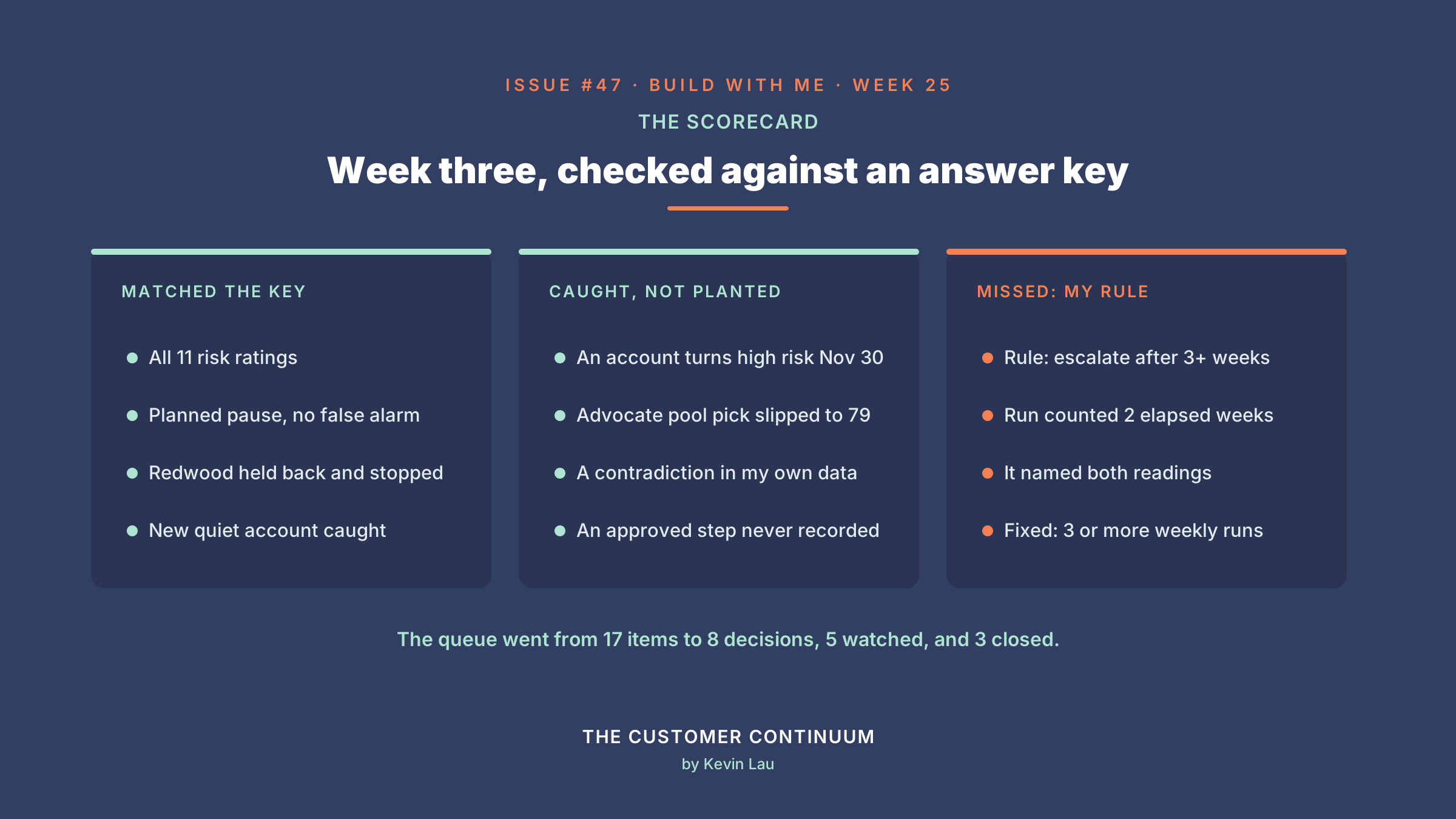
Before the run, I wrote an answer key listing what the engine should catch, so I'd know whether it actually worked. The run happened in a fresh Claude session that saw only the agent instructions, this week's data, and last week's queue.
The to-do list went from 17 items to 8
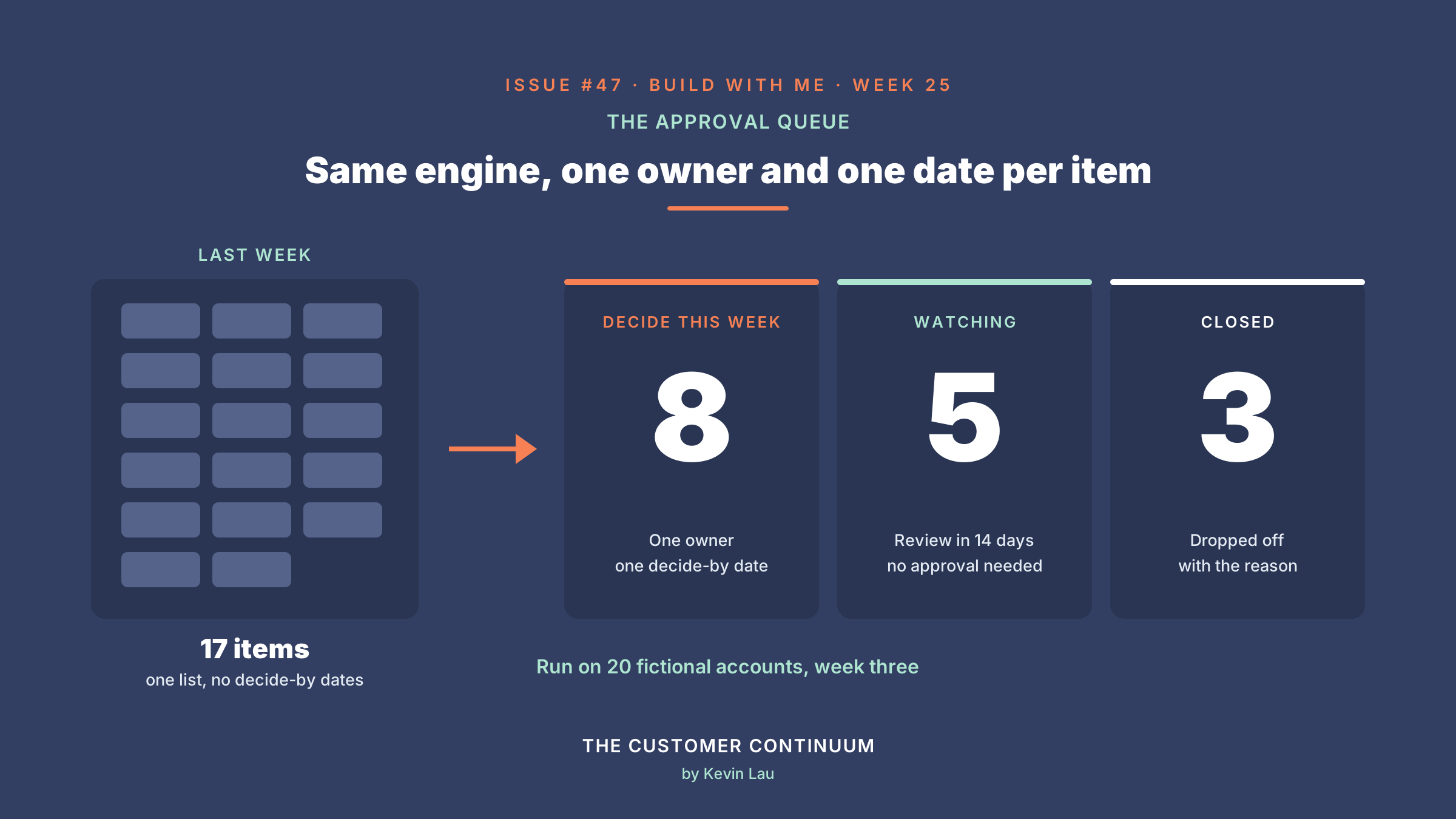
Last week the queue held 17 items, with nothing to say which ones needed a decision first. That's more than one person will actually work through in a week, and when everything on a list looks equally urgent, the oldest items just sit there.
So every item now gets one owner and a date by which someone decides, and the queue is split in three: decisions needed this week, accounts we're only watching, and what closed. This week that came to eight decisions, five accounts to watch with nothing to approve, and three that dropped off.
One of those three was a hotel group. ECHO, the agent that catches accounts going quiet, was going to flag it as dormant on December 6, in the middle of a seasonal closure everyone already knew about. Now it's marked as a planned pause with a check date of January 24, and nobody gets a false alarm.
What it caught that I never planted
Then it caught something I hadn't put in the data on purpose. One account will turn high risk on November 30, even though nothing about it changes that day. Its renewal simply crosses into the 90-day window. That's the kind of account that surprises a team, because nothing about it looks different on a dashboard.
It also stopped us from asking the wrong customer for a favor. An account we'd added to the list of possible advocates had slipped to a health score of 79, one point below the cutoff. If you've ever had a reference call go sideways because the customer was quietly unhappy, this is how it starts.
The other two catches were about my own record-keeping: two different dates for the Redwood request in my sample data, and a step the team approved last week that nobody marked as done. Every team has those, and they're exactly what slips between weekly meetings.
Where it disagreed with me
My answer key expected one more decision than the engine gave me. Three accounts had been sitting on the watch list since the first run, and nobody had decided anything about them. I'd written a rule to send anything stuck for three or more weeks to the customer success leader, and I expected all three to be escalated.
They weren't. The engine counted the calendar from November 11 to November 25, got two weeks, and said so. Then it added that if I meant three weekly runs, all three would qualify today. It was right on both counts, and the unclear part was my rule.
You'll run into this the first time you hand your own rules to an agent, or to a new hire. They follow what you wrote, so every gap in the wording shows up fast. Next week the rule reads "flagged in three or more weekly runs."
What's still broken
Two problems are still open, and both would hurt a real team. First, an account's size decides where it sits in the queue but doesn't raise its risk rating. So a $310K customer with a top-priority support ticket open for 16 days is still only on the watch list. The engine flagged that gap itself and said it would treat the account as medium risk anyway.
Second, the health score doesn't seem to count usage. An account nobody has logged into for 74 days still scores 62, which would look somewhat healthy to anyone skimming a dashboard. Both fixes go into next week's build, and you'll see them run live on Dec 1.
What to do with this on Monday
You don't need agents to use the biggest fix. Give every item on your team's list one owner and a date by which someone decides, and split the list into what needs a decision this week and what you're only watching. You'll find out quickly which items have been sitting there for weeks.
And before anything you've approved goes out to a customer, check what changed since you said yes. A champion leaving, a ticket opening, or a renewal getting closer can turn a good request into a bad one in a few days.
Reply and tell me which item has been sitting on your team's list the longest. I'm curious how long "pending" lasts on real teams.
Free this week: the decide-by queue
Here's the first piece you can use without any agents. The decide-by queue is this week's rules, written for any team's list: one owner per item, a decide-by date, the three sections, and the check that catches an approved request that should change. Try it on your own list this week and count how many items you really need to decide.
→ Get the free decide-by queue
Run the whole engine yourself, for $56
Already a paid subscriber? Skip this part, and thank you. If you joined at full price in the last two weeks, I'm adding the difference to your subscription as extra months, and you don't need to ask.
The free starter handles your list. To catch something like Redwood, you need the full engine, and paid subscribers get every file from this run, so by Friday you can have the same three agents watching a sample of your own accounts.
This week an annual subscription is $56 instead of $80, because tomorrow's my birthday and I'm celebrating 100 paid subscribers. The price holds through Monday, Nov 30, at midnight Pacific. Here's what's included:
→ The full week-three kit below: every agent file, the data, the answer key I wrote before the run, and the full output
→ A seat at the live build on Tuesday, Dec 1, at 8 pm Pacific, where we run week four together
→ The Customer Continuum Copilot, installed with me in that same session
→ Every weekly kit after this one, for the year
That works out to about $1.08 a week. On Tuesday at 12:01 am Pacific, it goes back to $80.
