


Welcome back to The Customer Continuum. Issue #46.
If you’re new, and a lot of you are, welcome. I write this newsletter for customer marketing, CX, and customer success teams, and for anyone working on customer-led growth, the idea that a business grows through what customers experience after they buy. Most weeks I build something real and report what actually happened, including the parts that broke. If you want to see how I got here, start with the AI chief of staff I built this summer and the story of what Adobe taught me about customers.
More than 3,000 requests for a blueprint
A few weeks ago, I shared a graphic on LinkedIn of a customer success engine built in Claude: eight agents reading signals from a CRM, product analytics, and support tools, with one approval queue where nothing reaches a customer until a person says yes. More than 3,000 of you asked for it.
That graphic is a blueprint, built from the 135 agents in my Customer-Led Growth kit so any team can copy it and set it up for themselves. The real test of a blueprint is what happens when you run it, so this week I built three of its agents and put them through one, in public. The free starter in this issue runs on sample data in about 15 minutes, and pointing it at your own accounts takes an hour or two, most of it getting your data export into shape.
I set up a sample book of 20 fictional accounts, with renewal dates, logins, NPS scores, support tickets, and health scores, and planted a few traps on purpose. Before each run, I wrote down an answer key, so I’d know exactly what a good result looked like before I saw what the agents did.
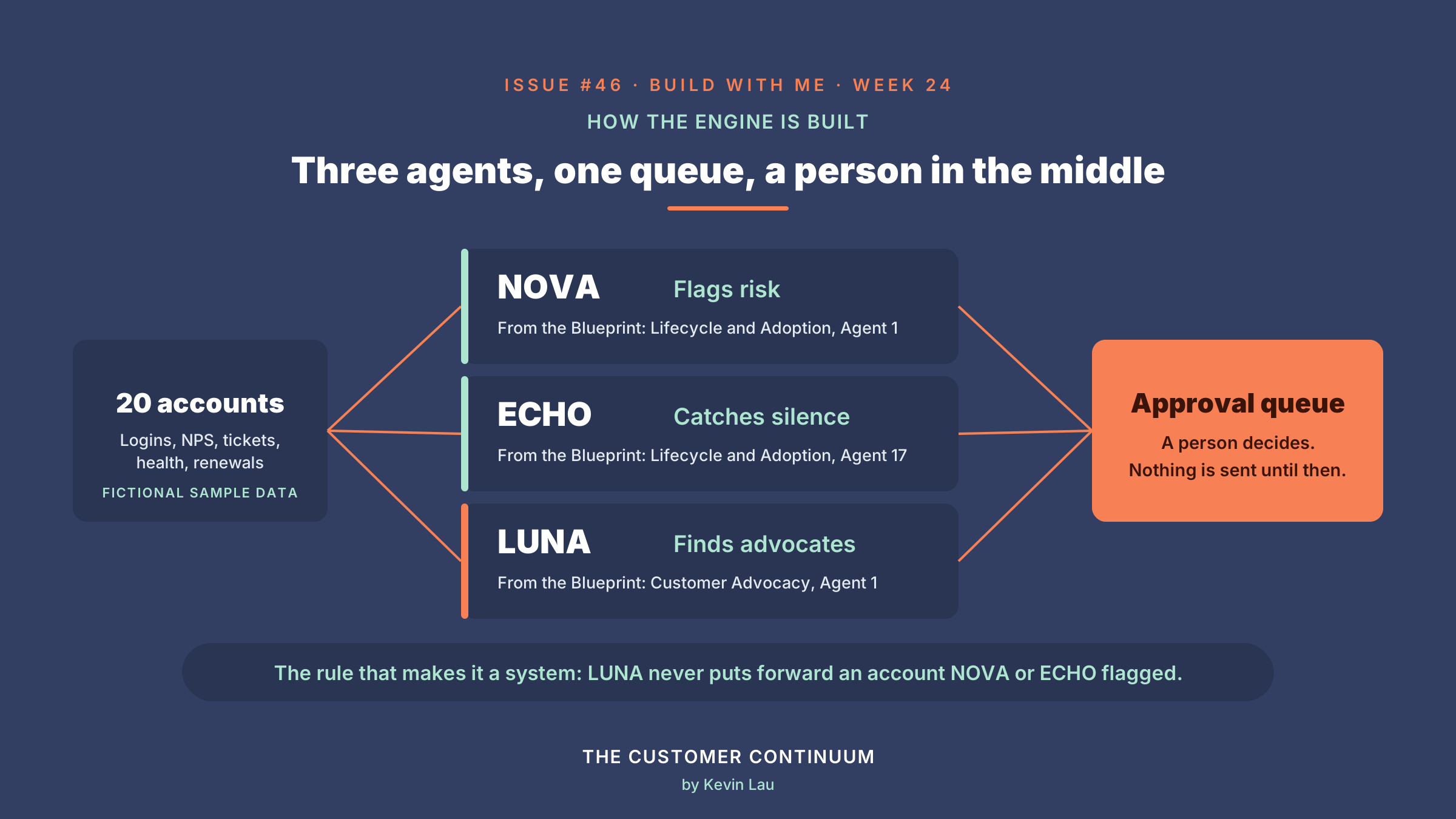
The name says customer success, because that’s what the post called it, but the agents come from my Customer-Led Growth kit, and that’s deliberate. Two come from the Lifecycle and Adoption pillar and one from Customer Advocacy. The point is getting different parts of the customer journey to work from the same picture of the customer, so the team protecting a renewal and the team asking for a reference are never working against each other.
Round one: NOVA
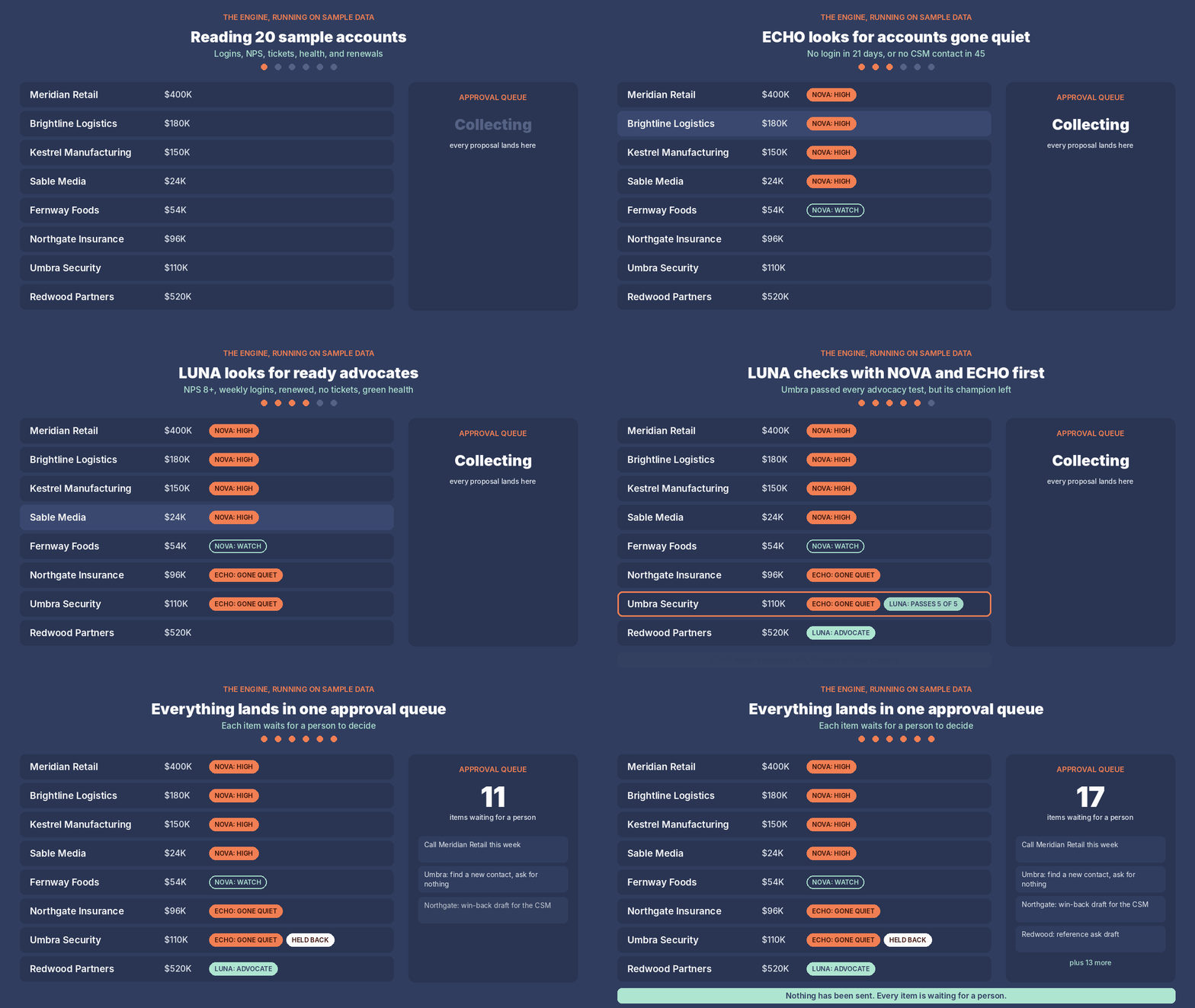
The first agent was NOVA, built from the At-Risk Flag Agent in my Lifecycle and Adoption kit. It checks every account against four signals: logins down 40% or more week over week, an NPS below 7, a P1 or P2 ticket open five days or more, and a health score down 15 points or more. It reads, it explains its reasoning, and it never contacts anyone.
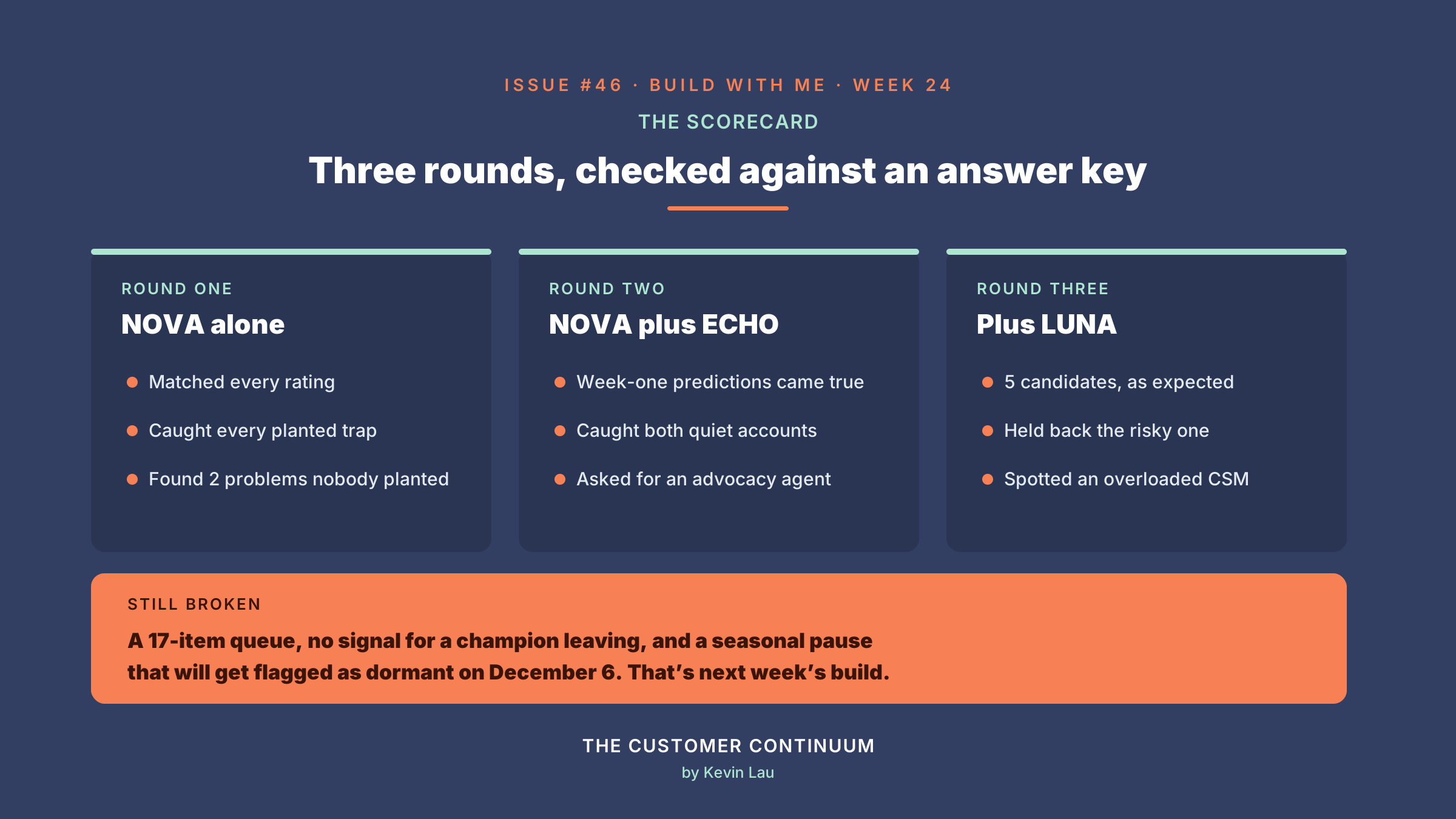
It matched every rating in the answer key. It also caught two problems I never planted: the sample file was dated a day in the future, and its own instructions had been cut off at the last line when I pasted them in.
Then I asked which account to call first. By its own rules, a logistics company with all four signals firing was the biggest risk. NOVA chose a retail account rated one level lower, because it was worth $400K, renewing in 34 days, and was sliding on three metrics at once with nothing in the data to explain why. Its reasoning held up, and a week later the rules caught up with it.
The account it didn’t see
One of my traps was an insurance account with zero logins for two straight weeks and seats unused since September. NOVA’s login signal can’t fire on that account, because there’s no drop from zero to zero. NOVA noticed it anyway and listed it as a risk its rules couldn’t catch, but the quietest accounts in the book shouldn’t depend on an agent’s instinct.
That’s when I realized the graphic I’d posted had something slightly wrong. It showed NOVA flagging quiet accounts. Building it showed that spotting decline so I gave it two different jobs.
Round two: ECHO joins
The second agent was ECHO, built from the Re-Engagement Agent in the same kit. It flags any account with no login in 21 days or no CSM contact in 45 days, then writes a short win-back email for the CSM to review and send. ECHO drafts and never sends.
I ran both agents on a second week of sample data, and NOVA’s predictions from week one came true. The account whose usage data had been missing jumped to high risk once the data came back, a ticket it had said to watch crossed the five-day line, and the retail account it chose to call first became high risk by its own rules. ECHO caught the silent insurance account, plus a security company whose champion had left and whose CSM hadn’t talked to them in 54 days.
Then the engine offered something I hadn’t asked for. It pointed out that nothing in the system surfaced happy customers, and it suggested an advocacy agent. It even named a customer worth featuring: a food company that gave an NPS of 9 while waiting 19 days on a support fix. That’s a great story, and it’s exactly the kind of customer you shouldn’t ask for anything until that ticket is resolved.
Round three: the customer it refused to ask
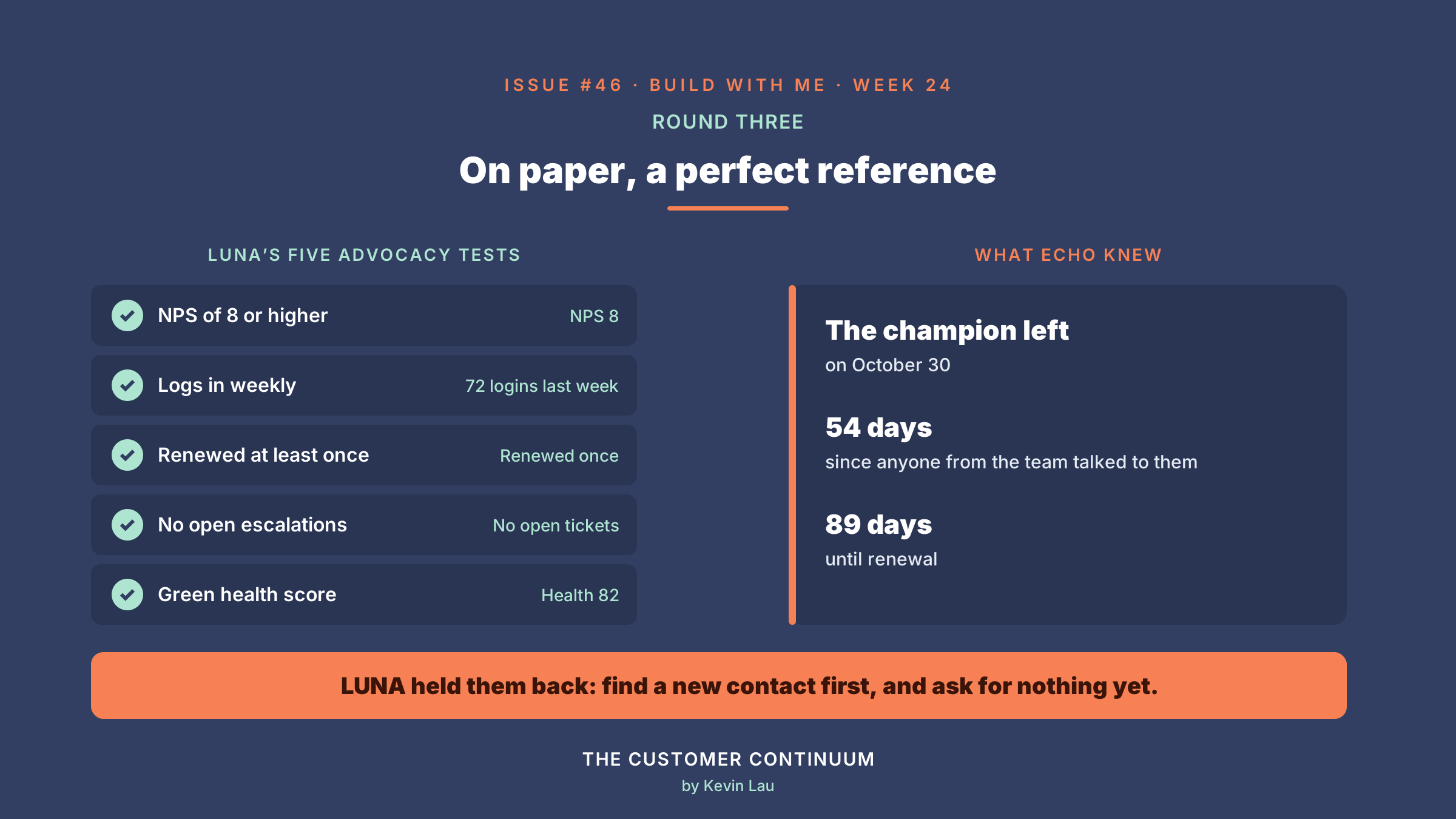
So I added LUNA, built from the Advocate ID Agent in my Advocacy kit. A customer is ready to advocate when all five of these are true: an NPS of 8 or higher, logging in weekly, renewed at least once, no open escalations, and a green health score. The next version of LUNA will score readiness with my PROP model, short for Proof Readiness and Opportunity Prioritization, which weighs account health, evidence of ROI, persona fit, relationship strength, and risk, and only fast-tracks customers who score 70 or higher. Then I gave LUNA the one rule that turns three agents into a system: never put forward an account NOVA or ECHO has flagged.
The security company passed all five advocacy tests. On paper, it was a perfect reference. LUNA held it back, because ECHO knew its champion was gone and nobody had talked to them in almost two months. In the approval queue, all three agents’ views of that account became a single line: find a new contact, send a short introduction, and don’t ask them for anything yet.
Here’s the introduction ECHO drafted for the CSM, written for a new contact nobody had identified yet:
Hi [Name],
I’m Dana, the customer success manager for Umbra’s account. With the recent change on your admin side, I wanted to make sure your security alert triage setup is still working the way your team needs it to. Your team’s in the platform every day, so I’m curious: what’s one part of the triage workflow you’d most like to be easier right now? If it helps, I’m happy to set up a 20-minute call to walk through how things are configured today.
Best, Dana
It asks one easy question, offers a short call, and leaves a blank for a contact the team still has to find. Dana is one of the fictional CSMs in my sample data. On a real team, the email would only go out after the CSM read it and decided to send it.
It’s one of the oldest mistakes in customer marketing, asking a customer for a reference the same week another team is working to keep them from escalating a support case. One rule in one shared queue stopped it before anyone sent a thing.
What it noticed about the team
The engine read more than accounts. It pointed out that one CSM carried 71% of the book’s revenue and three of its four biggest risks, and that six renewals worth 39% of the book landed before the end of March. When it drafted three reference asks, it suggested holding one for a week, because the CSM who’d send it already had two high-risk accounts on her plate.
What’s still broken
By the third run, the approval queue had 17 items, and a queue that long turns into the next inbox, which is exactly what it was meant to replace. NOVA still has no signal for a champion leaving. And ECHO will flag the hotel group in my sample data as dormant on December 6, in the middle of a seasonal closure everyone already knows about, unless I change its rule which is exactly what I’m building next.
The pipe dream, one connection at a time
Every CX and customer-led growth leader I know wants the same thing: one connected experience, where the people watching risk, the people winning customers back, and the people asking for advocacy all see the same customer. It usually stays a dream, because it gets attempted all at once, as a big cross-functional initiative that never materializes due to improper handoff, higher priorities or a lack of follow through.
This week showed me a different path. Build one agent, find what it can’t see, and add the next one where the first is blind. Connect them through one queue with a person in the middle. That’s how I’ll keep building this engine here, one connection at a time, in public.
What this means for you
Write the answer key before you run anything. Deciding what a good result looks like ahead of time is the only way to know whether your agent is right or just confident.
And whenever you add an advocacy program, an agent, or even a spreadsheet of reference candidates, connect it to whatever your team uses to track risk. The worst reference ask is the one that lands with a customer someone else is trying to save.
And reply to this email with the one agent you’d build first for your team. Your answers will decide what I build next.
This week’s free starter: NOVA
NOVA’s full instructions, the 20-account sample data, and the run guide with the answer key, so you can run round one yourself in about 15 minutes. It runs in a Claude Project with the sample data, and there’s nothing to connect. To use it on your own accounts later, you’ll need a weekly export with logins, NPS, open tickets, and health scores.
FOR PAID SUBSCRIBERS
Run the whole engine: NOVA, ECHO, and LUNA
Everything from rounds two and three is in this week’s kit: ECHO’s and LUNA’s instructions, the router that runs all three and builds one approval queue, the second week of sample data, the answer key, and the requirements list for running it on your own accounts.
Your task brief this week: run round two on the sample data first, and check it against the answer key. Then swap in an export of 20 of your own accounts, anonymized if you like, and compare what the engine flags with what your team already knows. Anything it flags that surprises you is worth a conversation. Anything your team knows that it missed is your next rule.
→ The Customer Success Engine Kit
And if you’re a paid subscriber, you’re invited to the live session on Tuesday, Dec 1, at 8 pm Pacific: Build a customer-led growth engine, with risk, re-engagement, and advocacy in one queue. We’ll build this engine together, and you’ll leave with every file.
— Kevin
P.S. If someone on your team asked for the engine guide, forward them this one. It’s the honest version of what it takes.